





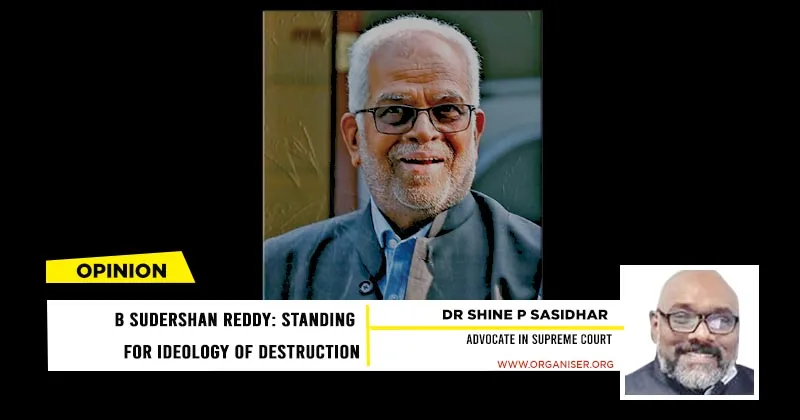
A fellow retired judge has chosen, of his own volition, to contest the election for the office of the Vice President of India. By doing so, he has stepped into the political arena as a candidate supported by the opposition. Having made that choice, he must defend his candidacy like any other contestant, in the realm of political debate. To suggest otherwise is to stifle democratic discourse and to misuse the cover of judicial independence for political convenience. Judicial independence is not threatened by the criticism of a political candidate. What truly tarnishes the reputation of the judiciary is when former judges repeatedly issue partisan statements, giving the impression that the institution itself is aligned with political battles. As a result of these tactics, because of the fault of a few, the larger body of judges ends up being painted as partisan coterie. This is neither fair nor healthy for India’s judiciary or democracy.
56 retired judges (which included four former SC judges, former Chief Justices P Sathasivam, Ranjan Gogoi, AK Sikri and former judge MR Shah) in a statement countering a group of retired judges who criticised UHM Amit Shah for his remarks on Salwa Judum judgement of opposition vice-presidential nominee Justice B Sudershan Reddy.
With the declaration of Justice B Sudershan Reddy as the Vice President candidate by the opposition alliance, a decade-old Supreme Court judgement has once again come into the spotlight: Nandini Sundar vs. State of Chhattisgarh. This case is considered one of the leading judgements of the Supreme Court. A case becomes a “leading case” when it addresses important constitutional questions or provisions. The judgement was delivered by a bench comprising Justice B Sudershan Reddy and Justice Surinder Singh Nijjar.
Examining Constitutional Validity
This judgement attracted criticism from various quarters. At its core, the case examined the constitutional validity of Salwa Judum. In the local language, Salwa Judum means “purification.” Under this programme, tribal youth above 13 years of age were recruited to fight against Maoists. These youth, popularly known as “Koya Commandos,” were appointed as Special Police Officers (SPOs) and given only basic weapons training. In return, they received a nominal honorarium for engaging in extremely dangerous counterinsurgency operations against what was often called “Red Terror.”
In a judgement, the Supreme Court declared this initiative as unconstitutional, holding that it violated basic human rights. While the ruling was celebrated in some circles, it also had unintended consequences. The withdrawal of Salwa Judum slowed down the State Government’s counterinsurgency efforts. Worse still, many tribal youths, who had participated in Salwa Judum, became direct targets of Maoist retaliation and were brutally hunted down. The same bench, however, did not take effective steps to rehabilitate the victims of Salwa Judum, thereby giving rise to a new human rights crisis.
Victims Fled to AP & Telangana
Even today, the issue persists. More than sixty thousand Koyas fled the Dandakaranya region of Chhattisgarh to neighbouring States, living under constant fear. Although the Chhattisgarh Government later announced rehabilitation packages, many of those who returned were killed in retaliatory attacks by Maoists. Currently, there are more than 50,000 Salwa Judum victims in Telangana and over 15,000 in Andhra Pradesh. Most of them live deep inside forests, without access to the privileges normally extended to Scheduled Tribes. Neither the Supreme Court nor the Central Government has taken effective steps to address the plight of these Internally Displaced Persons (IDPs), despite repeated appeals from the ST Commission, the Home Ministry and State Governments.
Laudable Work by Radhakrishnanji
During his brief tenure as Governor of Telangana, CP Radhakrishnan took some notable steps regarding the rights of displaced Guthikoyas, following requests from a few NGOs. He even sought reports from the State Government. Unfortunately, before any concrete results could emerge, he was transferred to Maharashtra.
The current Vice Presidential election has once again brought the Guthikoya issue into political discourse. It is hoped that this renewed attention will lead to a permanent solution for the victims—tribal communities who have suffered for nearly two decades due to what many consider negligent and irresponsible acts by both the Government and the judiciary.












Comments