





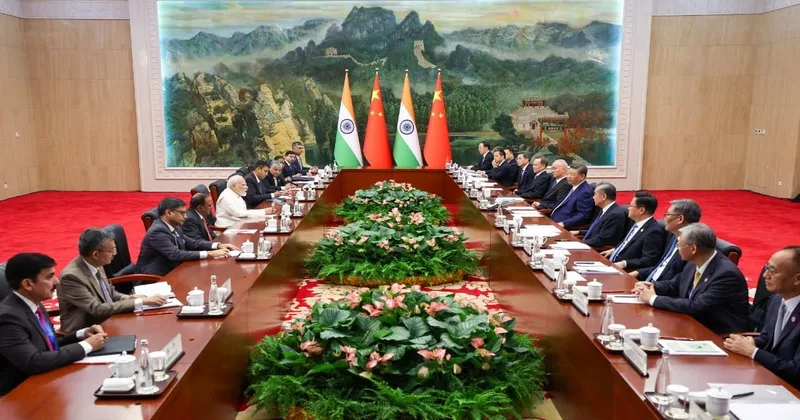
Prime Minister Narendra Modi and Chinese President Xi Jinping reaffirmed their commitment to strengthening India-China relations during a crucial meeting on the sidelines of the Shanghai Cooperation Organisation (SCO) summit in Tianjin. Both leaders underlined that the two countries are not rivals but partners in development, stressing the need for peace along the border, deeper economic cooperation, and a shared responsibility to shape a multipolar world order.
Leaders Stress Partnership, Long-Term Stability and Mutual Respect
The Ministry of External Affairs (MEA) announced that during talks between Prime Minister Modi and President Xi , both leaders emphasized that India and China are not rivals but development partners. They underscored the necessity of maintaining good neighbourly relations and avoiding disputes. The discussions reflected a shared commitment to stability and cooperation at a time of global economic uncertainty.
According to the MEA, Modi and Xi reiterated that differences between the two nations should not escalate into disputes. President Xi stated that fostering friendship between the two countries was the right decision for the future. The meeting concluded with a decisive understanding to sustain India-China relations over the long term.
The MEA noted that the two leaders welcomed the positive momentum and steady progress in bilateral ties since their previous interaction in Kazan in 2024. The statement highlighted that stable relations and cooperation between India and China and their combined population of 2.8 billion are essential for the growth and development of both nations. These relations, based on mutual respect, shared interests, and sensitivity to each other’s concerns, are also critical for fostering a multipolar world and a multipolar Asia in line with 21st-century trends.
The statement further added that both countries share a historic responsibility to improve the well-being of their people. Modi and Xi agreed that the relationship must be approached with a strategic and long-term perspective to ensure stability, solidity, and sustained progress. President Xi reiterated that India and China should move forward as partners, not adversaries. He stressed that their relationship should promote growth for both sides without posing threats to each other.
Modi Emphasises Border Peace and Stronger Bilateral Ties
Prime Minister Modi expressed optimism, stating that India-China relations were on a positive trajectory. He pointed out that stability and peace had been maintained along the border and that the Kailash Mansarovar Yatra had resumed, signalling a return to normalcy. Referring to their earlier meeting in Kazan, Modi described the discussions as fruitful and confirmed that direct flights between the two countries would soon be launched. He emphasised that the interests of 2.8 billion people are linked through cooperation between India and China, which he termed as essential for humanity.
The Prime Minister reaffirmed India’s commitment to advancing the relationship based on mutual trust and respect. He expressed gratitude to President Xi for the invitation to the summit and the constructive dialogue. It was reported that both leaders also exchanged views on resolving the longstanding border issue. The MEA noted that Modi underscored the importance of peace and tranquillity in border regions for the continued development of bilateral relations.
Had a fruitful meeting with President Xi Jinping in Tianjin on the sidelines of the SCO Summit. We reviewed the positive momentum in India-China relations since our last meeting in Kazan. We agreed on the importance of maintaining peace and tranquility in border areas and… pic.twitter.com/HBYS5lhe9d
— Narendra Modi (@narendramodi) August 31, 2025
The two leaders expressed satisfaction with the successful military disengagement that took place last year and the maintenance of peace and calm along the border since then. Both sides reaffirmed their commitment to a fair, rational, and mutually acceptable resolution to the boundary question. The MEA stated that they endorsed the decisions taken earlier this month by the two Special Envoys during their talks and agreed to continue supporting their efforts.
With the resumption of the Kailash Mansarovar Yatra and the restoration of tourist visas, Modi and Xi highlighted the need to strengthen people-to-people exchanges through direct air connectivity and streamlined visa processes. The Prime Minister also noted that both India and China pursue strategic autonomy and should avoid viewing their bilateral ties through the prism of a third country.
Shared Goals on Global and Regional Issues
The leaders assessed the necessity of developing common understandings on bilateral, regional, and global challenges, including terrorism and the promotion of fair trade in multilateral forums. Prime Minister Modi expressed support for China’s chairmanship of the SCO and commended the organisation of the summit in Tianjin. In return, he invited President Xi to attend the BRICS summit, which India will host in 2026. President Xi accepted the invitation and assured China’s support for India’s BRICS presidency, the MEA confirmed.
During the visit, Modi also met with Cai Xie, a member of the Politburo Standing Committee of the Communist Party of China. The timing of the Modi-Xi meeting was significant given the ongoing tariff disputes with the United States. The meeting began at 9:30 a.m. IST and lasted for about an hour. Key officials present included National Security Advisor Ajit Doval, External Affairs Minister S. Jaishankar, and Foreign Secretary Vikram Misri. India has been working to strengthen ties with both China and Russia following the imposition of 50 percent tariffs on Indian imports by the United States. The U.S. has also increased tariffs on Chinese goods.
This marked the first visit by Prime Minister Modi to China in seven years and his second meeting with Xi Jinping within 10 months, following their previous engagement at the BRICS summit in Kazan, Russia. Both leaders recognised the role of India and China in ensuring stability in the global trade environment and reaffirmed their resolve to cooperate in combating terrorism.
Commitment to Combating Terrorism and Economic Stability
Prime Minister Modi sought China’s support in tackling cross-border terrorism, a matter he discussed in detail with President Xi. According to Foreign Secretary Vikram Misri, China expressed its backing on this issue. Misri explained at a press conference after the meeting that cross-border terrorism poses a challenge for both India and China, making mutual understanding and cooperation imperative.
The two leaders also reviewed the situation along their shared border and reiterated the importance of maintaining peace in the region. They agreed that continued coordination through existing mechanisms was essential to prevent tensions from resurfacing. Both sides affirmed that friendly relations between India and China would serve the interests of 2.8 billion people.
Highlighting the importance of shared interests over differences, the leaders resolved not to allow disagreements to escalate into disputes. Misri added that for the Asian century and a viable multipolar world order, with Asia at its core to materialise, strong cooperation between India and China is indispensable.
Focus on Stability and Long-Term Vision
Prime Minister Modi reiterated that India-China relations are essential for the broader progress of humanity. He added that the agreements reached in Kazan had been successfully advanced during the Tianjin meeting. President Xi extended a warm welcome to Modi, expressing his pleasure at meeting the Prime Minister again. He highlighted the cultural linkages between the two nations and underscored the significance of the “dragon-elephant” friendship. Xi stated that it is crucial to sustain good neighbourly relations between the two Asian powers.
The discussions carried broader strategic implications. Both leaders acknowledged that two world powers with a combined population of nearly 2.8 billion could transform the global economic order if they worked together. This sentiment formed a central theme of their meeting in Tianjin on the sidelines of the SCO summit.












Comments