





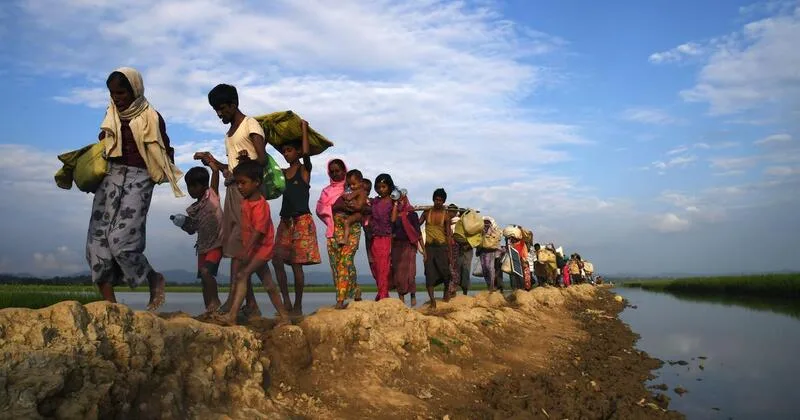
India has always been a land of compassion, civilisational strength, and spiritual shelter. From offering refuge to the Dalai Lama and the Tibetan community in 1959 to supporting Sri Lankan Tamils during the civil war, the country has historically demonstrated generosity towards the persecuted. However, in recent decades, the nature of migration into India—particularly illegal infiltration disguised as refugee inflow—has posed serious challenges to internal security, demographic stability, and socio-economic balance, especially in border states. The so-called refugee crisis, especially concerning illegal Muslim migrants such as the Rohingyas and certain undocumented entrants from Bangladesh, must be viewed not merely through a sentimental or humanitarian lens, but through the constitutional duty of protecting India’s sovereignty, resources, and the rights of its legitimate citizens. “Demography is destiny.” This adage underscores the crucial role population dynamics play in determining a nation’s trajectory. In India, a country already grappling with overpopulation, uneven development, internal migration, and socio-economic disparities, the refugee crisis presents a formidable challenge. What began as humanitarian responses to neighbouring conflicts has now evolved into a sustained, unregulated influx of people, many of whom lack documentation and legal standing. This crisis has serious implications not only for national security but also for India’s socio-economic equilibrium. The burden is particularly acute in the border and urban states such as Assam, West Bengal, Jammu and Kashmir, and Delhi, where local populations are increasingly under stress. While compassion is a virtue, and India has upheld its duty to humanity for decades, there is a growing need to critically examine the refugee crisis through the dual lens of security and socio-economic sustainability.
India has historically provided refuge to those fleeing war and persecution—from Tibetans escaping Chinese aggression, to Sri Lankan Tamils during the civil war, and Afghan minorities fleeing extremism. These were organised, state-monitored efforts rooted in bilateral understanding and strategic management. However, the newer waves of undocumented migration—particularly from Bangladesh and Myanmar—have been largely uncontrolled, leading to a spillover effect on India’s internal stability. The most concerning among these is the influx of Rohingya Muslims from Myanmar, whose arrival over the past decade has raised serious national security concerns. India is currently home to approximately 40,000 Rohingyas, many of whom have settled illegally in Jammu, Delhi, Hyderabad, and various parts of Uttar Pradesh, West Bengal, and Haryana. Unlike earlier refugees who entered India through formal channels and with government clearance, most Rohingyas have arrived illegally, crossing borders with the help of human trafficking networks or slipping through porous terrain.
The implications of such unregulated entry are far-reaching. Several intelligence agencies and national security experts have warned of the growing risks posed by undocumented refugee populations, particularly in conflict-sensitive regions. Reports have surfaced of Rohingya individuals being radicalised and recruited by terror outfits operating from across the border. The Arakan Rohingya Salvation Army (ARSA), a jihadist group based in Myanmar, has known ties with transnational networks. Instances of forged identification documents, voter cards, and ration cards being acquired by illegal migrants raise alarm about potential misuse of democratic and legal systems. The presence of undocumented populations in sensitive zones like Jammu further complicates security management. In regions already experiencing terrorism, communal tensions, or cross-border infiltration, the introduction of stateless individuals with no background verification creates loopholes in the internal security apparatus.
In J&K, where the demography is already a politically sensitive subject, the unchecked settlement of Rohingya families has become a flashpoint. Hundreds of Rohingya families have established shanty settlements in and around Jammu city. Local residents have expressed concern over rising crime, encroachment of land, and a visible strain on public resources. The demographic shift, combined with ideological concerns, has stirred local anxieties. Although the government-initiated identification and deportation drives, such efforts have been met with legal challenges and opposition from various non-governmental groups. The debate, however, cannot ignore the fact that refugee settlements in such areas make law enforcement more difficult and raise the risk of exploitation by anti-national elements. National security is not merely about preventing terror attacks; it is also about ensuring internal harmony, law enforcement, and protecting the integrity of citizenship.
The refugee crisis is equally destabilising on the socio-economic front. States like Assam and West Bengal, already vulnerable due to their proximity to the Bangladesh border, are experiencing demographic transformations with long-term consequences. Assam has seen decades of illegal infiltration from Bangladesh, which has altered the cultural, linguistic, and religious makeup of several districts. The strain on resources is visible—schools are overcrowded, healthcare systems are stretched thin, and employment opportunities are dwindling. Illegal migrants and refugees, often working in informal sectors for extremely low wages, displace local labour and depress wage levels. This not only creates resentment among locals but also contributes to the growth of slums, child labour, and urban poverty. The NRC (National Register of Citizens) exercise in Assam, although controversial, was a necessary step toward identifying and documenting genuine citizens. However, the lack of proper refugee documentation frameworks makes such exercises incredibly complex and vulnerable to politicisation.
In West Bengal, similar patterns have emerged. Border districts such as Cooch Behar, Murshidabad, and Malda have seen a steady influx of migrants from across the border. While some may be legitimate refugees, many are undocumented entrants driven by economic reasons. Over time, these groups form concentrated settlements, often along religious lines, which leads to the ghettoisation of populations and sharpens communal divides. Access to subsidised food, healthcare, and education further strains public services, often diverting resources away from the local poor. Political mobilisation around such settlements has further complicated matters, with accusations that illegal migrants are used as vote banks in exchange for protection and basic services. The erosion of border discipline not only affects security but also fuels corruption, land grabs, and identity theft. Local populations, particularly in rural areas, bear the brunt of these transformations.
In urban centres like Delhi, the refugee crisis manifests in sprawling slums and unauthorised colonies. In areas such as Kalindi Kunj and Shram Vihar, thousands of Rohingyas live in precarious, unhygienic conditions without sanitation, drainage, or access to reliable electricity. These areas, often located near vulnerable urban infrastructure, become breeding grounds for disease, crime, and human trafficking. With limited livelihood opportunities, many refugees—especially women and children—fall into exploitative labour, sex trafficking, or begging. Government agencies and local authorities struggle to manage these settlements, as the absence of legal status prevents long-term rehabilitation or integration plans.
Instead, firefighting becomes the norm, with periodic evictions followed by resettlement elsewhere. The cost of maintaining even basic law and order in these zones is high, and locals often complain of deteriorating infrastructure and growing insecurity. In such circumstances, the distinction between compassion and compromise becomes blurry, and the long-term cost of ignoring refugee regulation becomes evident.
Economically, illegal refugees and undocumented migrants contribute very little to formal taxation systems but extract disproportionately from public welfare. Their inclusion in subsidised schemes such as PDS, government schools, and healthcare services—often using forged documents—directly affects India’s poor and working-class citizens who compete for the same benefits. This is particularly harmful in underdeveloped districts where government resources are already overstretched. The informal economy that illegal refugees sustain often bypasses regulations, weakening labour rights, sanitation norms, and environmental safeguards. These factors, while rarely discussed in mainstream discourse, are crucial to understanding the true impact of the refugee crisis on India’s socio-economic fabric.
There is also the matter of national identity and the sanctity of citizenship. In a country with a population of over 1.4 billion, defining who has the right to be here is not a matter of ideology but of necessity. A robust framework for citizenship, refugee recognition, and border regulation is essential to maintaining order and trust in democratic systems. India remains one of the few major nations without a comprehensive refugee law. This vacuum creates ambiguity, allows for arbitrary enforcement, and leaves both refugees and host communities vulnerable. It is time for India to adopt a rational, nationally coordinated refugee policy that distinguishes between genuine asylum seekers fleeing persecution and economic migrants or illegal infiltrators entering with falsified intent. Such a policy must involve the creation of proper detention and repatriation centres, biometric tracking systems, and international cooperation to address the root causes of displacement.
In conclusion, the refugee crisis in India must be understood as both a national security concern and a socio-economic challenge. While India has always upheld its civilisational commitment to offering refuge, today’s circumstances demand a more pragmatic and structured approach. The unchecked settlement of undocumented populations compromises internal stability, burdens the economy, and risks transforming the social fabric in ways that are difficult to reverse. It is not inhumane to expect that all those who enter India do so legally, with proper documentation and respect for national laws. Nor is it unreasonable to insist that the rights of Indian citizens be prioritised in access to public resources. Compassion must be balanced with caution, and generosity with governance. If India is to remain secure, united, and economically resilient, it must act decisively to regulate the refugee crisis before the cost becomes irreversible.













Comments