





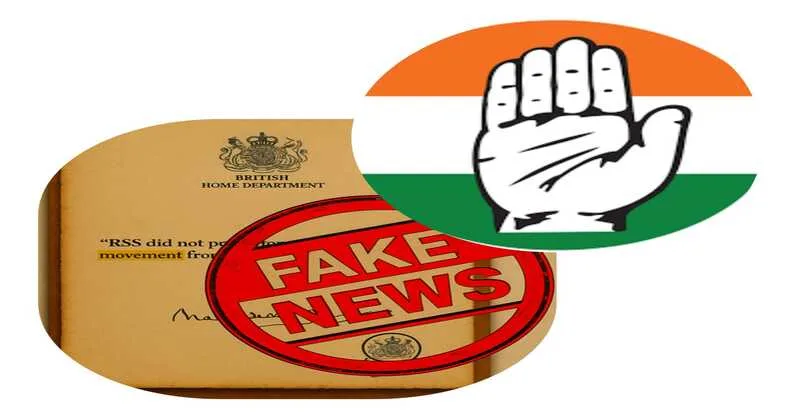
Once again, the Congress party and its leaders have been caught spreading false propaganda to defame the Rashtriya Swayamsevak Sangh (RSS). Recently, leaders like Manish Tewari and Jairam Ramesh circulated an image on social media, claiming that “RSS did not participate in any anti-British movement between 1925 and 1947.” However, a fact-check by Organiser revealed that this was nothing but a malicious attempt by the Congress party to denigrate the RSS.
It is noteworthy that this fake news was spread just before the three-day lecture series at Vigyan Bhavan, New Delhi, by RSS Sarsanghchalak Dr. Mohan Bhagwat, on the theme “100 Years of RSS: New Horizons”.
The AI-Generated Fake Narrative Exposed
The so-called “document” shared by the Congress leaders was not a historical record but an AI-generated fake image. It was falsely attributed to the “British Home Department,” a department that never existed under British India, exposing the fraudulent nature of the claim.
Even the emblem on the fake document was distorted. The authentic British Royal Coat of Arms bears the motto “Dieu et mon droit” (“God and my right”), whereas the Congress-shared version bizarrely read “Dieu Droit” a meaningless phrase. The so-called “seal” on the document was nothing but a set of random AI-generated scribbles, not an official insignia.
Another glaring mistake was the use of the term “RSS.” Historical records show that the British administration always referred to the Sangh as “RSSS” never as “RSS.” The use of the wrong acronym clearly exposes the fabricated nature of the image circulated by the Congress.
These errors demonstrate that Congress is resorting to AI tools and fabricated documents to malign the Sangh, rather than acknowledging the contribution of nationalist forces in India’s freedom struggle.
RSS and the Satyagraha
Contrary to Congress’s propaganda, the Sangh’s involvement in the freedom movement is well documented. During the Dandi March of 1930, RSS founder Dr. K.B. Hedgewar himself participated, even stepping down temporarily as Sarsanghchalak, because he believed that the freedom struggle must be fought under the banner of the Congress at that time. He was subsequently jailed for nine months after participating in satyagraha in Yavatmal. Over 100 swayamsevaks were also imprisoned in Akola Jail.
By 1932, owing to the Sangh’s rising popularity and growing participation in the freedom struggle, the British imposed restrictions on government employees, barring them from associating with the RSS. In January 1933, British official M.G. Henlett even ordered detailed intelligence reports on the RSS, acknowledging its rapid growth despite restrictions.
Quit India Movement and RSS
After Dr. Hedgewar’s demise in 1940, the Sangh continued its contribution under the leadership of M.S. Golwalkar (Shri Guruji). When the Quit India Movement was launched in 1942, some of the most intense agitations took place in Vidarbha, where the RSS network was strong. Leaders like Dada Naik, Baburao Begde, and Annaji joined hands with the Congress leader Uddhavrao Korekar to lead protests.
During this time, young swayamsevak Balaji Raipurkar attained martyrdom. In the famous Chimur-Ashti episode, more than 125 satyagrahis and thousands of swayamsevaks were imprisoned. Volunteers like Hemu Kalani and RSS leader Dada Naik were sentenced to death in 1943.
A British intelligence report of 1943 explicitly stated:
“The main objective of the RSS is to expel the British from India and secure freedom for the country.”
The truth remains that no amount of AI-generated propaganda can erase the sacrifices and contributions of the countless swayamsevaks who stood for India’s independence and cultural resurgence. Instead of manufacturing falsehoods, Congress must acknowledge historical realities and the sacrifices made by all those who fought for the nation.













Comments