






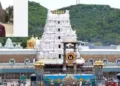
Short of suggesting that temples be freed from government control – a demand consistently raised by Hindu devotees, temple activists, and mutts – the Madras High Court has posed a question to the state government: why not consider setting up Devasthanam Boards akin to Tirumala Tirupati Devasthanam (TTD) to manage temple administration in Tamil Nadu?
A division bench comprising Justice R. Suresh Kumar and Justice S. Sounthar observed on 28 August, “It is high time the state considers forming Devasthanam Boards, like the Tirumala Tirupati Devasthanam (TTD), to run the affairs of popular temples such as Palani and Tiruvannamalai. Though the boards would be independent bodies, the government will still have control over them.”
The court pointed out that the Tirupati model has been successful, questioning why the Tamil Nadu government should not consider adopting a similar system for its temples.
The bench also directed the Hindu Religious and Charitable Endowments (HR&CE) Department to reconsider its proposal to construct a building opposite the Raja Gopuram of Arunachaleswarar Temple in Tiruvannamalai. Instead, it urged the department to identify alternative sites to provide better infrastructure for devotees. The matter has been adjourned to September 11.
The issue relates to the HR&CE Department’s decision to build either a commercial complex or a queue hall in front of the Raja Gopuram, which evoked stiff opposition from devotees and activists. The court asked the HR&CE to identify government poramboke lands in Tiruvannamalai town for the proposed complex and to obtain prior permission from the court before construction. It noted that building such a structure on temple land, especially blocking the view of the ancient gopuram, would serve no useful purpose.
In another order, the same bench directed the HR&CE Department to bear the reconstruction cost of Rs 15.9 lakh for the ancient Bhaktha Markandeya Temple located on the Girivalam (parikrama) path in Tiruvannamalai. The temple had allegedly been demolished by an encroacher to build a coffee shop. The court ordered that reconstruction costs be recovered from encroachers if allegations are proved in a criminal court.
Tamil Desiya Makkal Katchi president C. M. Sivababu alleged that the temple was pulled down overnight by encroachers. He claimed it was one of the sub-temples of Arunachaleswarar Temple, managed by the HR&CE Department. The petitioner stated that in 2013, eight local residents encroached upon land adjacent to the temple and set up a coffee shop.
On August 28, the court said: “Since the Highways Department has also granted an NoC, there is no impediment for the HR&CE Department to reconstruct the temple.”
The court further directed the HR&CE Department to sanction the required funds within two weeks and obtain all approvals from expert committees and the State Archaeological Department within four weeks. It also ordered that reconstruction begin on an auspicious day and time fixed by an expert, with a compliance report on commencement to be filed by 23 October.
Temple activist T. R. Ramesh wrote on X : “Once again, victory to temple-worshipping Hindus! Today I argued my writ petition seeking to quash Govt Order No. 336 recklessly issued by the TN Government approving shops before the Raja Gopuram of Sri Arunachaleswara Temple, Tiruvannamalai. The Hon’ble Division Bench said NO to @tnhrcedept’s proposal – no shops, no queue complex, nothing in ancient temple precincts or adjacent. Queue complexes can be built on government land away from Sri Arunachaleswara Temple – the Court opined.”
Once again victory to Temple Worshipping Hindus!
Today I argued my Writ Petition seeking to quash the Govt Order No 336 recklessly issued by TN Govt approving shops to be constructed before the Raja Gopuram of Sri Arunachaleswara Temple, Tiruvannamalai-
The Hon’ble… pic.twitter.com/iT8MfCsBjg
— trramesh (@trramesh) August 28, 2025
Devotees reacted, saying: “At least now onwards, the HR&CE Department, particularly Minister P. K. Sekar Babu, should take note of the HC orders. He should establish Devasthanam Boards for all major high-revenue temples in the state and provide basic amenities such as waiting halls for devotees, like in Tirumala. HR&CE should not focus solely on introducing more revenue-generating fees that burden devotees.”














Comments