





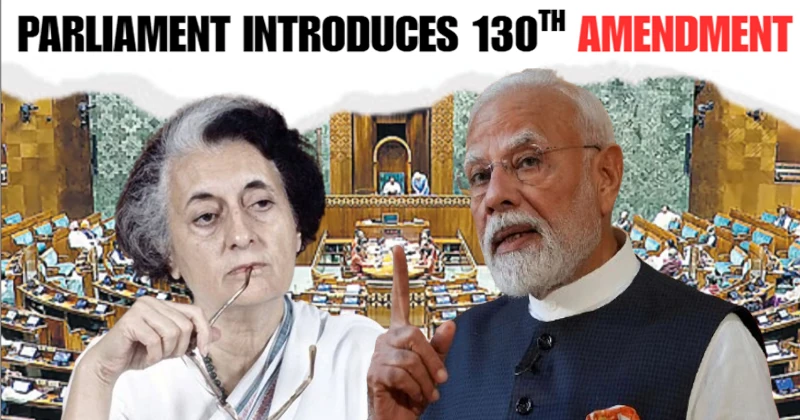
In 1975, Indira Gandhi’s 39th Amendment silenced the judiciary and placed herself above the law during the Emergency. In 2025, PM Modi’s 130th Amendment reverses that legacy by ensuring even the Prime Minister is accountable, ending the culture of leaders governing from jail
In 1975, Indira Gandhi twisted the Constitution to shield herself from the judiciary, igniting the darkest period in India’s democratic history. In 2025, Prime Minister Narendra Modi has turned the same Constitution into a weapon against political corruption and unaccountable governance. The passage of the 130th Constitutional Amendment marks not just a legal milestone, but a profound ideological departure from the Emergency-era 39th Amendment.
This is a story of two amendments, two Prime Ministers, and two very different visions of power. One was driven by powerlust, the other by the creed of nation first.
𝐓𝐰𝐨 𝐚𝐦𝐞𝐧𝐝𝐦𝐞𝐧𝐭𝐬. 𝐓𝐰𝐨 𝐏𝐫𝐢𝐦𝐞 𝐌𝐢𝐧𝐢𝐬𝐭𝐞𝐫𝐬. 𝐓𝐰𝐨 𝐯𝐞𝐫𝐲 𝐝𝐢𝐟𝐟𝐞𝐫𝐞𝐧𝐭 𝐢𝐝𝐞𝐨𝐥𝐨𝐠𝐢𝐞𝐬.
𝐈𝐧𝐝𝐢𝐫𝐚 𝐆𝐚𝐧𝐝𝐡𝐢 – 𝐏𝐨𝐰𝐞𝐫 𝐥𝐮𝐬𝐭.
𝐏𝐌 𝐌𝐨𝐝𝐢 – 𝐍𝐀𝐓𝐈𝐎𝐍 𝐅𝐈𝐑𝐒𝐓.One shielded herself from the law. The other brought himself… pic.twitter.com/dBJw4Dtnum
— BJP (@BJP4India) August 26, 2025
The dark precedent of 1975: Indira’s 39th Amendment
On June 12, 1975, the Allahabad High Court found Indira Gandhi guilty of electoral malpractices and struck down her election. The verdict should have ended her premiership. Instead, Indira declared Emergency, crushed dissent, and rammed through the 39th Constitutional Amendment.
- It barred judicial review of the elections of the Prime Minister, President, Vice President, and Lok Sabha Speaker.
- It effectively gave the sitting Prime Minister immunity from law.
- It placed the executive above accountability, silencing the courts.
This was not governance. It was dictatorship by stealth. The message was chillingly clear: “One leader is above the law.” That single amendment epitomised the Emergency — a period where Parliament became a rubber stamp, the judiciary was shackled, and the citizenry lived under surveillance and fear.
2025: PM Modi’s 130th Amendment brings PM in ambit
Fast forward 50 years. The 130th Amendment passed by the Modi government restores the opposite principle: no public servant, not even the Prime Minister, is above scrutiny.
The law is clear, if any Union or State Minister (including PM or CM) is arrested for a serious offence (≥5 years sentence) and denied bail for 30 consecutive days, they are automatically removed from office. Reappointment is possible after release, ensuring fairness but ending the practice of clinging to power while behind bars.
The process is institutional:
- Union Ministers – Removed by the President on PM’s advice.
- State Ministers – Removed by the Governor on CM’s advice.
- Delhi Ministers – Removed by the President on CM’s advice.
In one stroke, the government has ended the culture of leaders running ministries from jail.
Why it was needed: Governance hijacked from behind bars
The need for this amendment arose not from theory but from repeated abuse of power:
- Arvind Kejriwal (Delhi Liquor Scam) – The sitting Chief Minister continued to hold office even as he faced serious corruption charges, signing files from custody.
- Manish Sisodia (Delhi Excise Case) – Key decisions of Delhi’s excise policy were linked to corruption, yet governance limped on under the shadow of jail walls.
- V. Senthil Balaji (Tamil Nadu Money Laundering Case) – Arrested for large-scale financial fraud, yet he clung to his ministerial berth, crippling administrative integrity.
These cases exposed a glaring loophole, the Constitution had no automatic mechanism to prevent ministers in jail from wielding authority. The 130th Amendment plugs that hole decisively.
Predictably, the opposition has denounced the amendment, raising the bogey of “misuse.” But their arguments collapse under the weight of history.
- In 1975, they applauded when Indira Gandhi armed herself with immunity through the 39th Amendment.
- In 2013, they cheered when Rahul Gandhi theatrically tore up an ordinance that sought to shield convicted leaders.
- Today, they cry “due process” when accountability reaches the highest office.
This double standard exposes not concern for democracy, but fear of losing privilege.
For PM Modi, the principle is clear: corruption and governance cannot coexist. His oft-repeated mantra, “Na khaunga, na khane dunga,” finds constitutional expression in the 130th Amendment. Unlike Indira Gandhi, who used constitutional amendments as a sword to protect herself, PM Modi has used it as a scalpel to remove the rot at the top. The symbolism is powerful:
- 1975 → The Prime Minister put herself above the law.
- 2025 → The Prime Minister puts himself under the law.
This shift transforms governance from personality cults into institutional accountability.
Why the 130th Amendment strengthens democracy
- Prevents Governance Paralysis – Ministers cannot run departments from judicial custody.
- Restores Public Trust – Citizens see that the law applies equally to the powerful.
- Strengthens Institutions – Removal becomes automatic, not dependent on political discretion.
- Balances Fairness and Justice – Reappointment allowed after release prevents vendetta-driven misuse.
This is democracy in action, not democracy in rhetoric.
The tale of the 39th and 130th Amendments is not just about two legal provisions. It is the story of two Indias:
- One where power devoured accountability.
- One where accountability defines power.
In 1975, India saw “absolute power, zero accountability.” In 2025, India witnesses “executive responsibility, zero immunity.”














Comments