





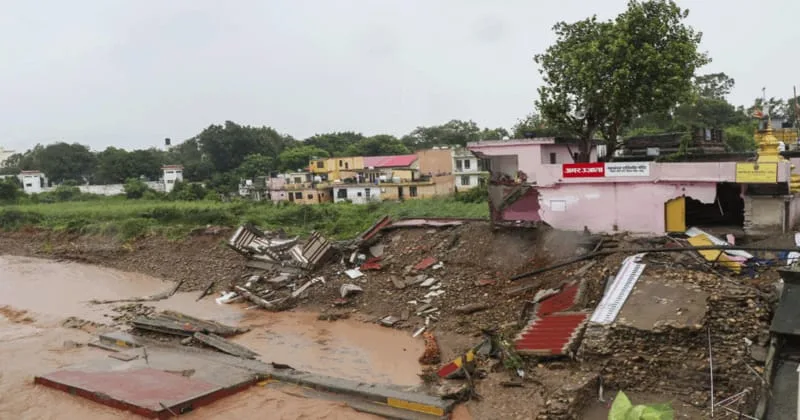
In an incident of a landslide reported from the Adi Kumari area of the Shri Mata Vaishno Devi trek, at least 34 people have lost their lives, and 23 others have been injured.
The Shri Mata Vaishno Devi Shrine Board (SMVDSB) officials are involved in rescue operations and will issue updates periodically. In a related development, all trains originating from Katra have been cancelled. A report said that the railway administration has cancelled all trains departing from Katra till further notice.
This has been done keeping the safety of passengers in mind, as railway tracks have been inundated in some areas. Waterlogging has also been reported in some areas, and subsidence of tracks becomes a real threat to passenger safety in such situations, according to the report. Some district authorities have issued advisories asking the residents to stay indoors due to extreme weather. They have also been advised to stay away from water bodies for their own safety.
According to some reports, mobile and Internet services have been affected all across the Union Territory (UT) of J&K after major damage to optical fibre cables at multiple locations. Due to this snapping, people are unable to make calls and use net-enabled services. According to telecom officials, technical teams are trying to restore services.
Meanwhile, a red alert has been sounded in several areas with heavy rain, at least 15 mm per hour, predicted. Jammu city, where the Divisional Commissioner of the province is located, has recorded over 250 mm of rain in 20 hours, with downpour continuing.
Across the Jammu region, in all 10 districts of the province, incessant rains, flooding, rivers in spate and low-lying areas being evacuated are the reports reaching Jammu city. Almost all perennial rivers and seasonal water bodies are overflowing, with some bridges collapsing. The authorities have stopped vehicular traffic in many areas, mainly due to bridges being declared unsafe. In Jammu city, the Tawi River, which bisects it, is flowing above its danger mark, and some low-lying areas have been evacuated.
Out of 10 districts of the region, located on the southern side of the mighty Pir Panjal mountains, nine have seen heavy rains. Several road links in Kathua, Samba, Jammu, Udhampur, Reasi, Rajouri, Ramban, Doda and Kishtwar have been snapped. Poonch is the only district from where no reports of any damage due to rains have been received. In the last 24 hours, Jammu and its surrounding areas have received over 250 mm of rain, which is truly unprecedented. There were reports of cloudbursts at three different places with substantial damage to infrastructure, including houses and government buildings. However, no loss of life has been reported.
The Chenab River, which flows about 30 km west of Jammu city, is in spate like never before, and low-lying areas on its banks have been evacuated. All gates of the Salal hydropower project, about 50 km upstream of the India-Pakistan border below Akhnoor, have been opened to release accumulated water in a controlled manner.
Incidentally, it bears mention here that the Indian government had, on Sunday, cautioned Pakistan that heavy floods may occur in the Tawi and most of its tributaries. This was done as a humanitarian gesture, and the message was conveyed through the Indian diplomatic staff posted in Islamabad. On April 23, the Indian government had put the Indus Waters Treaty (IWT) in abeyance following the Pahalgam terrorist strike a day earlier.
Under the IWT norms, data from around 280 monitoring stations, 190 located on the Western Rivers, and 90 located on the Eastern Rivers, were being shared with Pakistan. Since then, no data has been provided to our western neighbour through channels established under the IWT mandate. This data deficiency has a very detrimental impact on Pakistan as it cannot properly plan its irrigation and crop sowings, as well as flood control measures.
In another development, reports have been received during the past two or three days of snowfall from some road stretches leading to Gurez valley, Zanskar area of Kargil and Sonamarg. This is being attributed to fast-changing climate patterns in vast areas of the Himalayan and sub-Himalayan regions.















Comments