





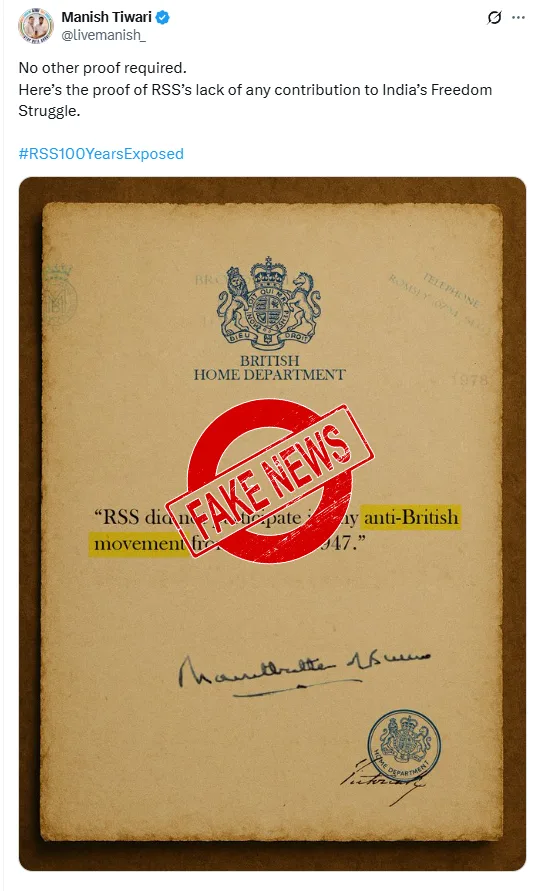
Once again, the Congress party and its leaders have been caught spreading fake propaganda to defame the Rashtriya Swayamsevak Sangh (RSS). Leaders like Manish Tewari and Jairam Ramesh recently shared an image on social media, alleging that “RSS did not participate in any anti-British movement from 1925–1947.” However, a examination by Organiser exposes this as nothing but a malicious attempt to demean RSS.
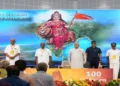
Notably, Congress is peddling this fake news just hours before the three-day lecture series by RSS Sarsanghchalak Dr Mohan Bhagwat at Vigyan Bhawan, New Delhi, with the theme “100 Years of Journey of RSS: New Horizons.”
AI-Generated image exposed: The image being circulated by Congress is not a genuine historical document, but an AI-generated creation. The so-called report claims to be issued by the “British Home Department,” but the fact is no such department ever existed under British India. This very claim itself exposes the fraud.
Distorted Seal: The forged document bears a distorted version of the original British emblem. The authentic motto is “Dieu et mon droit” (“God and my right”), whereas the Congress-shared image strangely displays only “Dieu Droit”, a meaningless phrase. Moreover, the stamp on the paper shows random scribbles typical of AI generation, not a structured official seal.
Wrong terminology used: Another blunder in this fake creation is the way “RSS” has been mentioned. British administration always referred to the Rashtriya Swayamsevak Sangh as “R.S.S.S” and never “RSS.” The fact that the Congress image uses “RSS” clearly proves it is fabricated.
From all this, it is evident that Congress is desperately attempting to defame the RSS through artificial intelligence tools and fabricated documents. Instead of acknowledging the contributions of nationalist forces, the party is indulging in baseless attacks driven by political hate.
Sangh and the Satyagraha
The role of the Sangh in the Dandi March during the freedom struggle in 1930 was evident with the participation of Dr Hedgewar, who even resigned from his position as Sarsanghachalak of the RSS, as he believed that the freedom struggle must be fought under one organisation, the Congress. He even went to jail during this time. He also strongly reiterated that while one could join the Congress agitation, one could also remain in the RSS and work for the constructive freedom of the nation while simultaneously working towards reforming Hindu society.
After conducting Satyagraha in Yavatmal on July 21, 1930, Dr Hedgewar was sentenced to nine months’ imprisonment with hard labour. More than 100 swayamsevaks were also sent to Akola Jail.
With the rise in the popularity of the RSS and its involvement in the freedom struggle, the British administration, under Section 23 of Government Rules, clearly barred any government servant from becoming a member of, or even participating in the activities of, the RSS in 1932. In fact, it was the British Secretary MG Hanlet who issued an order in January 1933 to collect detailed information on the RSS, as the organisation was expanding rapidly despite restrictions. Finally, the British had to take steps to curb this growth, and in December 1933, another order was issued by the British Secretary tagging the RSS as “communal” and banning teachers from joining the organisation. In the 1934 session of the Madhya Prant Assembly, many Congress representatives firmly opposed this ban and stood in favour of the RSS.
RSS in the Quit India Movement
After the demise of Dr Hedgewar in June 1940, the RSS continued to contribute to the freedom struggle under the leadership of MS Golwalkar, popularly known as Shri Guruji. When the Quit India Movement was announced in 1942, the fiercest agitations took place in the Vidarbha region, where the RSS network was strongest. The agitation was led by RSS leaders Dada Naik, Baburao Begade, and Annaji, along with Congress leader Uddhavrao Korekar. During these events, a young swayamsevak named Balaji Raipurkar was killed. This was followed by the famous Chimur encounter, also called the “Chimur-Ashti episode,” where 125 Satyagrahis and thousands of swayamsevaks were imprisoned. Swayamsevak Hemu Kalani and RSS leader Dada Naik were sentenced to death in 1943.
The Quit India Movement was a monumental moment in the history of both India and the Sangh, with numerous efforts made by the RSS and unconditional support extended to Congress leaders in every way possible to achieve the single goal of Swaraj. The British closely monitored the functioning of the RSS from time to time, and regular reports were exchanged between the CID, Home Department, and British intelligence regarding the day-to-day activities of the Sangh, describing them as “anti-British volunteers who were ready to sacrifice their lives for the cause of the country.” One of the British Intelligence reports of 1943 clearly stated: “The ulterior objective of the RSS is to drive the British away from India and free the country.”
In fact, it was the Communists, who themselves kept distant from the freedom struggle and went so far as to call India’s Independence as ‘unreal,’ and denounced the Constitution as a bourgeoisie document.
The truth remains that such propaganda cannot erase the sacrifices and contributions of countless swayamsevaks who stood for India’s cultural resurgence and freedom.










Comments