





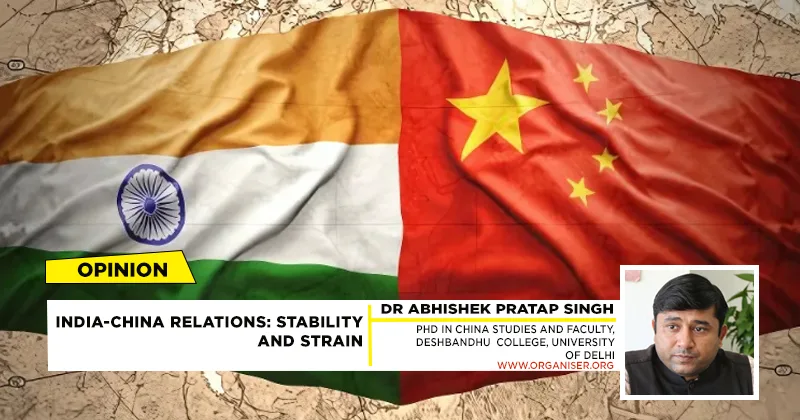
Recent months have seen a surge of high-profile Indian delegations led by political leaders and diplomats travelling to China. While New Delhi emphasizes a “calibrated engagement,” the bilateral equation remains fragile, shaped by border tensions, shifting global alignments and China’s willingness to consolidate unilateral gains. The recent visit of Wang Yi, Chinese foreign minister to India has to be seen in this wider context.
To point out, External Affairs Minister (EAM) S. Jaishankar’s July 14, 2025 visit to Beijing underscored both symbolic outreach and unresolved differences. Meeting senior Chinese leaders, he noted “progress in normalization” since the Modi-Xi summit in Kazan (October 2024). Yet, this narrative of stabilization, conflicts with realities on the ground.
Border disengagement remains incomplete, with heavy troop deployments continuing in eastern Ladakh for a sixth consecutive winter. Still there is less clarity and agreement in the resumption of Indian patrolling or grazing rights in buffer zones. Bilateral mechanisms for crisis prevention are operating, but restoration of status quo ante (April 2020) is still a critical priority for India. While it might not be more overtly in expression from the Indian side, China must not take it as any kind of strategic shift in itself. Thus, diplomacy is functioning, but without addressing the foundational issue between both the countries which is lack of trust and clarity of thought on the contested frontier. In addition, some new complexities on the border issue have been added in last year’s.
At the same time it is also true that certain efforts have been made to restore better civilian exchange and build people to people contact. To say, the step for the resumption of the Kailash-Mansarovar pilgrimage, and the Commemorations for 75 years of diplomatic ties is a positive development. Moreover, India has also responded to the Chinese outreach with flexible visa processing and restoring direct flights between India and China.
However, most of these gestures align with Beijing’s longstanding wish-list and do little to address structural irritants in the relationship. It is necessary to understand that symbolic softening, while tactically useful, cannot offset deeper security anxieties.
At the same time some new and alarming concerns have developed to the detrimental interests of India from the Chinese side. The development of Hydropower Projects on the Brahmaputra by Beijing’s and commencing of five mega-dams on the Yarlung Tsangpo (upper Brahmaputra) poses grave risks for India. Not only this will alter the river flows affecting water security in Arunachal Pradesh and Assam but can also have High seismic risks amplifying disaster potential in the critical northeast region of India. This new project on Brahmputra by China, tripled the size of its Three Gorges Dam, posing both an ecological challenge and a strategic lever of coercion against India.
Similarly, China’s support for Pakistan during the Pahalgam terror attack and subsequent cross-border hostilities (May 7-10, 2025) revealed unprecedented battlefield coordination between both, against India. During the Operation Sindoor, China played a key role in supplying advanced weaponry to Pakistan and provided necessary intelligence and surveillance support. The Real-time advisory inputs from China during the war to enhance Pakistan’s operational capacity against India. This new dimension of all weather friendship between China and Pakistan is a major security concern for India. This synergy underscores Beijing’s growing ability to influence South Asian security calculus without direct military intervention.
China has also used its economic leverages and technological denial by practicing a kind of economic coercion against India. China failed to adapt with the desire of the Modi government to have a “developmental partnership” with China.
Many times, the Withholding the transfer of EV and battery technologies and by putting pressure on firms like Foxconn to withdraw Chinese engineers from India are some examples of this economic coerciveness. Such calibrated economic pressure complicates India’s industrial modernization strategies, making diversification of supply chains a pressing imperative.
China, seems to be more confident that it has withstood the US pressure, is now testing the limits of both the European Union and Asian powers like India. It seems to be adopting a fine tactic of hard bargaining opting for a selective accommodation and economic coerciveness with India.
India’s challenge lies in balancing firmness on core interests with flexibility in diplomacy. India wants some credible steps and progress towards border de-escalation before deeper normalisation of mutual ties. India also wants to diversify its supply chains to reduce dependence on Chinese economic leverage. India’s goal for a more active role and reliance on multilateral forums also stems from the desire to have a counterbalance level with China.
To sum up, the bilateral discourse still suffers from strategic ambiguity and management of tactics. The relationship faces the big challenge of managing instability and deepening fragility in relations. While diplomatic channels and symbolic gestures suggest incremental stability, the underlying structural challenges — from unresolved border tensions to water disputes and technological coercion — remain unaddressed.












Comments