





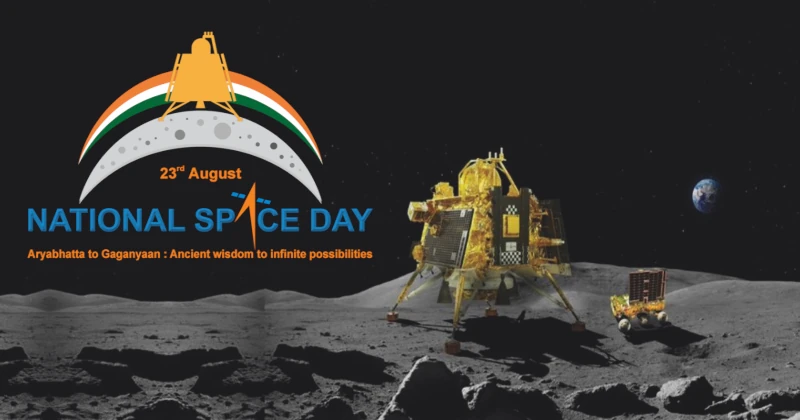
On August 23, India celebrates the second National Space Day, commemorating the country’s historic achievement of becoming the first nation to land near the Moon’s south pole through the successful soft-landing of the Chandrayaan 3 mission’s Vikram Lander on August 23, 2023. The day, officially declared as National Space Day by Prime Minister Narendra Modi in 2024, honours India’s lunar triumph and inspires the next generation of scientists, innovators, and entrepreneurs.
The Chandrayaan 3 mission etched India’s name in global space history as the fourth nation to achieve a lunar landing and the first to master the southern polar region of the Moon—an area rich in scientific potential. After the smooth touchdown, the Pragyan Rover was successfully deployed, and the landing site was christened “Shiv Shakti Point” (Statio Shiv Shakti), symbolising the combined strength of science and spirituality in India’s space journey.
Theme: Aryabhatta to Gaganyaan: Linking ancient wisdom to future possibilities
The theme of this year’s celebrations, “Aryabhatta to Gaganyaan: Ancient Wisdom to Infinite Possibilities,” draws a direct line between India’s pioneering astronomers and mathematicians of antiquity and the country’s cutting-edge ambitions in manned spaceflight through the upcoming Gaganyaan Mission.
Prime Minister Narendra Modi greeted the nation on the occasion of National Space Day, underlining India’s growing leadership in space exploration and the transformative role of reforms that have opened the sector to startups and private players, urging the nation’s youth to step forward and actively participate in the growing astronaut pool being developed for the upcoming Gaganyaan Mission.
In a message, PM Modi said India’s journey in space reflects the determination, innovation, and brilliance of scientists who have consistently pushed boundaries. He credited government-led reforms in the space sector for encouraging youth, private companies, and startups to explore new frontiers and contribute meaningfully to the country’s space odyssey.
Greetings on National Space Day! India's journey in space reflects our determination, innovation and the brilliance of our scientists pushing boundaries. https://t.co/2XPktf49Ao
— Narendra Modi (@narendramodi) August 23, 2025
“Powered by the skills of 140 crore Indians, our country is making remarkable strides in the world of space. And we are going to do even more!” the Prime Minister wrote, adding that India’s space story is now breaking into a New Space Age driven by the dynamism of startups.
Powered by the skills of 140 crore Indians, our country is making remarkable strides in the world of space. And, we are going to do even more! #NationalSpaceDay https://t.co/zVMLD32F2W
— Narendra Modi (@narendramodi) August 23, 2025
Highlighting the role of the private sector, PM Modi said India’s journey in space is no longer just about ISRO. A new wave of startups is breaking barriers, shaping global-first innovations, and positioning Bharat as a leader in the New Space Age, he said. From rocket launches and satellite technologies to next-generation Earth observation systems, Indian startups are transforming the nation into a true space powerhouse, unlocking opportunities in technology, innovation, and international cooperation.
Our Government has ushered in various reforms in the space sector, which have encouraged youngsters, private sector and Startups to explore new frontiers and contribute meaningfully to India’s space journey.#NationalSpaceDay https://t.co/rFnkl6Qtex
— Narendra Modi (@narendramodi) August 23, 2025
The Prime Minister stressed that India’s transformation into a global space power is guided by his government’s bold reforms and vision for the sector. “From pioneering missions to bold reforms, India is fast emerging as a global space power. This transformation is shaping Bharat’s rise in the New Space Age,” he said.
The Prime Minister also hailed India’s expanding capabilities in space exploration, describing the occasion as a “festival of innovation and inspiration.” Congratulating scientists, researchers, and students, he said, “Creating new milestones in space has become a regular achievement for our scientists. From landing on the Moon to developing docking mechanisms, India continues to break barriers.”
India recently became the fourth nation in the world to successfully demonstrate advanced docking technology, a critical requirement for long-duration space missions and the future Bharatiya Antariksh Station. Recalling his recent interaction with Group Captain Shubhanshu Shukla, who carried the tricolour to space, PM Modi said, “When he showed me the national flag that he unfurled in space, words could not capture the emotions I felt.”
The Prime Minister announced that India was preparing to build a dedicated astronaut pool, a cadre of trained professionals who will be central to human spaceflight missions in the coming decades. Calling it a “call to action,” he appealed to young Indians to join the nation’s space odyssey.
Outlining India’s long-term vision, PM Modi highlighted upcoming projects including the Gaganyaan human spaceflight mission, the development of semi-cryogenic and electric propulsion systems, and the establishment of the Bharatiya Antariksh Station by 2035. “We have explored the Moon and Mars, but now humanity’s future depends on going deeper into space where critical secrets for our survival and progress lie,” he said.
He also praised the creativity of young innovators participating in the IDRI Hackathon and Robotics Challenge, congratulating the winners and calling them “the vanguard of India’s future in space.”
Drawing from India’s rich scientific heritage, the Prime Minister said, “Our ancestors gave us the confidence of the past, and we carry the pledge for the future.” Concluding his address, he declared: “In space, there is no end. Beyond galaxies lies our horizon.”
Marking the celebration of National Space Day 2025, the Indian Space Research Organisation (ISRO) unveiled a model of the first module of the Bharatiya Antariksh Station (BAS), India’s ambitious plan to establish a fully indigenous orbital laboratory in space.
According to ISRO, the first module of BAS is targeted for launch by 2028, with the complete station expected to become fully operational by 2035. Once realised, the Bharatiya Antariksh Station will enable India to conduct a wide range of indigenous experiments in space, including microgravity research, advanced material studies, life sciences, and testing technologies crucial for long-duration human space missions.
ISRO has unveiled a model of the first module of the "Bharatiya Antariksh Station" (BAS).
This ambitious project aims to launch its first module by 2028, with the full station expected to become operational by 2035. The BAS is set to be a significant platform for indigenous… pic.twitter.com/Q4curF9u7S
— DD News (@DDNewslive) August 23, 2025
The BAS project is regarded as a critical stepping stone towards India’s future in deep space exploration, particularly as it will prepare the country for interplanetary missions and long-term human presence beyond Earth.
Unveiling the model on this historic day, ISRO officials said the Bharatiya Antariksh Station will not only cement India’s status as a global space power but also provide a platform for international collaboration in cutting-edge scientific research.
As part of the commemoration, the Indian Space Research Organisation (ISRO) hosted the National Space Meet 2.0 in New Delhi on August 22. The event saw participation from Ministries, State Governments, Startups, Academia, and Private Stakeholders, who collaborated across ten breakout sessions to identify practical use cases for India’s growing space applications—from agriculture and healthcare to disaster management, navigation, and climate resilience.
Dr PK Mishra, Principal Secretary to the Prime Minister, emphasised that India’s space programme is not merely about “conquering the stars” but about enhancing lives on Earth. He highlighted that the space startup ecosystem has expanded dramatically from just two startups in 2014 to over 350 today thanks to reforms and private sector integration in the space economy.
ISRO Chairman V Narayanan, recalling the journey from humble rocket launches at Thumba in 1963 to India’s emergence as a global space leader, said that capability augmentation and deeper private sector involvement will be key to achieving Viksit Bharat 2047.
The Department of Space has rolled out nationwide initiatives throughout August to spark curiosity in space science among students and young innovators. NCERT has introduced a new module titled “India – A Rising Space Power” across schools in Uttar Pradesh, highlighting key missions including Chandrayaan, Mangalyaan, and Gaganyaan. Digital platforms such as DIKSHA, NISHTHA, and India on the Moon are hosting interactive content to make space science more accessible to students.
Additionally, the Physical Research Laboratory (PRL) is holding outreach events across its campuses in Ahmedabad, Udaipur, and Mount Abu, ensuring that the spirit of Chandrayaan-3’s achievement resonates beyond scientific circles and inspires communities across the nation.















Comments