





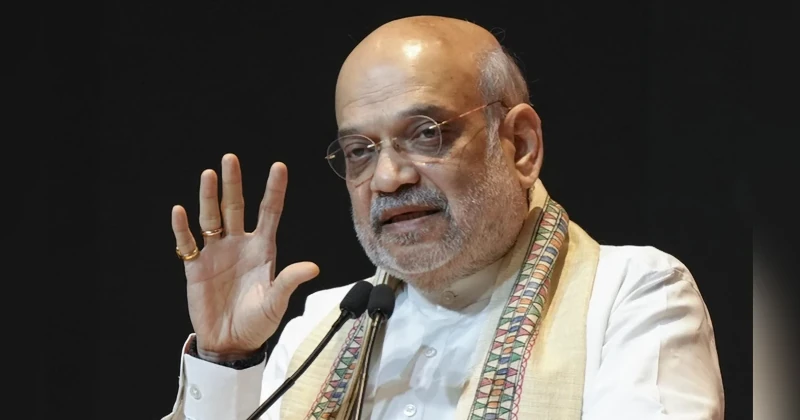
Union Home Minister Amit Shah, delivered a scathing address at the Manorama News Conclave 2025, forcefully defending the Constitution Amendment Bill that seeks to remove ministers—including Chief Ministers and even the Prime Minister if they remain in office after being jailed for corruption or serious criminal charges. Calling it an unprecedented corrective step in India’s democratic history, Amit Shah declared that the Bill would never have been required had Delhi Chief Minister Arvind Kejriwal resigned after his arrest.
In a fiery intervention that linked together questions of constitutional morality, political accountability, and national security, Amit Shah accused the Congress and its allies of double standards, reminded the nation of past ordinances brought for political survival, and warned that India’s democracy could not afford to be held hostage by leaders running governments from prison cells.
The Home Minister pointed out that in the seven decades of India’s independent journey, no government had contemplated such an amendment because political morality was self-regulated. “Before the Delhi incident, in the 75 years of India’s independence, never was a need felt to bring such an amendment. Several ministers and chief ministers were imprisoned in the past, but they all resigned before going to jail. However, the Delhi Chief Minister ran the government while being lodged in prison. So should the Constitution not be amended?” Amit Shah asked, drawing thunderous applause at the conclave.
Amit Shah said that the BJP, despite being in power for 11 years at the Centre, had never felt the need for such a measure because no Prime Minister or minister under Narendra Modi’s leadership would ever continue in office from behind bars. “Had Arvind Kejriwal tendered his resignation, we would not need to do it even today,” he reiterated.
The Constitution Amendment Bill introduced by Amit Shah in the Lok Sabha proposes amendments to Articles 75, 164, and 239AA of the Constitution—covering the Union Council of Ministers, State Councils of Ministers, and Ministers in Union Territories.
The Bill’s provisions mandate the removal of a minister who is jailed for 30 days or more on charges of corruption or grave criminal offences. Importantly, the law also provides for reinstatement once the individual is released, thereby maintaining the principle of fairness.
What makes the Bill historic is that it explicitly includes the Prime Minister and Chief Ministers under its ambit, ensuring that no leader, irrespective of position, can exploit legal loopholes to remain in power while incarcerated.
In sharp contrast, Amit Shah recalled, Indira Gandhi’s infamous 39th Amendment in 1975 had sought to insulate the Prime Minister’s election from judicial scrutiny during the Emergency. “We have Narendra Modi as our Prime Minister who places himself within the ambit of such a law. This is the difference between us and them,” Amit Shah asserted.
Turning his guns on the Congress, Amit Shah reminded the audience of Rahul Gandhi’s dramatic tearing of the 2013 ordinance brought by the Manmohan Singh government to nullify a Supreme Court ruling that disqualified convicted MPs.
“The same Rahul Gandhi, who slammed an ordinance cleared by his own government to protect Lalu Prasad Yadav, is today hugging the same Lalu ji at Patna’s Gandhi Maidan. What transpired in these years? What changed in the Congress party’s morality?” Amit Shah asked.
He accused the Congress of playing politics of convenience: protesting against strong measures when in Opposition while protecting convicted allies when in power.
In perhaps the most hard-hitting section of his speech, Amit Shah attacked the Congress-led alliance’s Vice-Presidential candidate, retired Supreme Court judge Justice B. Sudershan Reddy. He accused the former judge of “supporting Maoism” through his 2011 judgment striking down the Salwa Judum movement in Chhattisgarh.
“Sudershan Reddy gave the Salwa Judum judgment to support Maoism. If that judgment had not been passed, Maoist terrorism would have been wiped out by 2020. He used the pious forum of the Supreme Court to weaken India’s fight against extremism,” Amit Shah declared.
The Salwa Judum case, Nandini Sundar v. State of Chhattisgarh, had struck down the state’s recruitment of tribal youth as Special Police Officers to fight Maoists. Amit Shah argued that this single judicial act gave fresh oxygen to the extremist movement, prolonging bloodshed in several states, including Kerala. “People of Kerala know the menace of Maoism. They will not forgive the Congress for fielding a candidate who helped extremists under the guise of law,” he said.
Answering questions on Kerala’s socio-economic situation, Amit Shah praised the state’s literacy but warned of deep unemployment caused by economic dependency. “Kerala has the highest literacy rate but also the highest unemployment rate. Because of tourism and foreign remittances, a strange kind of laziness has taken root. The people of Kerala deserve industries like IT, semiconductors, and ports to harness their talent,” he said, striking a chord with the local audience.
He appealed to Opposition parties to stop obstructing reforms and instead contribute positively in the Joint Parliamentary Committee where the Bill will be examined. “This is about raising the standards of morality in public life, not about politics,” he said.















Comments