





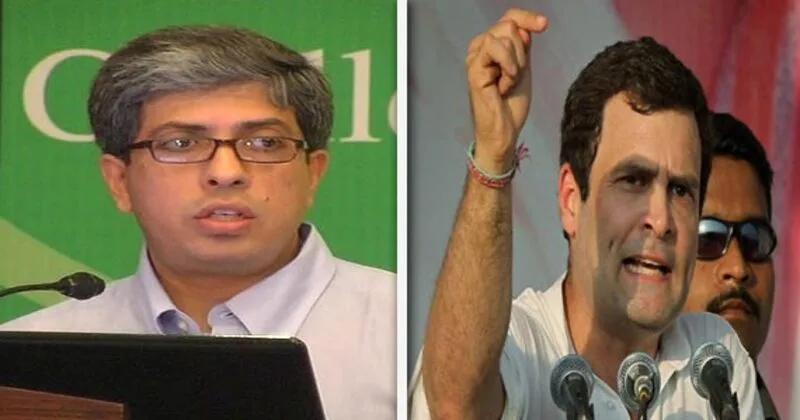
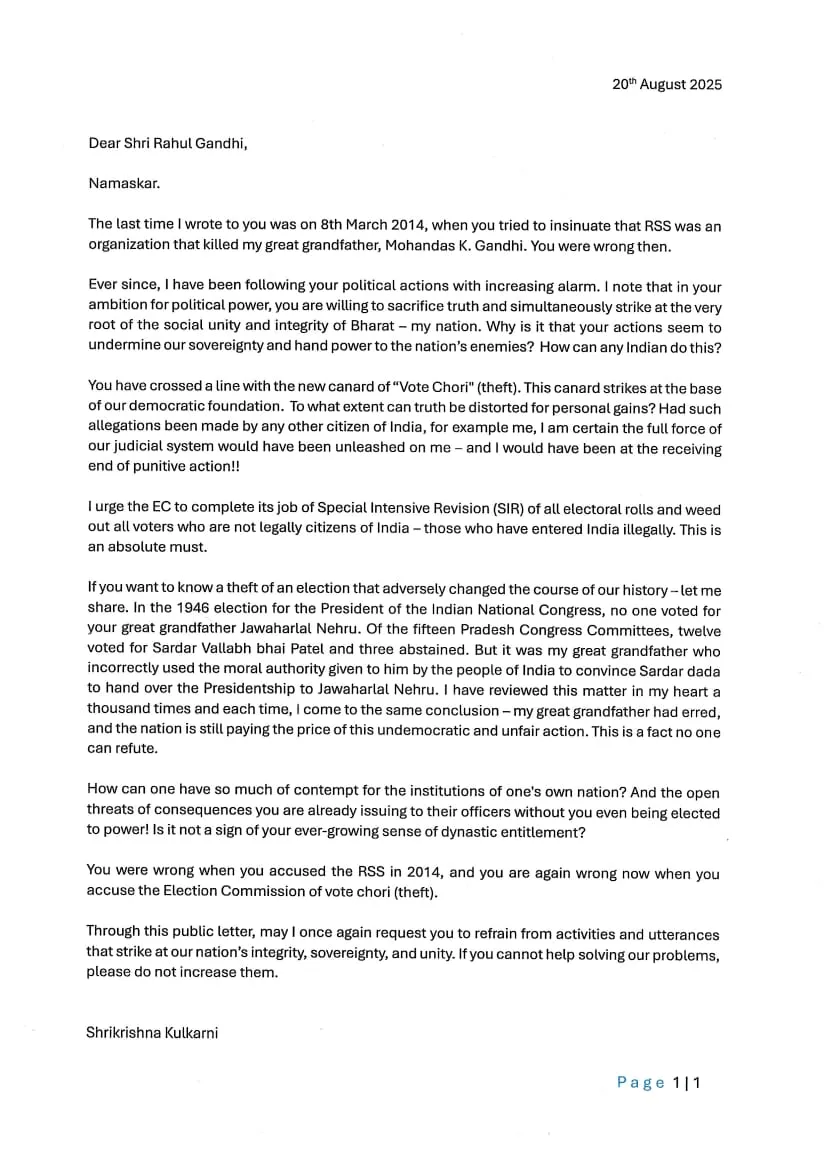
On 20th August 2025, Shrikrishna Kulkarni, great-grandson of Mahatma Gandhi, released an open letter addressed to Rahul Gandhi. Published on his social media account, this letter was not merely a personal communication but a piercing commentary on the Congress scion’s continued pattern of reckless political behaviour. The sharpest thrust in Kulkarni’s note comes in a single, unambiguous line:
“You were wrong when you accused the RSS in 2014, and you are again wrong now when you accuse the Election Commission of vote chori (theft).”
This statement deserves special attention, for it does not come from a swayamsevak or a political adversary, but from the very lineage of the Mahatma Gandhi himself. And yet, it vindicates what the Rashtriya Swayamsevak Sangh and millions of nationalist voices have been saying for decades—that the vilification of RSS is nothing but political propaganda, devoid of truth and designed to shield Congress’ own historical failures.
The RSS Bogey in Congress Politics
In 2014, Rahul Gandhi attempted to drag RSS into the assassination of Mahatma Gandhi—a slander that was legally challenged and morally indefensible. Courts have long acquitted the Sangh of any such involvement, and historians have exposed this falsehood. Yet, Congress leaders, incapable of fighting ideological battles on merit, resorted to demonising RSS as their perennial bogeyman.
Kulkarni’s reminder is thus significant. When even the descendant of Mahatma Gandhiji publicly declares that the Sangh had no hand in his great-grandfather’s killing, the Congress narrative collapses like a house of cards. The RSS, born in 1925 with the vision of national unity and Hindu renaissance, has withstood decades of slander while quietly working at the grassroots—building character, discipline, and service-mindedness in society. To accuse such an organisation of murder was not just historically false but also morally obscene.
From 2014 to 2025: Repeating Falsehoods
But Rahul Gandhi has not learned. If in 2014 it was the RSS, in 2025 it is the Election Commission. By alleging “vote chori,” he has once again targeted a foundational institution of Indian democracy, much like his attack on Sangh a decade ago. As Kulkarni rightly notes, such reckless statements erode public trust, sow discord, and embolden forces hostile to Bharat’s sovereignty.
This comparison between RSS in 2014 and EC in 2025 is revealing. It shows a mindset trained to delegitimise every institution that does not bend to dynastic whims. For Rahul Gandhi, when the people reject him, it is never self-introspection—it is always the fault of RSS, of EVMs, of EC, of judiciary, of media. In this ecosystem of blame-shifting, truth is the first casualty.
Historical Parallels of “Real Vote Theft”
Kulkarni’s letter also revisits the 1946 Congress presidential election, where 12 out of 15 Pradesh Congress Committees voted for Sardar Vallabhbhai Patel. Yet, by Gandhiji’s persuasion, Nehru was imposed as President. The result? Patel, the iron man who would have ensured national integration with a firmer hand, was sidelined, and Nehru’s flawed policies shaped independent India. If there was ever a “vote theft” in Indian history, it was this moment—when democratic will was sacrificed at the altar of dynastic preference.
How ironic, then, that the heir of that very dynasty now lectures India on electoral integrity.
RSS: Custodian of National Unity
By juxtaposing Rahul Gandhi’s false accusations with the historic truth of Congress’ own manipulations, Kulkarni indirectly highlights the contrast between two visions of India. On one side, a dynastic Congress that survives by discrediting institutions and inventing conspiracies. On the other, the RSS, which despite being vilified, has worked tirelessly to strengthen social cohesion, promote discipline, and nurture nationalism.
Even Mahatma Gandhi, despite his differences, recognised the patriotism of swayamsevaks. In 1934 at Wardha, when some tried to malign RSS, Gandhiji himself clarified: “I have visited the RSS camp. I was very impressed by their discipline, absence of untouchability, and the spirit of unity.” These words resonate today when Kulkarni reminds his readers that maligning the Sangh is not only wrong but dangerous to the fabric of national unity.
Time for Rahul Gandhi to Learn
Shrikrishna Kulkarni’s open letter is not just a rebuke but a mirror held up before Rahul Gandhi. The mirror shows a man who has inherited political entitlement but not the wisdom to safeguard national institutions. By wrongly accusing RSS in 2014 and the Election Commission in 2025, Rahul Gandhi has displayed a consistent pattern of undermining truth for political gain.
For the Congress, such politics may still appear as short-term strategy, but for Bharat, it is corrosive. Institutions survive on trust, and leaders who peddle lies corrode that trust. If the great-grandson of Mahatma Gandhi can stand up to say that enough is enough, perhaps it is time for Rahul Gandhi to stop repeating the very errors that have made his dynasty irrelevant.
The RSS will continue to serve Bharat silently and selflessly, as it has for the last hundred years. Whether dynasts learn from history or not, the Sangh’s work in nation-building will outlast all political propaganda.












Comments