





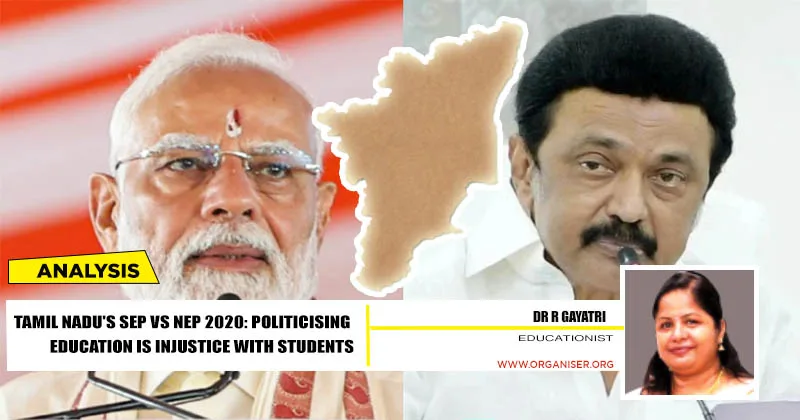
When Tamil Nadu released its State Education Policy (SEP) 2025, it did not merely present an academic framework; it made a political declaration. For decades, the State has stood firm on its two-language policy, refusing to embrace the Centre’s three-language formula under the National Education Policy (NEP) 2020.
Embrace European, Reject Bharatiya Bhasha
Rooted in the Dravidian movement’s resistance to Hindi imposition, the stance prioritises Tamil and English, rejecting the notion that a third Indian language is necessary for academic or professional success. Yet, in a curious twist, several minority schools and colleges in Tamil Nadu actively encourage — even insist upon — a third language. The catch? It is not Hindi but often a foreign language like French, German, or Japanese. The argument is that these languages carry economic and career advantages in a globalised market. This dual standard poses a tough question: if a third language is acceptable when European, why does it become objectionable when it is Indian?
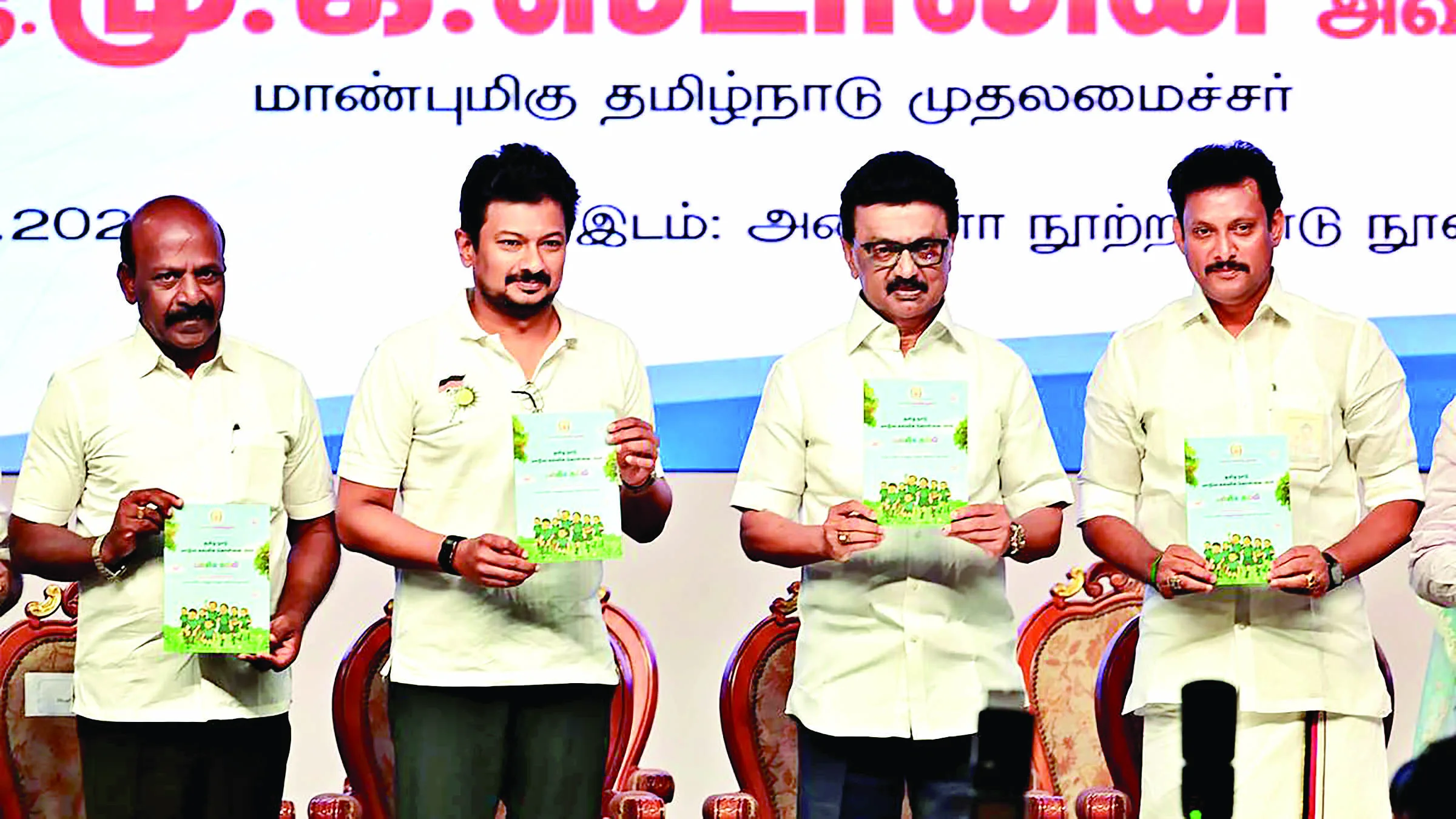
Protecting Tamil: Priority of DMK
For the State, language is not just a medium of communication; it is a symbol of identity, a protective wall against cultural dilution. As the Tamil proverb goes, “A river without boundaries will lose its way” — and in the eyes of policymakers, Tamil without protection risks being overshadowed. Or as Mahatma Gandhi once said, “A nation’s culture resides in the hearts and in the soul of its people.”
Shared Ground: NEP 2020 & SEP 2025
While the rhetoric makes them seem like polar opposites, a closer look reveals that NEP and SEP have significant overlap in vision. Both aim to make education more inclusive, child-centred, and future-ready — though their methods often differ.
Priority to Mother Tongue: NEP recommends teaching in the mother tongue up to Class 5, possibly extending to Class 8, and encouraging regional language use even at the university level. However, SEP goes further, making Tamil the first language from Anganwadi to the end of schooling, and encouraging its use in higher education. As UNESCO has repeatedly stated, “Mother tongue instruction is a key to quality education.”
Preventing Dropouts: NEP wants to know why students leave schools and bring them to Class 12. SEP focuses on career and professional guidance to retain students before they disengage.
Nutrition as Policy: NEP proposes mid-morning meals from Anganwadi to Class 5, with possible extension to Class 8. Tamil Nadu, with its midday meal programme, upgrades this to morning meals to tackle hunger and improve learning readiness.
Foundational Literacy and Numeracy: NEP aims to strengthen these skills via common exams for Classes 3, 5, and 8. SEP accepts there is a gap but avoids exam stress, preferring targeted teaching within a set timeframe.
Addressing Learning Gaps: NEP promotes after-school teaching by volunteers. SEP implements Illam Thedi Kalvi, where education is brought directly to children’s homes — a post-pandemic necessity.
From Rote to Creativity: NEP seeks innovative, creativity-driven teaching. SEP echoes this, adding financial literacy as an essential skill.
Cultural Education: NEP wants to instil culture, traditions, and values via arts and stories. SEP focuses on uniquely Tamil heritage and customs.
Technology in Learning: NEP advocates ICT-based, activity-led teaching. SEP builds SMART classrooms and introduces AI tools.
Assessment Reform: NEP replaces high-stakes testing with varied formats like open-book tests and practicals. SEP shifts from “valuation” to true “evaluation” along similar lines.
Teacher Upskilling: NEP mandates 50 hours of training per year. SEP insists on subject-specific training before each academic year.
Flexible Schooling: NEP proposes shared campuses from Anganwadi to Class 12. SEP works on infrastructure upgrades to support flexibility.
Model Schools for Excellence: Both encourage model schools, special coaching for competitive exams, and balanced emphasis on academics, sports, and arts.
Encouragement to Sports: NEP promotes sports activities; SEP ensures at least two hours per week are dedicated to them.
Library Use: NEP suggests book discussions. SEP adds visits to public libraries twice a year, preserving dedicated library hours.
Preserving Art Forms: NEP offers after-school art teaching. SEP brings the teaching into the school premises itself.
Focus on Hill Area Students: NEP hires local teachers for remote areas. SEP improves internet access to integrate these regions into mainstream education.
Vocational Education: NEP promotes bag-free weeks showcasing local industries. SEP ties vocational exposure directly to future employability and entrepreneurship.
Making Mathematics Engaging: Both policies promote maths labs and interactive teaching tools.
Strengthening School Governance: NEP and SEP both empower School Management Committees and PTAs to address student welfare.
Global Readiness: Both prepare students for competitive global scenarios, acknowledging rapid technological and social changes. As Nelson Mandela said, “Education is the most powerful weapon which you can use to change the world.”
Where the Paths Diverge
Despite common goals, NEP 2020 and SEP 2025 diverge in key areas — and these are not just bureaucratic tweaks, but ideological divides.
- Starting Age of Schooling – NEP starts Class 1 at age six. SEP starts at age five, favouring earlier formal learning.
- Language Formula – NEP enforces a three-language formula. SEP limits it to two, with a concession for minorities to study their mother tongue as a third language.
- Extent of Compulsory Education – NEP ensures schooling up to Class 12. SEP’s clarity fades beyond Class 8, with an “all pass” system up to that stage.
- Assessment Approach – NEP requires common exams in Classes 3, 5, and 8. SEP avoids these, sticking to internal assessments.
- Higher Secondary Structure – NEP introduces semesters from Classes 9–12 with wide subject choice. SEP maintains a regular pattern.
- Public Exams – NEP keeps only Class 12 as the senior school public exam. SEP retains both Class 10 and Class 12 board exams, scrapping the Class 11 public exam.
- Alternative Education Pathways – NEP offers bridges for alternative school students to enter higher education. SEP is silent on the matter.
- Higher Education Reforms – NEP envisions integrated PG programmes, a four-year B.Ed., and direct Ph.D. routes. SEP does not address these.
Identity Versus Integration
Education policy is more than curriculum design; it is a mirror of political philosophy. NEP 2020, while presented as flexible, represents a unified national framework. Tamil Nadu’s SEP 2025 asserts a regional-first stance, ensuring Tamil language and culture remain central. However, in this tug-of-war, students stand at the crossroads. Will a Tamil-first policy give them the tools to compete nationally and globally, or will it limit opportunities by narrowing exposure? As the saying goes, “Knowledge is like a tree — the deeper the roots, the wider the branches.” Tamil Nadu must ensure that in protecting its roots, it does not stunt the growth of its branches.
In a rapidly globalising world, education cannot thrive in isolation. NEP 2020, with its emphasis on flexibility, multilingual exposure, and integration of technology and vocational skills, offers students a wider playing field to compete both nationally and internationally
And perhaps it should remember the wisdom of Thiruvalluvar: “Learning is the true imperishable wealth; all other riches are not riches.”
Education Can’t Thrive in Isolation
Tamil Nadu’s SEP 2025 is undeniably rooted in cultural pride and social inclusivity, and these values are worth preserving. However, in a rapidly globalising world, education cannot thrive in isolation. NEP 2020, with its emphasis on flexibility, multilingual exposure, and integration of technology and vocational skills, offers students a wider playing field to compete both nationally and internationally.
Language preservation and cultural identity must go hand in hand with broad-based competence. A student who can think critically, communicate in multiple languages, adapt to diverse environments, and navigate global opportunities is better equipped for the future.
NEP’s three-language policy, multidisciplinary learning structure, and technology-driven pedagogy do not diminish regional heritage — they equip students to protect it while engaging with the wider world. If SEP and NEP could be harmonised — blending Tamil Nadu’s deep cultural commitment with NEP’s expansive vision — India’s students could stand taller on the global stage, with their roots firm in their heritage and their branches reaching confidently into the future.











Comments