





Deep ocean diving has long been considered one of humanity’s most difficult scientific challenges, a domain that lies at the very edge of exploration and endurance. The crushing pressures, near-freezing temperatures and complete darkness below 4,000 meters make the deep sea more harsh and tough than outer space. This harsh environment holds answers to some of the greatest mysteries from the origin of life to the vast reserves of untapped resources that can power future economies. For decades, nations such as the United States, France, Japan and Russia have led expeditions into the deep sea, setting benchmarks for endurance and engineering.
Over centuries, technological innovations transformed diving from a risky move into a scientific pursuit. The invention of diving bells during the Renaissance period, atmospheric diving suits and pressurized submersibles in the 20th century opened the door of new inventions in sea sector. The deepest known dive, Challenger Deep in the Mariana Trench was achieved in 1960 by the bathyscaphe Trieste. Since then advances in submersibles and robotic vehicles have enabled scientists to study minerals, unique life forms and tectonic activity on the seabed.
Bharat entered this demanding field later but steadily because our ancient knowledge related to sea is almost lost, so one cannot claim if there is knowledge left. Early efforts involved collaborations with established programs. Bharatiya scientists from CSIR-NIO dived aboard international submersibles: Alvin (USA) in 1997 descending near to 3,800 meters and Nautile (France) in 2002 diving to 2,800 meters. These experiences exposed Bharatiya researchers and scientists to high-end technologies and laid the foundation for indigenous ambitions.
Bharat’s Growing Deep-Sea Aspirations
Bharat has 11,098 kilometers of coastline and an Exclusive Economic Zone (EEZ) of over 2 million square kilometers. Bharat’s marine territory is vast and resource rich. The seabed holds polymetallic nodules with cobalt, nickel, copper and rare earths critical for renewable energy, electric mobility and advanced electronics. To access these Bharat signed contracts with the International Seabed Authority to explore and mine resources at depths of 4,000–5,500 meters in the Central Bharat Ocean Basin.
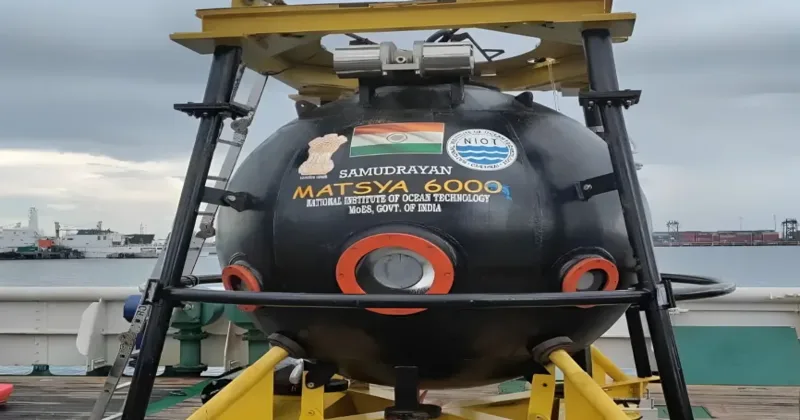
To realise this vision, the Government launched the Deep Ocean Mission an ambitious initiative whose centrepiece is Samudrayan, a program to send aquanauts in the indigenously built human submersible MATSYA-6000 to 6,000 meters by 2027. This mission seeks both, to harness marine resources and establish Bharat as a leader in ocean exploration.
2025 Breakthrough: Bharat Joins the Elite
On August 5 and 6, 2025, Bharat reached a milestone when aquanauts Raju Ramesh, Senior Scientist and Cdr. Jatinder Pal Singh (Retd.) completed dives to 4,025 meters and 5,002 meters in the Atlantic Ocean. This dive was conducted on IFREMER’s French submersible Nautile, these dives marked the first time Bharat ventured beyond 5,000 meters. They executed operational tasks over seven hours, including sample collection and manipulator interventions before returning safely. Union Minister Dr. Jitendra Singh hailed the event as historic, noting that Bharat had joined fewer than half a dozen nations capable of such feats. He also emphasized its symbolism, that just weeks earlier astronaut Shubhanshu Shukla had flown to the International Space Station which represents “Bharatiyas are now making trips to both the International Space Station and the deep ocean, we have demonstrated scientific ambition and move closer to a Viksit Bharat.”
MATSYA-6000 and its strategic significance
Lessons from the 2025 expeditions, directly supports the development of MATSYA-6000, a fourth-generation scientific submersible built by the National Institute of Ocean Technology (NIOT), Chennai. It is designed for 12 hours of operational endurance and 96 hours of emergency survival. It features high-density Li-Po batteries, acoustic telephones, drop-weight emergency systems and bio-vests for crew safety.
Between January to February 2025, MATSYA-6000 has completed wet trials at the L&T Shipyard, Tamil Nadu. Shallow-water trials up to 500 meters are set for 2026, with full integration and deep-water tests by mid-2027. Once operational, Bharat will become the sixth nation to develop its own human submersible.
These Strategic and Scientific advances carry enormous importance across sectors:
Resource Security: Securing access to strategic minerals important for clean energy and electronics.
Blue Economy: Supporting fisheries, biotechnology and coastal livelihoods.
Climate Studies: Forecasts of monsoons, cyclones and long-term climate shifts through ocean climate services.
Global Leadership: With Samudrayan mission, Bharat transitions from participant to leader, inviting global collaboration.
Ocean and Space are Bharat’s twin pillars of growth, as emphasized by Prime Minister Narendra Modi during his Independence Day addresses of 2021, 2023 and 2025. Together both of them form a roadmap for technological sovereignty and economic expansion.
The Lisbon expedition was a ground of learning, it was a training ground where NIOT’s crew gained hands-on expertise in piloting, buoyancy management, descent and ascent procedures, manipulator operations and emergency preparedness. These experiences are now shaping Bharat’s operational protocols.
The future of sea exploration outlines important milestone, which begins with the realization of the titanium hull and certification of essential subsystems, ensuring the submersible’s structural and its operational integrity. This will be followed by shallow-water demonstrations planned for 2026, which will serve as primary validations of its performance. Research vessels will be supported with Launch and Recovery Systems (LARS) to enable safe deployment and retrieval of the submersible.
MATSYA-6000 will undergo full-depth trials by 2027, marking a decisive step toward operational readiness. In year 2027–28 Bharat plans to conduct scientific expeditions to aim the exploration of deep-sea mineral resources and studying unique marine ecosystems.
Bharat and its Deep-Sea Future
The year 2025 has been more than technological achievement for Bharat. For centuries, ocean depths were the “final frontier” of human discovery. Today Bharat is breaking barriers by indigenous innovation and international collaborations, to unlock the mysteries of the deep.
By expanding its reach from space to the sea floor, Bharat is preparing for a better future of its individuals where oceans and technology forms the backbone of growth. The Samudrayan mission and MATSYA-6000 will ensure that coming decades will witness harvesting of resources as well as enriching global knowledge of ecosystems and climate. This is not just exploration it is about ensuring the blue frontier becomes a source of prosperity, resilience and leadership for generations to come.















Comments