





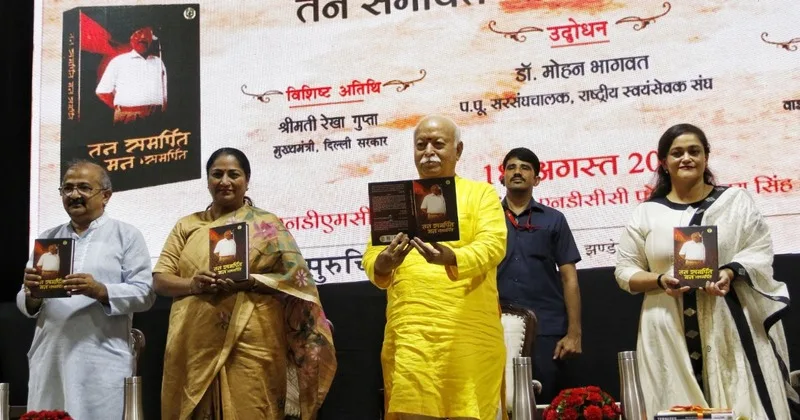
“Ideals are like stars, which we cannot reach, but we can find our path guided by their light. This is the beauty of ideals, and in our society, it is our good fortune that this tradition continues even today. However, when we look at the path illuminated by ideals, it is filled with challenges…Therefore, an ordinary person often lacks the courage to follow such a path. To walk it, they need someone relatable, a companion who is just a few steps ahead, holding their hand and guiding them,” said Rashtriya Swayamsewak Sangh Sarsanghchalak at the launch of book ‘Tan Samarpit Mann Samarpit’, based on the life of Late Shri Ramesh Prakash on August 18, 2025 at NDMC Convention Centre, New Delhi.
He further said that, “We talk about an ideal life, which involves fulfilling family responsibilities. A pracharak’s duty requires full dedication and speed. Normally, one must manage family and contribute to society, but time is limited. That’s why pracharak in the Sangh appear in the forefront, they invest extra time, while the entire sangh is maintained by those managing household and societal duties diligently behind the scenes.”
“In Nagpur, from 1945–1948 up to 1968, there were no full-time pracharak, 3–5 young pracharaks would regularly go out, traveling to distant regions, working in difficult conditions, dedicating their lives to the work. Some of them are still alive, some have passed away. Very few return after completing their work. How is this inspiration received? This inspiration is a way of life. Moreover, this way of life naturally seems life-like to others,” he further said.
Dr Mohan Bhagwat further said that, “The work of the Sangh is not just to think or talk; it is to act, to do, and to persevere. One must work hard to develop faith, and after developing faith, one must continuously strive to instil it in others. For a committed Sangh swayamsewak, the first mission of their life is this work of dedication and service”
“In 1942 and later, the British Government had their spies conduct detailed surveys of the Sangh. I came across the survey documents in our Vidarbha and Khandesh regions. Seeing how much information the spies had was truly astonishing. They had records of how many regular Sangh swayamsewaks were in a shakha, their names, and how many were full-time pracharaks. They even had data on the activities, who spoke, and what was said.”
“When we talk about change, how will this change reach people? For this, we will keep guiding, but not just through words. First, it will appear in the lives of swayamsewaks and be visible to others. It won’t be for show; it will exist in life, and thus be seen. Through friendships, they will then explain it. The ideas are good, accepted everywhere, people want to do it, but how? They will follow examples. This is how social change happens, knowledge alone doesn’t bring change. Change must come through action, which requires a change of mind,” he said.
On the women’s active participation in Sangh, he said, “In the implementation groups of the Sangh’s Karya vibhag, women have also joined. They are gradually becoming more involved…In all other activities carried for the welfare of society, men and women work together. Even in the core group, leadership roles are held by women,” he said.
Narrating an anecdote he said, “Once, in Jaipur, I was asked how many women are in the Sangh. I replied that at least, the number of women is equal to the number of our Swayamsevaks.”
Dr Bhagwat further reflected on Prakash Ji’s simplicity and selfless dedication, stressing that such personalities strengthen the moral fabric of society. Without desire for recognition or status, Ramesh Ji worked tirelessly for national welfare and inspired all.
“Shakha is not just limited to that one hour. Behind it, there are 23 hours of connection. One has to touch the lives of individuals, reach their minds, make them feel a sense of belonging. Ramesh Prakash has also worked here for Delhi, so many people here know him. The recently published book also contains detailed information about him,” he said.
“This book should be purchased and kept at home. All family members should read it. If our weekly family guidance meetings start with reading a small portion of such books, it will bring great benefits to our mindset, work style, and overall well-being. The book is beautifully designed and technically well-made,” he said.
A true karyakarta, he said, is not identified by titles, wealth, or public applause, but by inner discipline, humility, and constant dedication to the larger good. Such a person remains calm, ever ready to fulfill responsibilities, never desiring recognition, and always inspiring others through his conduct.
“Ramesh Ji embodied these very values. Among his greatest teachings was the conviction that service to the nation should not come at the cost of family duties. Within the framework of Grihastha Ashram, he demonstrated how a family can be nurtured with love and responsibility while extending the same sense of duty towards society and the nation. By harmonising personal obligations with public service, he proved that both are not separate but complementary”, Dr Bhagwat said.
Kali Purie, Vice-Chairpersonm India Today Group who was the Chief guest at the event said, “RSS lives by the principles of simplicity and discipline. Its long-term vision and planning are a lesson for all of us”
Kalli Purie further shared her personal experience of meeting Dr Mohan Bhagwat for the first time. She said that during that interaction, Dr Bhagwat answered all her questions with openness and encouraged discussion.
She further lauded the Panch Parivartan initiative by RSS, stressing that these five transformations are essential for the strength of any community. She also praised the remarkable work of RSS swayamsevaks during the natural disaster in Uttarakhand, noting their dedication and selfless service.
Kalli Puri noted that the books serves as a timely reminder of the importance of personal sacrifice in nation-building. She said the book portrays the untiring journey of Ramesh Prakash Ji, whose life was dedicated to selfless service, social upliftment, and national progress.
Delhi Chief Minister, Rekha Gupta while addressing lauded Ramesh ji’s contribution to public life and emphasised that his values will continue to guide generations in service to society.
“The speciality of the Sangh is that, on one hand, it embraces the youth, and on the other, it never forgets its veteran karyakartas,” said Asha Sharma, wife of Late Ramesh Prakash, at the book launch.
A large number of social workers and admirers, deeply influenced by Ramesh Ji’s simple, humble, and fully dedicated life, participated and paid heartfelt tribute to him. The event also saw the presence of scholars, litterateurs, journalists, researchers, and students in significant numbers.














Comments