





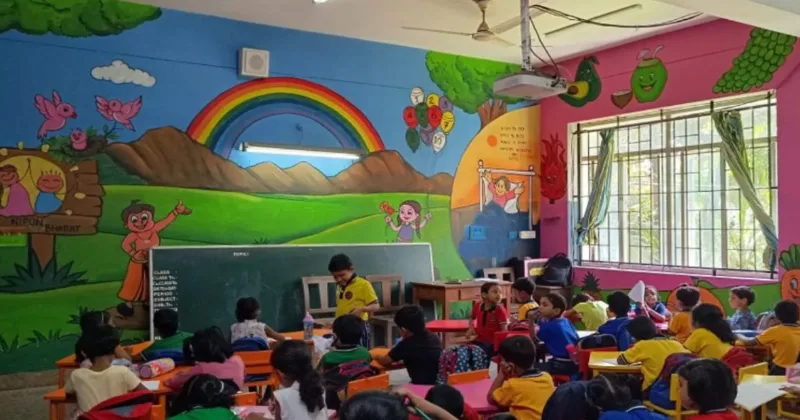
On the occasion of India’s 79th Independence Day, Uttar Pradesh witnesses a significant step in the field of education. Chief Minister Yogi Adityanath’s government formally launches Bal Vatika classes across the state. This has opened a new chapter in early childhood learning. A total of 5,118 Bal Vatikas have started functioning in government schools, providing a colorful and engaging environment for children aged between 3 to 6 years. “These Bal Vatikas offer children not just pre-primary education, but also access to nutrition, health check-ups, and a happy environment. This step builds the foundation for a confident new generation,” the Chief Minister said while addressing Independence Day celebrations.
The initiative comes in line with the National Education Policy (NEP) 2020, which states early childhood care and education are the cornerstone of lifelong learning. These Bal Vatikas will focus on preparing children for formal schooling not through rote learning, but through joyful, activity-based, and play-oriented methods.
Government schools in Uttar Pradesh, until now, admit children only from Class 1 onwards. However, research and experts put emphasis on the importance of nurturing children in their early years before exposing them to structured academics of Class 1. The Bal Vatika initiative addresses this gap. Children in the 3 to 6 years age group will attend classes that resemble pre-nursery and kindergarten setups. They will spend their time learning alphabets, numbers, colors, and rhymes while also engaging in games, stories, and group activities.
The classrooms will be decorated with colorful charts, toys, and play materials to make the environment lively. Teachers will adopt interactive methods so that learning feels natural and enjoyable rather than a burden for children. The aim is simple: by the time these children reach Class 1 at the age of six, they are already comfortable with the school culture.
The launch of Bal Vatikas also provides a constructive use for school buildings that remain vacant after the school merger exercise. With low-enrollment schools merged into nearby institutions, several buildings across the state had no students. Now, these empty campuses transform into early learning centers.
The scheme also works in close collaboration with the Women and Child Development Department (ICDS). Nearby Anganwadi centers merge into the school premises, ensuring children smoothly progress from community-based early care to school readiness programs.
The program focuses on three areas:
- Cognitive skills – basics of language, numbers, shapes, and colors.
- Social and emotional growth – sharing, teamwork, discipline, and self-expression.
- Physical development – yoga, games, and activities to boost health and motor skills.
Opposition’s Allegations and Government’s Stand
The initiative sparks political debate. The Samajwadi Party accuses the UP government of “closing schools in the name of merger” and questions whether rural students will benefit.
The Yogi government, however, dismisses these charges. Education Minister Sandeep Singh explains that merging happens only where student numbers are extremely low. “Every child is accommodated in nearby schools with proper staff. No school is closed; in fact, children get more resources. Vacant buildings are now centers of early childhood learning,” he clarifies in the Assembly.
The government insists that the program is about expansion, not reduction. This will bring younger children into the education system earlier and prepare them better for future learning.
In Line with NEP 2020
The National Education Policy 2020 lays strong emphasis on Early Childhood Care and Education (ECCE) and recommends integrating pre-primary education with the school system. Uttar Pradesh becomes one of the first large states to implement this vision at scale. By launching more than 5,000 Bal Vatikas in one go, the state takes a giant stride towards building a strong educational foundation.
















Comments