





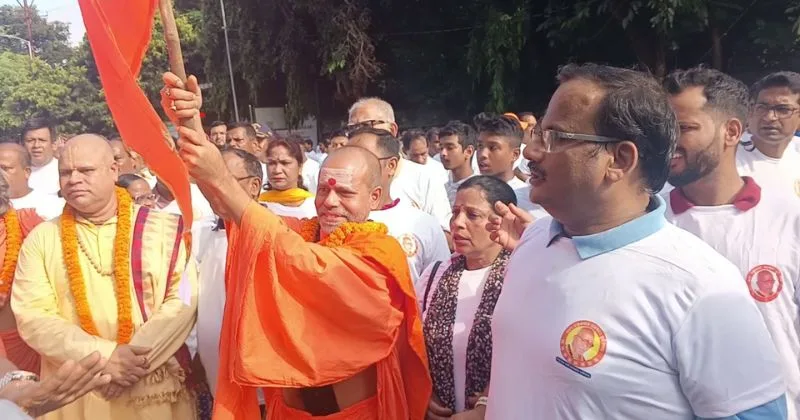
To mark the occasion of Janmashtami and observe the Balidan Divas of Swami Lakshmanananda Saraswati, a mini marathon was organized in Bhubaneswar, drawing a massive turnout of over 4,000 participants. The event, primarily involving youth from diverse backgrounds, was organized by the Swami Lakshmanananda Saraswati Smriti Trust.
The marathon commenced from the Exhibition Ground and passed through key city landmarks including Shriram Mandir, Shreya Chowk, Master Canteen, and Giridurga Temple, before concluding at the starting point. Before the run began, a solemn Sankalp Sabha was held where saints and spiritual leaders blessed the participants and invoked the spirit of Swamiji’s teachings.
A host of revered sadhus and spiritual luminaries graced the occasion, including Swami Shraddhanand Saraswati Maharaj, National Sah Sangathan Mantri of the Akhil Bharatiya Sant Samiti, and Mahant Ramakrishna Das Maharaj, Mahant of Radhaballav Math, Odisha. These dignitaries jointly flagged off the marathon, marking a spiritually significant start to the event.
Mansukhlal Sethia, Managing Trustee of the Swami Lakshmanananda Saraswati Smriti Nyas, along with heads of several religious and social organisations, also attended the program, expressing support and reverence for the legacy of the late Swamiji.
During the event, the Sadhus recounted the extraordinary life and contributions of Swami Lakshmanananda Saraswati. Born in 1924 in Odisha’s Angul district, Swamiji dedicated his life to the upliftment of tribal communities. After spending years in the Himalayas, he returned to Odisha in 1965 and became an unwavering voice against cow slaughter and forced religious conversions. He moved to Kandhamal district in 1968, where he worked tirelessly for over four decades to bring about social, religious, and economic reforms.
Swamiji’s contributions to education were particularly notable. He established residential schools, colleges, and hostels in Chakapada and Jaleshpata, and promoted spiritual upliftment through satsang centers in every village of Kandhamal. His efforts helped thousands of tribal people overcome addiction and gain valuable skills in agriculture, animal husbandry, and fruit cultivation.
An ardent advocate for the preservation of tribal culture, Swamiji was known for his firm stand against religious conversions allegedly carried out through coercive and deceptive means. This made him a target of hostility from certain quarters.
On Janmashtami, August 23, 2008, Swamiji was tragically assassinated in an attack at the Shankaracharya School in Jaleshpata. The incident also claimed the lives of Mata Bhaktamayi, Baba Amritananda, Kishore Baba, and Puranjan Ganti. Even after more than a decade, the masterminds behind the crime remain unpunished.
Mansukhlal Sethia stated that a series of commemorative events including seminars, health camps, and discussions are being held across Odisha in Swamiji’s memory. “His life’s mission was the upliftment of tribal society. Fulfilling that mission is the truest tribute we can offer him,” he said.Trustee Rupendra Kahanr was also in the dias.
The mini marathon served not only as a remembrance of Swamiji’s martyrdom but also as a reaffirmation of the values he stood for service, selflessness, and spiritual awakening















Comments