





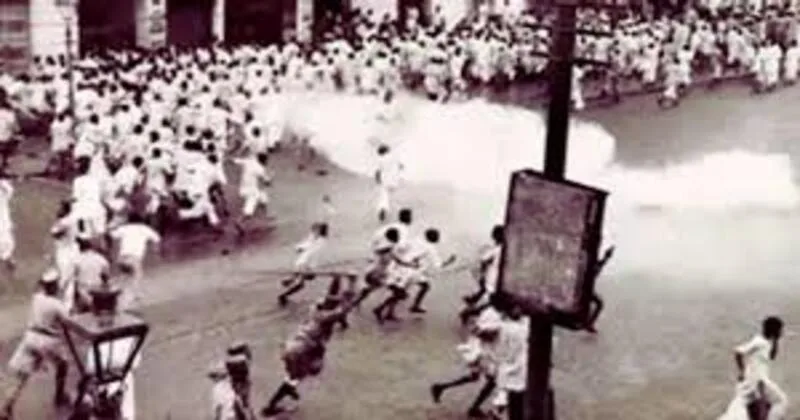
The seventy-eighth anniversary of Direct Action Day serves as a grim reminder of how quickly the flames of communal hatred can consume a civilization. On August 16th, 1946, what began as a political demonstration by the Muslim League transformed into one of the most horrific episodes of anti-Hindu violence in the subcontinent’s history. Today, as Hindus in Bangladesh face renewed persecution following Sheikh Hasina’s ouster, the echoes of that fateful day in Calcutta reverberate with disturbing clarity, revealing uncomfortable truths about the nature of Islamic communalism and the vulnerability of Hindu communities in Muslim-majority regions.
The premeditated massacre: deconstructing the “Direct Action”
The events of August 16th, 1946 were neither spontaneous nor accidental. Muhammad Ali Jinnah’s call for “Direct Action Day” was a calculated declaration of war against Hindu society, designed to demonstrate Muslim strength, terrorize the Hindus and threaten the latter to accept the demand for creation of ‘Pakistan’. The timing itself was symbolic – the 17th day of Ramzan, coinciding with the Battle of Badr, Islam’s first decisive victory over “heathens”. This was not merely political posturing but a deliberate invocation of Islamic conquest narratives.
The preparation for violence was meticulous. Chief Minister Huseyn Shaheed Suhrawardy, the “Butcher of Bengal,” declared August 16th as a public holiday in Bengal and ensured maximum Muslim participation in the public event, while paralyzing the law and order situation. Special petrol coupons were issued to Muslim League ministers for bomb-making, and one month’s food rations were stockpiled to sustain rioters. The Mayor of Calcutta, S.N. Usman, distributed leaflets in Bengali, declaring: “Kafer! Toder dhongsher aar deri nei! Sarbik hotyakando ghotbe!” (“Infidels! Your end is not far off! There will be a massacre!”).
At the massive rally in Calcutta Maidan, Suhrawardy assured the attendance of 100,000 Muslims and police and military was “restrained”, which was an open invitation to violence. The assembled mob, were armed with iron bars and lathis, included a significant number of goondas (hoodlums) who had been specifically mobilized for the occasion. When the rally ended, these organized gangs immediately dispersed to Hindu areas, initiating what would become known as the “Great Calcutta Killings”.
The Hindu holocaust: Systematic extermination and brutalization
What unfolded over the next 72 hours represented the darkest manifestation of Islamic jihad in modern India. The violence was not random rioting but systematic extermination designed to terrorize the Hindu population. Hindu shops were specifically targeted first, forcing closures and creating immediate economic disruption. The attacks then escalated to residential areas, with entire Hindu neighborhoods like Amherst Street, Bortola, and Jorasanko set ablaze. The scale of brutality defied human comprehension. Conservative estimates put the death toll at 4,000, though many sources suggest figures closer to 10,000. Over 100,000 Hindus were rendered homeless within three days. The violence was characterized by unprecedented sadism. Hindu women were gang-raped in front of their families before being murdered, children were butchered and bodies were mutilated beyond recognition. Eye-witness Philip Talbot described the horrific scenes-“bodies grotesquely bloated in the tropical heat, slashed bodies, bodies bludgeoned to death, bodies piled on push carts, bodies caught in drains, bodies stacked high in vacant lots”.
The targets were not merely communal but they were civilizational targets. Hindu temples were desecrated and destroyed, religious symbols defiled and sacred texts burned. The attackers deliberately sought to erase the Hindu presence from Calcutta, considering the city as the future capital of East Pakistan. This was ethnic cleansing in its purest form-the systematic attempt to eliminate an entire community from its ancestral homeland.
The Hindu awakening: Gopal Patha and the fight back
While secular historians have consistently downplayed the Hindu resistance, the fight back led by Gopal Chandra Mukhopadhyay (Gopal Patha) represents one of the most remarkable examples of the Hindu valor in modern times. A follower of Netaji Subhash Chandra Bose and leader of the ‘Bharatiya Jatiya Bahini’ with 700-800 members, Gopal Patha’s journey transformed from a local wrestler and mutton shop owner into the savior of Calcutta’s Hindu population. Understanding that organized violence required an organized response, Gopal Patha mobilized Hindu youth from all sections of society-migrant laborers, milkmen, blacksmiths and Marwari traders who provided financial support. Using arms procured from American soldiers during World War II and weapons gathered during the Quit India Movement, his forces launched a systematic counter-offensive on August 18th. The strategy was clear: secure Hindu-majority areas first and then take the fight to Muslim territories.
The resistance anchored by Hindus was devastating in its effectiveness. Within three days, Muslim casualties began to exceed Hindu deaths, forcing a humiliated Suhrawardy to send emissaries begging Gopal Patha to cease operations. The Muslim League’s carefully planned genocide was thwarted by the courage of one man and his dedicated followers. By August 21, Suhrawardy’s government was dismissed, and the immediate threat to Calcutta’s Hindu population was neutralized.
Gopal Patha’s significance extends beyond military success. He demonstrated that when Hindus organize and fight back with determination, even the most vicious Islamic onslaught can be defeated. His example provides a template for Hindu resistance that remains relevant today, particularly as Hindu communities face renewed atrocities in Bangladesh.
The ideological architects: Suhrawardy’s role and Muslim League strategy
The role of Huseyn Shaheed Suhrawardy in orchestrating the Direct Action Day massacre cannot be understated. As Chief Minister of Bengal holding both Home and Information portfolios, Suhrawardy possessed complete control over law enforcement and media narratives. His deliberate instructions to police to remain inactive during the violence constituted active collaboration in genocide. Intelligence reports documented his presence in police control rooms throughout the riots, directing operations to maximize Hindu casualties while protecting Muslim attackers. Suhrawardy’s post-riot statements revealed the calculated nature of Muslim League strategy. He openly boasted that Direct Action Day would demonstrate how impossible British plans to make “Mr. Nehru rule Bengal” were. The massacre was designed to create facts on the ground that would make Hindu-Muslim coexistence untenable, thereby justifying Partition. This represented the practical application of the Two-Nation Theory – the presence of such deep communal hatred stated that separation was inevitable.
The international dimensions of Muslim League planning are evident in the coordinated nature of attacks across Bengal. The violence was not confined to Calcutta but spread systematically to rural areas where Hindus were even more vulnerable. The Noakhali genocide that followed in October 1946, demonstrated the same organizational capacity and ideological motivation. This pattern of coordinated attacks across multiple locations indicates that without central planning and resource allocation from the highest levels of Muslim League leadership, such atrocities was not possible.
Contemporary echoes: Bangladesh and the continuing Hindu persecution
The persecution of Hindus in Bangladesh following Sheikh Hasina’s departure in August 2024 represents a direct continuation of the communal hatred unleashed on Direct Action Day. Within weeks of Hasina’s resignation, over 2,000 incidents of anti-Hindu violence occurred, including attacks on 152 temples and the killing of 23 Hindus. The pattern mirrors 1946 exactly – organized mobs targeting Hindu homes, businesses, and places of worship while authorities remain passive. The demographic transformation of Bangladesh tells the complete story of this persecution. From comprising 28% of the population in 1940, Hindus now constitute barely 7.5% – a decline of over 7.5 million people in absolute terms despite overall population growth. This represents one of the most successful instances of demographic engineering in modern history, achieved through systematic persecution, forced conversion, and migration.
Recent attacks follow the same template established in 1946. Hindu properties are specifically targeted during periods of political instability, with attackers using religious slogans and invoking Pakistan’s creation as justification. The 2021 Durga Puja attacks, the 2013 Jamaat violence following war crimes verdicts, and the 2024 post-Hasina violence all demonstrate identical patterns of organization and execution. Social media has merely accelerated the process, allowing false accusations against Hindus to spread rapidly and trigger further coordinated attacks. The response of international “secular” opinion to Hindu persecution remains as inadequate today as it was in 1946. Western governments and human rights organizations consistently downplay anti-Hindu violence. This selective outrage enables continued persecution by removing international pressure for accountability. Veer Savarkar’s prescient warnings about Muslim League intentions have gained renewed relevance in light of Bangladesh’s deteriorating situation. Savarkar had argued that Congress’s appeasement policies would ultimately lead to Hindu genocide, a prediction that tragically vindicated by subsequent events.
The Forgotten Lessons: Political and Social Implications
The most critical lesson of Direct Action Day remains largely unlearnt – that Islamic communalism operates according to specific theological and political imperatives that make coexistence difficult without Hindu vigilance and strength. The secular establishment’s continued denial of these realities ensures that Hindu communities remain vulnerable to repeated attacks. The refusal to acknowledge the religious motivations behind anti-Hindu violence perpetuates the cycle by preventing effective counter-measures. The international dimension of Hindu persecution also remains inadequately addressed. The same ideological networks that supported Jinnah’s Pakistan movement continue operating even today through organizations like Jamaat-e-Islami.
The anniversary of Direct Action Day must serve not merely as remembrance but as warning. The ideological forces that produced August 16th, 1946 remains active and potent even for this day. Only through honest acknowledgment of these realities, coupled with determined preparation to thwart their recurrence, can Hindu communities hope to avoid repeating the tragedies of the past. The choice between vigilant resistance and helpless victimhood remains as stark today, as it was seventy-eight years ago in the burning streets of Calcutta.















Comments