





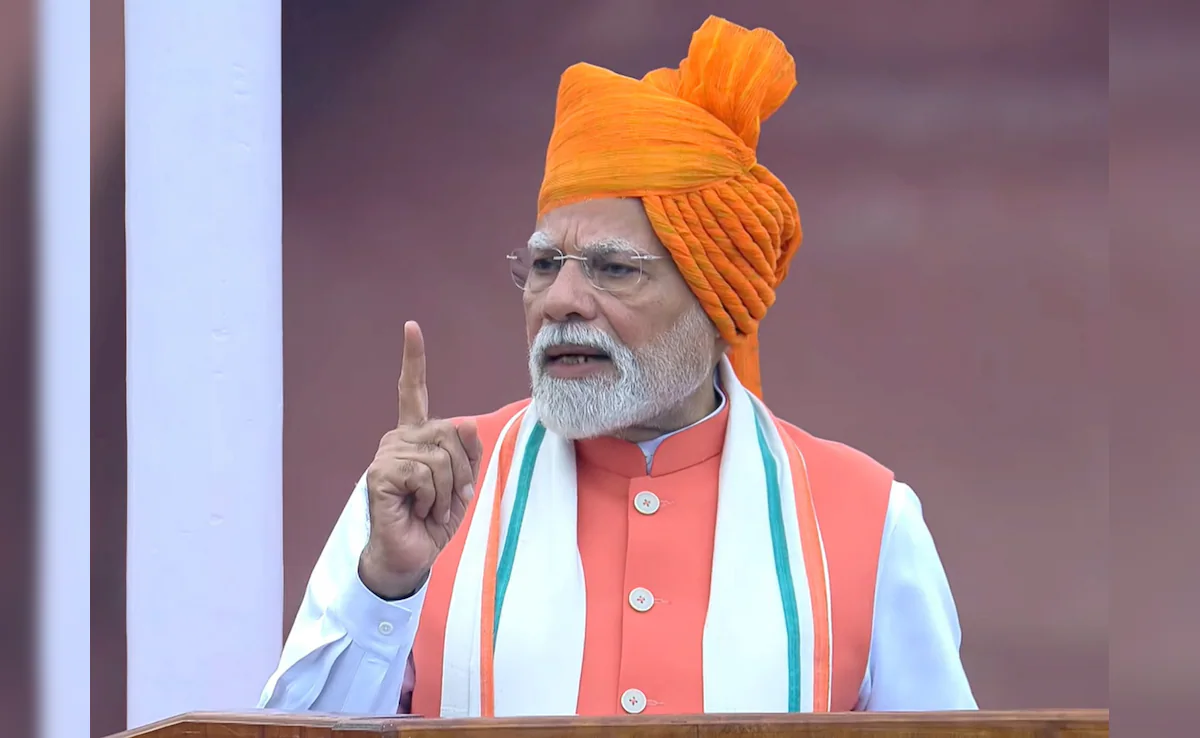
On August 15, 2025, PM Modi minced no words when he cautioned against a “well-planned conspiracy” to alter India’s population composition.
His statement was emphatic: “Under a well-thought-out conspiracy, the country’s demography is being changed, and the seeds of a new crisis are being sown. Infiltrators are snatching away the livelihood of our youth, targeting the sisters and daughters of our country, misleading innocent tribals, and capturing their land. This will not be tolerated.”
By linking demographic change with infiltration, PM Modi noted that this is not merely a social issue but a security threat. The High-Power Demography Mission aims to track, analyse, and act upon these shifts, especially in border regions where illegal immigration and religious conversions are driving rapid change.
His announcement has reignited a debate: Which states are experiencing the sharpest demographic shifts, what drives these changes, and what does this mean for India’s future?
This report is an attempt to find answers to these questions.
What do census numbers reveal about demography?
The last official religion-wise census data (2001-2011) reveals a clear demographic trend. The Hindu population declined from 80.46 percent to 79.8 percent, while the Muslim population rose from 13.43 percent to 14.23 percent. Christians registered a marginal rise, particularly in the Northeastern states.
A study by Professor Shamika Ravi and other economists published in Economic and Political Weekly further highlighted the scale of this change: the Hindu population declined in 468 out of 640 districts, accounting for 70 percent of all districts, while the Muslim population increased in 513 districts and the Christian share rose in 439 districts.
Notably, the Muslim growth rate stood at 24.6 percent, significantly higher than the national average growth of 17.7 percent, whereas the Hindu growth rate lagged behind. Importantly, this trend is not uniform across the country, district-level variations reveal that certain pockets are witnessing rapid demographic transformation, a matter that has begun to alarm policymakers.
Which states face the sharpest demographic changes?
Assam: The epicentre of infiltration
Assam has emerged as the ground zero of demographic change in India. Its porous border with Bangladesh has facilitated illegal infiltration, dramatically reshaping districts such as Dhubri, Barpeta, and Goalpara. In 2001, Muslims constituted 30.9 percent of Assam’s population, which rose to 34 percent by 2011. Dhubri district, in particular, has become overwhelmingly Muslim-majority. The National Register of Citizens (NRC) exercise in 2019 excluded 1.9 million people, highlighting concerns over illegal migration. Indigenous Assamese communities fear losing both land and cultural identity, and incidents such as temple desecrations, clashes, and encroachment of tribal lands have deepened mistrust and tension in the region.
Kerala: Fertility and religious shifts
Kerala has experienced notable shifts in religious demographics driven largely by differential fertility rates rather than migration. According to a 2021 report by the Centre for Policy Studies (CPS), Muslims overtook Hindus in live births after 2015. By 2019, Muslims accounted for 44 percent of live births while Hindus had 41 percent. Between 2008 and 2019, the Muslim share in births increased from 36.3 percent to 44.4 percent, while the Hindu share declined from 45 percent to 41 percent, and the Christian share dropped from 17.6 percent to 14.3 percent. These figures indicate that natural growth is a key driver of demographic change in Kerala, shaping long-term population patterns.
West Bengal: Silent demographic transformation
In West Bengal, districts such as Murshidabad, Malda, Uttar Dinajpur, and North and South 24 Parganas have witnessed significant demographic shifts, with Muslims now forming the majority in several areas. Analysts attribute part of this change to the Trinamool Congress’s political patronage, which has allowed illegal migrants to settle relatively freely. In Malda and Murshidabad, the Hindu population share has dropped by more than one percent over a decade, exceeding the national average decline. These demographic changes have increasingly influenced political outcomes in border districts, tilting the balance in favour of Muslim consolidation.
The Northeast: Christian missionary influence
In the Northeastern states of Nagaland, Mizoram, and Meghalaya, the Christian population surged by 50 percent in many districts between 2001 and 2011. This growth has been driven primarily by missionary activities targeting tribal communities. Missionaries have employed financial incentives, access to education, and healthcare benefits to encourage conversions, reshaping entire tribal belts and contributing to a significant demographic transformation in the region.
Uttar Pradesh and Bihar: Growing Muslim concentration
Western Uttar Pradesh districts such as Sambhal and Meerut have seen a rising Muslim population, altering local social dynamics. In some localities, Hindu temples stand abandoned as communities migrate out of Muslim-majority areas. Bihar also shows districts along the Indo-Nepal border where the Muslim share has increased disproportionately, raising concerns about the exploitation of porous borders and the potential impact on regional stability.
Maharashtra, Karnataka, and Kerala’s coastal belt
The Malabar region of Kerala, coastal districts of Karnataka, and central districts of Maharashtra have all recorded sharp growth in Muslim populations. According to research published in Economic and Political Weekly, in several areas, the decline of the Hindu population is far steeper than the national average. These shifts highlight the uneven nature of demographic change across states, reflecting the combined effects of differential fertility, migration, and localised religious conversions.
How do illegal immigration and religious conversions accelerate the shift?
Illegal Immigration:
- Bangladeshi and Rohingya migrants have expanded from Assam and West Bengal to Delhi, Tripura, Jammu, and Kerala.
- Fake documents such as Aadhaar and ration cards help them integrate into local populations.
- While many take up menial jobs, intelligence reports link some groups to smuggling, crime, and radical networks.
Religious Conversions:
- Christian missionaries in the Northeast and tribal belts of Chhattisgarh, Odisha, and Jharkhand use financial and social inducements to convert locals.
- Islamic conversion rackets, often backed by foreign funding, are regularly uncovered.
- Cases like Chhangur Peer Jamaluddin’s network highlight the role of illegal funding in driving mass conversions.
Why are these changes seen as a threat to national security?
PM Modi emphasised that border demography is directly linked with national security. The logic is simple:
- Demographic change in border states like Assam, Bengal, Tripura, and J&K creates fertile ground for separatism, radicalism, and infiltration networks.
- Areas with heavy Muslim dominance have witnessed incidents of temple desecration, mob violence, and anti-Hindu riots.
- Clashes during Ram Navami, Hanuman Jayanti, or even India’s cricket victories highlight how demographic consolidation changes social dynamics.
What does history teach about demography and division?
The Prime Minister’s concerns resonate strongly with India’s historical experience. Before Partition, Muslim-majority areas in Bengal and Punjab became epicentres of separatist politics, as the Muslim League strategically exploited demographic concentrations to further its agenda, ultimately contributing to the creation of Pakistan.
One stark example was Direct Action Day in 1946, when demography-driven politics triggered one of the bloodiest communal massacres in Indian history. Earlier, British policies such as the 1909 Morley-Minto Reforms, which granted Muslims separate electorates, had already deepened communal fault lines and institutionalised divisions.
History demonstrates that demography often dictates political outcomes, and when Hindus become a minority, secularism weakens and separatist tendencies rise, leaving long-term implications for national unity and stability.
How do current demographic trends affect politics?
Demography is not merely a matter of numbers; it fundamentally reshapes the electoral landscape. Consolidation of Muslim populations has created pocket boroughs where Hindu votes are diluted, influencing local political outcomes. Political parties such as the Trinamool Congress (TMC) and Rashtriya Janata Dal (RJD) have often been accused of appeasing Muslim communities to secure electoral gains. Even in Kerala, demographic shifts have begun to impact education policies, mosque construction, and voting behaviour, reflecting how population patterns shape governance.
Recent studies highlight the long-term implications of these trends. The 2024 Economic Advisory Council to the Prime Minister (EAC-PM) report showed that the Hindu share of India’s population fell from 84 percent in 1950 to 78 percent in 2015, while the Muslim share rose from 9.84 percent to 14.09 percent. The Centre for Policy Studies (CPS) Kerala study revealed that Muslim fertility rates have consistently outpaced those of Hindus.
Meanwhile, research published in Economic and Political Weekly indicated that over 70 percent of districts recorded a decline in Hindu populations between 2001 and 2011. Taken together, these studies reveal a consistent pattern over decades: a decline in Hindu population share alongside rising Muslim and Christian populations.
Why is the issue linked to religious identity and security?
Demographic dominance often translates into the assertion of religious superiority, manifesting in actions such as blocking Hindu festivals, engaging in mob violence, and vandalising temples. It also creates informal no-go zones where Hindus fear celebrating their traditions openly. Cross-border linkages further exacerbate the situation, as illegal migrants maintain ties with Bangladesh or Myanmar, facilitating smuggling and the spread of radical ideologies.
Examples from Assam, Sambhal in Uttar Pradesh, and districts in West Bengal illustrate how demographic consolidation can embolden Islamist networks, affecting social cohesion, local governance, and the safety of minority communities.
Why is PM Modi’s warning timely?
India celebrates 79 years of independence, yet the scars of Partition remain painfully vivid. The creation of Pakistan and Bangladesh on religious lines serves as a stark reminder of the consequences of demographic and political divisions. While both countries have struggled with state-building and governance, India has succeeded in maintaining stability and secularism, largely due to its Hindu majority, which has historically underpinned the nation’s social and cultural fabric. As Prime Minister Modi emphasised, demography is destiny, and if demographic trends are left unchecked, India risks repeating the mistakes of the past.
The Prime Minister’s announcement of a High-Power Demography Mission shows that the challenge extends far beyond census figures. It is fundamentally about safeguarding India’s national security, cultural identity, and territorial integrity.
From Assam, where tribal lands have been encroached upon by infiltrators, to Kerala, where fertility imbalances are shifting population patterns, and from Bengal’s porous borders to the Northeast’s missionary-driven conversions, the evidence of demographic change is consistent and pervasive.
Available data highlights a clear trend: the Hindu population is declining, while Muslim and other populations are rising. The pressing question now is whether India will act decisively to preserve its demographic stability or allow history to repeat itself.
Ultimately, as history has repeatedly demonstrated, demography is indeed destiny.














Comments