





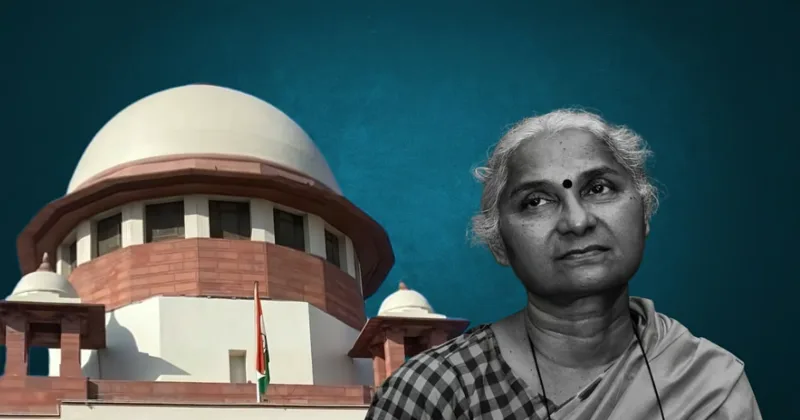
A 24-year-old defamation case has resurfaced in the spotlight, not only for its outcome but for the questions it raises about judicial consistency and the influence of ideological leanings in India’s highest court.
On 11 August 2025, the Supreme Court of India upheld the conviction of activist Medha Patkar under Section 500 of the Indian Penal Code for criminal defamation, but significantly reduced the punitive consequences. While the bench of Justice MM Sundresh and Justice N. Kotiswar Singh retained the finding of guilt, it removed the Rs 1 lakh fine and probationary conditions, allowing her to walk free on a personal bond.
From Email to Apex Court — The Legal Journey
The dispute originated in 2000, when Patkar emailed a press note to journalist Dileep Gohil accusing VK Saxena, then head of the Ahmedabad-based National Council for Civil Liberties and a supporter of Gujarat’s Sardar Sarovar Dam project, of hawala dealings and questioning his patriotism. Gohil published the note in Gujarati, prompting Saxena to file a criminal defamation complaint.
In July 2024, Delhi’s Saket Court convicted Patkar, sentencing her to five months’ simple imprisonment and a ₹10 lakh fine, noting the allegations were “baseless” and aimed at damaging Saxena’s reputation.
On appeal, the Sessions Court (April 2024) upheld the conviction but reduced the fine to Rs 1 lakh and released her on a Rs 25,000 probation bond.
The Delhi High Court (July 2024) sustained this order, modifying only the appearance requirements.
Finally, the Supreme Court’s August 2025 order eliminated even the reduced fine and probation terms.
The Equality Question
Here lies the controversy: if the offense was proven beyond reasonable doubt, why dilute the penalty? Does citing Patkar’s age (70) and record as a “social worker” align with the Article 14 guarantee of equality before the law?
The court’s reasoning contrasts with its own precedent in Subramanian Swamy v. Union of India (2016), where it upheld criminal defamation laws, affirming that reputation is intrinsic to the right to life under Article 21. In that judgment, the deterrent effect of punishment was considered vital.
Would an ordinary citizen—without a celebrated activist’s profile—receive such relief? Or is this selective compassion?
Beyond Defamation: Financial and Legal Controversies
Patkar’s legal troubles are not confined to defamation. She faces:
- NGO Fund Misappropriation Case (Barwani, MP — July 2022): Alleged diversion of ₹13–14 crore meant for tribal education and rehabilitation under the “Narmada Nav Nirman Abhiyan” to political campaigns, booked under Sections 420 and 406 IPC.
- Money Laundering Probe (ED — April 2022): Registered under PMLA for alleged irregularities in foreign and domestic donations, suspicious large transactions, and fund diversion.
Patkar calls these politically motivated. Yet, the existence of multiple serious pending cases complicates the public perception of her as a “social crusader.”
An Ideological Backdrop
The Patkar–Saxena clash is rooted in the decades-long Sardar Sarovar Dam debate. Saxena and then Chief Minister Narendra Modi backed the project for its irrigation and power benefits. Patkar’s Narmada Bachao Andolan, often accused by critics of being influenced by foreign interests, opposed it on grounds of displacement and environmental harm.
The 2000 press note that sparked the defamation suit was an extension of this political and ideological battle.
Judicial Contrasts
The relief granted to Patkar contrasts with earlier rulings:
- Bal Thackeray v. Harish Pimpalkhute (2005): The Supreme Court refused to quash a defamation case despite political stature.
- M.S. Jayaraj v. Commissioner of Excise (2000): Even indirect remarks harming character warranted legal action.
In both, the Court maintained a strict stance. In Patkar’s case, the reduced sentence risks eroding the deterrence principle.
The Peril of Perceived Bias
Justice must be impartial—and be seen as impartial. When leniency coincides with a litigant’s political or ideological identity, public confidence in the judiciary suffers.
Key questions emerge:
- Should political activism grant immunity from full punishment?
- Can age and “public service” outweigh proven malice?
- Does this set a precedent for ideology-based sentencing relief?
By upholding the conviction, the Court safeguarded legal principle. By diluting the punishment, it risked diluting public faith in equal justice.
In a democracy, the danger lies not only in bias but in the appearance of bias. The Patkar verdict may be remembered less for its affirmation of defamation law and more for the shadow it casts on the scales of justice.
















Comments