





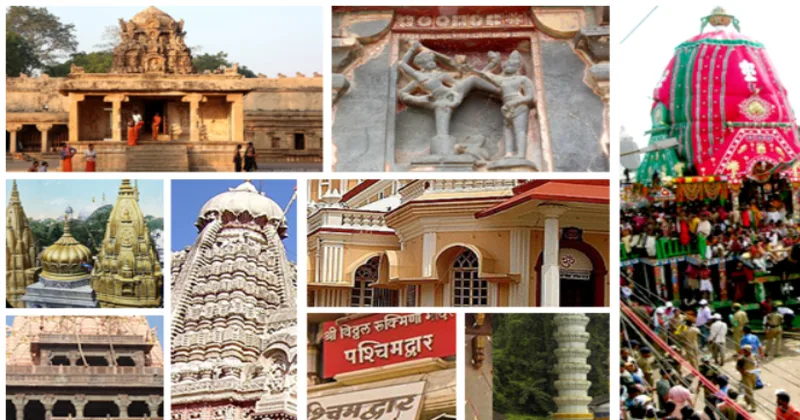
India’s struggle for independence was not confined to the battlefield or political arenas alone. It was a nationwide movement, deeply rooted in the heart of every Indian. The inspiration and strategies for this monumental struggle were often drawn from the nation’s rich cultural and spiritual heritage. The spirit of resistance was nurtured not only in the hallowed halls of political discourse but also within the sacred precincts of our temples.
These temples, which stood as symbols of India’s enduring civilisation and cultural pride, served as clandestine meeting points, centers for planning and organising, and sources of immense inspiration. The valor and sacrifices of our heroes and the meticulous plans they forged, drawing strength from these very places, are what we celebrate today as India commemorates its 79th Independence Day on August 15, 2025. This day reminds us that the fight for freedom was a holistic movement, encompassing every facet of Indian life and identity.
This report is based on a comprehensive list of the top 15 temples that played a significant role in India’s freedom struggle, spanning the period from the Revolt of 1857 to 1947.
Augharnath Mandir: The spark for the 1857 mutiny
On May 10, 1857, the Augharnath Shiva Temple in Meerut, Uttar Pradesh, became the epicenter of a historic uprising. The temple was a popular gathering place for soldiers of the British Army. A key grievance that fueled the rebellion was the use of cartridges greased with animal fat, which went against the religious beliefs of both Hindu and Islamic soldiers. When the temple priest refused to allow the soldiers inside due to this perceived religious impurity, the soldiers were enraged. This rejection, along with the deep-seated resentment over the greased cartridges, led them to sound the bugle of the 1857 Mutiny right there at the Augharnath Temple, marking the beginning of India’s First War of Independence.
Sarasbagh Mandir: A secret headquarters for Maratha warriors
During the 18th and 19th centuries, the Sarasbagh Temple in Pune, Maharashtra, served as a crucial secret meeting place for Maratha warriors. Built by Nanasaheb Peshwa between 1750 and 1784, the temple was strategically located on an island in the middle of a lake. This unique location made it an ideal and secure site for planning military strategies against British colonialists and the Nizams. To ensure complete secrecy, Maratha leaders like Shrimant Peshwa, Mahadji Shinde, and Nana Fadnavis would arrive at the temple in boats rowed by deaf and mute African oarsmen, who were unable to understand or leak the sensitive discussions. This practice of using the Sarasbagh Temple as a command center for physical planning and discussions highlights its vital role as a hub of resistance.
Tarkulha Devi Mandir: A symbol of sacrifice in the 1857 Mutiny
The history of the Tarkulha Devi Temple located near Chauri Chaura in Gorakhpur, Uttar Pradesh, is closely tied to the martyrs of the 1857 Mutiny. The temple was the cherished shrine of Senani Baba Bandhu Singh, son of Babu Shiv Prasad Singh of Dumri Riyasat. Tarkulaha Devi was the Ishta Devi of Babu Bandhu Singh, a guerrilla warrior who fought against the British. Whenever he came across a British soldier in the jungle, he would kill the soldier, cut off their head, and offer it at the feet of his goddess.
On August 12, 1857, Baba Bandhu Singh was publicly sentenced to be hanged by the British in the Alinagar Chauraha of Gorakhpur. The British made seven attempts to hang him, but each time, the rope broke. It was only when Baba Bandhu Singh himself prayed to his goddess and asked for her permission to be hanged that he was finally martyred. The Tarkulha Devi Temple and his story of sacrifice remain an integral part of the local lore, symbolising the deep-seated spiritual and nationalistic fervour of the mutiny.
Tamoli Mandir: The launchpad for the Quit India Movement
On August 13, 1942, the Tamoli Mandir in Tirwa area of Kannauj, Uttar Pradesh, became a focal point for the Quit India Movement and the “Do or Die” call to action. In defiance of Section 144, which the British had imposed to prevent revolutionary gatherings, freedom fighters from surrounding districts met at the Tamoli Mandir.
During the gathering, a Police Inspector Khwaja Mahfuzur Rahman and Constable Bhikham Singh arrived at the temple to disperse the crowd. The freedom fighters challenged the police, urging them to quit their posts and join the fight for independence. This led to a heated confrontation, during which the freedom fighters tore their uniforms and snatched revolver from the police officers. It was from this very temple that the bugle for the “Quit India” and “Do or Die” movements was sounded, inspiring a new wave of resistance across the region.
Nagla Mandir: A strategy against the British
During the freedom movement, the Nagla Mandir situated at Purab Nagla Sharki village near Badaun, Uttar Pradesh, served as a covert center for revolutionaries. To ensure that their meetings remained a secret from the British, the revolutionaries made statue of Kaali mata and started doing “Kirtan” near the temple’s garden. During these Kirtans, freedom fighters would gather and strategise their plans to counter the British.
The revolutionaries believed they had the divine grace of the goddess at Dargah Sharif. This belief was reinforced on one occasion when the British police, acting on a tip-off, arrived at the temple to arrest the freedom fighters during a Kirtan. However, as the police approached, a fierce dust storm began, forcing them to retreat, allowing the revolutionaries to escape.
Modi Mandir: A headquarters for freedom fighters
The ancient Modi Mandir, located near Nirmi Nala in Banda, Uttar Pradesh, served as a crucial hideout and meeting place for freedom fighters. Revolutionary leaders, including Netaji Subhas Chandra Bose, and other patriots would find refuge here.
In 1941, Netaji Subhas Chandra Bose secretly visited the Modi Mandir, successfully evading British officials and their intelligence agencies. During his time there, he met with several freedom fighters, including Swatantra Senani Pandit Gopinath Bajpai, Narayan Prasad, and Gopinath Danand. It was in this temple that they planned strategies to intensify the fight for India’s independence.
Phulwari Ashram: A hideout for revolutionaries
From 1920 to 1947, the Phulwari Ashram in Saharanpur, Uttar Pradesh, served as a safe haven for freedom fighters. Revolutionaries like Bhagat Singh, Ajit Prasad Jain, Lalta Prasad Akhtar, Thakur Mukund Singh, Shiva Verma and Jaidev Kapoor all found refuge here. Following the assassination of Saunders in 1928, Bhagat Singh, while evading the British army, hid in a room above the Shree Krishan Temple within the Phulwari Ashram where he also held secret meetings.
The Ashram was also the site of a significant event related to the Non-Co-operation Movement. At the Phulwari Ashram, a pledge was taken to break the shackles of slavery and to boycott foreign goods. This further cemented the Ashram’s status as a symbol of resistance.
Arya Samaj Mandir: Witness to the freedom struggle
The Arya Samaj Mandir on Station Road in Mainpuri, Uttar Pradesh, was a hotbed of activity during the freedom struggle. Mahatma Gandhi visited Mainpuri on September 20, 1929, and held a meeting with revolutionaries at this very temple to strategise the future of the movement.
Freedom fighters like Ram Prasad Bismil and Ashfaqulla Khan also stayed at the temple for a week, conducting revolutionary activities. Inspired by these leaders, Ram Prasad Bismil and students from Christian Inter College burnt the British flag. The Arya samaj mandir and its history of hosting these revolutionary leaders and their activities remain an important chapter in the city’s contribution to the freedom struggle.
Congress Mandir: A secret hideout for freedom fighters
The Congress Temple in Champaran, Bihar, is a sacred place dedicated to the eleventh avatar of Bhagwan Shiva. It became a powerful symbol of the freedom struggle by providing safe refuge to freedom fighters who were evading the British. In 1942, at the peak of the Quit India Movement, revolutionaries like Bhagat Singh, Subhas Chandra Bose, Chandrashekhar Azad, Mangal Pandey, Veer Kunwar Singh, and Mahatma Gandhi found sanctuary within the temple’s hidden sanctum. They used this secret hideout to hold meetings and strategise plans to drive the British out of the country.
Bodh Gaya Math: A refuge during the 1857 Mutiny
The Bodh Gaya Math, a monastery of the Dashnami Sanyasi sect founded by Adi Shankaracharya, not only provided spiritual guidance to its followers but also offered crucial support to freedom fighters. During the 1857 Sepoy Mutiny, the Math provided a safe haven for soldiers and women, a move that greatly angered the British administration.
When freedom fighters held meetings in the Bodh Gaya area, the Math’s management would secretly arrange for their food and accommodation. Revolutionaries would receive meals at the monastery, ensuring their sustenance and safety as they continued their struggle for independence. The Bodh Gaya Math’s contribution went beyond spiritual matters, making it a silent but vital participant in the fight for freedom.
Banke Bihari Mandir: A revolutionary center
From 1940 to 1947, the ancient Banke Bihari Mandir in Hamirpur, Uttar Pradesh, served as a center for revolutionary activities. Freedom fighters, including former Prime Minister Chandrashekhar and former Chief Minister N.D. Tiwari, used the temple as a secret hideout and a place to strategise against the British.
The revolutionaries would also print and distribute a nationalist newspaper called “Bundelkhand Kesari” from within the temple’s sanctum. The newspaper, which was secretly delivered to the masses, became a powerful tool for spreading revolutionary ideas and igniting a sense of patriotism among the public. Under the guidance of revolutionary Pandit Mannilal Gurudev, Baidnath Pandey, Ramgopal, and Diwan Shatrughan Singh, secretly printed the newspaper and used it to challenge the British rule.
Ram Janaki Mandir: A meeting point for freedom fighters
The history of the Ram Janaki Mandir in Jaura Bazaar, Bulandshahr, Uttar Pradesh, is closely tied to the independence movement. The temple served as a sanctuary for freedom fighters, who would gather there to strategise their plans and exchange information. The temple became a central hub for revolutionary activities during the 1857 Mutiny.
Many freedom fighters, including Rajvanshi Rai, Shivprasad Pandey, Suraji Baba, and Ramakant Tiwari, Bhairav Rai, Babu Jeet Singh, Babu Ram Singh, Birjhan Singh found refuge and inspiration at the temple. These revolutionaries used the temple as a base to plan strategies to overthrow British rule, making it a pivotal location in the local freedom struggle.
Bhareshar Mahadev Mandir: A divine intervention
During the 1857 Revolt, Raja Roop Singh, a prominent leader, used the Bhareshar Mahadev mandir in Etawah (Chambal), Uttar Pradesh, as a hub for revolutionary activities and military training. His goal was to inspire the youth of the region to join the freedom struggle.
When the British army surrounded the temple, a large troop of wild bees, which lived near the temple, suddenly attacked the British forces. This unexpected attack forced the British army to retreat, and they were compelled to flee the area. The locals believed that this divine intervention helped the revolutionaries to escape.
Shiva Mandir: A hub for revolutionaries
From 1940 to 1942, the Shiva Temple in Chapra, Bihar, served as a crucial hub for the freedom struggle. A local revolutionary leader, Pandit Mahendra Misra, used the temple as a base for his activities. Every night, he would secretly print currency notes in the temple’s sanctum, and in the morning, he would distribute the notes to beggars, who were in fact freedom fighters. This system of providing financial aid to revolutionaries was so secretive that even when the British government deployed a CBI officer to uncover his activities, it took three years to figure out how he was operating.
Gopal Mandir: A center for nationalistic meetings
From 1880 to 1920, the large courtyard of the Gopal Mandir in Indore, Madhya Pradesh, served as a center for nationalist meetings and cultural activities. Prominent freedom fighters like Vidarbha Kesari Brijlal Biyani, Jamunalal Bajaj, Arjunlal Sethi, and Seth Govind Das delivered impassioned speeches at the temple. These speeches, filled with nationalist fervor, inspired the common people to join the struggle for independence. The temple also provided free food and medical facilities to the poor, embodying the spirit of community and social welfare that was central to the freedom movement.
The examples of these temples collectively demonstrate a profound truth about India’s freedom struggle: it was not solely a political or military campaign, but a deeply spiritual and cultural one. These sacred sites provided more than just refuge; they were strategic hubs where revolutionaries could organise, train, and plan without fear of detection. They served as platforms for impassioned speeches, places for secret meetings, and even clandestine printing presses for revolutionary literature.













Comments