





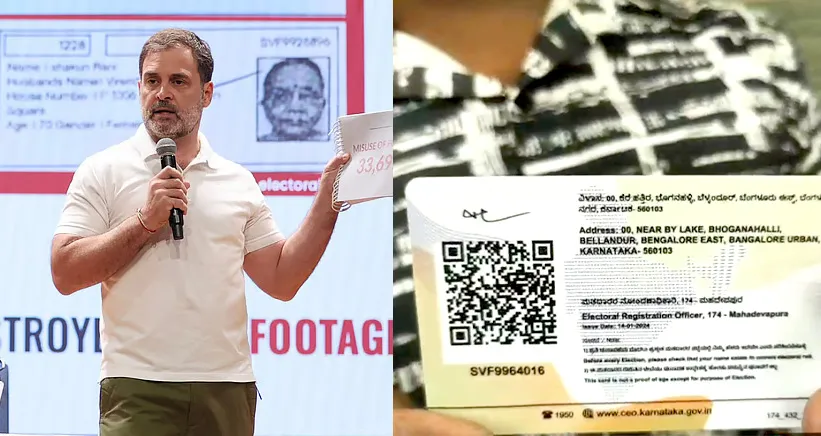
The controversy surrounding Congress leader Rahul Gandhi’s claims of “vote theft” in the 2024 Lok Sabha elections has taken a new turn as real voters with “House Number 0” on their voter IDs have spoken out, confirming their valid registration and residence. Gandhi had cited entries in the electoral rolls of Mahadevapura, Karnataka, alleging that tens of thousands of votes were manipulated through bogus voter entries.
During a press conference in Delhi, Rahul Gandhi claimed that an internal survey of the Congress party revealed 1,00,250 alleged bogus voters in Mahadevapura, with 40,009 entries containing “fake and invalid addresses” and 10,452 voters registered at the same house number. He highlighted voter entries with house numbers marked as “0” and clusters of multiple voters at the same address as proof of electoral malpractices favouring the BJP.
However, subsequent reporting and testimonies from voters have clarified that “House Number 0” is a procedural tool used by the Election Commission of India (ECI) to include individuals without well-defined or permanent residential addresses. This includes homeless persons, residents of unnumbered houses, or voters who left their house number field blank in electoral forms. Multiple voters at the same address often occur due to joint families, shared housing, or rental arrangements, particularly in rural and semi-urban areas.
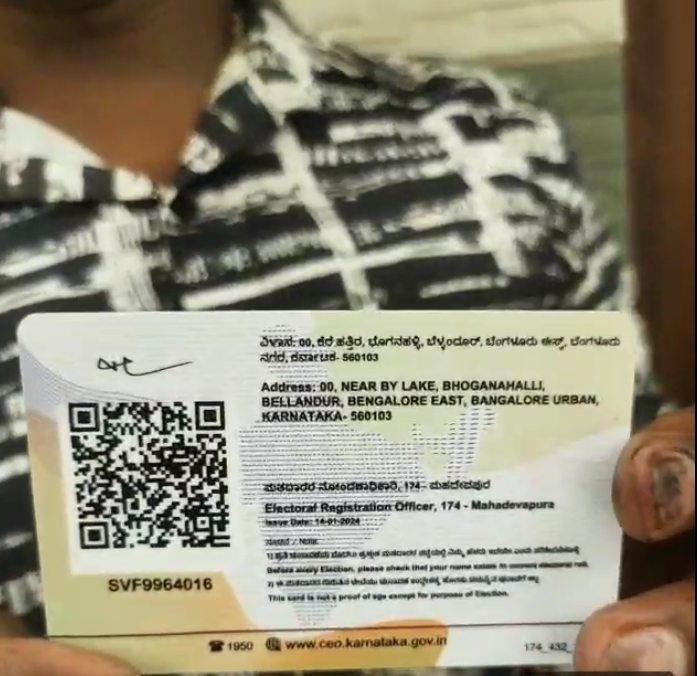
Several videos have surfaced showing voters who have lived at their residences for 10–15 years displaying their Electoral Photo Identity Cards (EPICs) with “House Number 0” listed in the address field. In one video, a woman stated that she faced harassment for having the number 0 on her voter card, underscoring public confusion over notional addresses.
Election Commission officials explained that assigning “notional addresses” is an inclusion-focused policy meant to ensure all eligible voters are registered. In cases where voters lack a proper address, the ERO assigns notional numbers verified through multiple checks, especially for homeless persons. The procedure, in place since 2011, requires Booth Level Officers (BLOs) to confirm that the applicant actually resides or sleeps at the claimed location. No documentary proof is necessary for verified homeless voters.
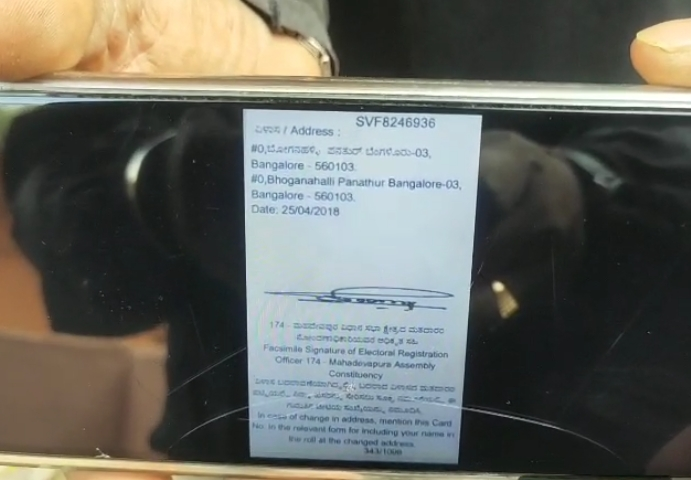
The ECI further clarified that municipalities often assign “0” as house numbers in illegal colonies to avoid granting legal status, which is why such numbers appear in the rolls. Notional numbers are computer-generated starting from 1 in each section and do not necessarily match municipal numbering systems. These instructions were also followed during Special Intensive Revision (SIR) exercises in Bihar, Chhattisgarh, Madhya Pradesh, Mizoram, Rajasthan, and Telangana in May 2023.
This development highlights the ECI’s commitment to voter inclusivity and transparency while countering claims of large-scale electoral fraud. Experts argue that the controversy over “House Number 0” stems from a lack of public understanding of administrative procedures rather than any manipulation of votes.












Comments