





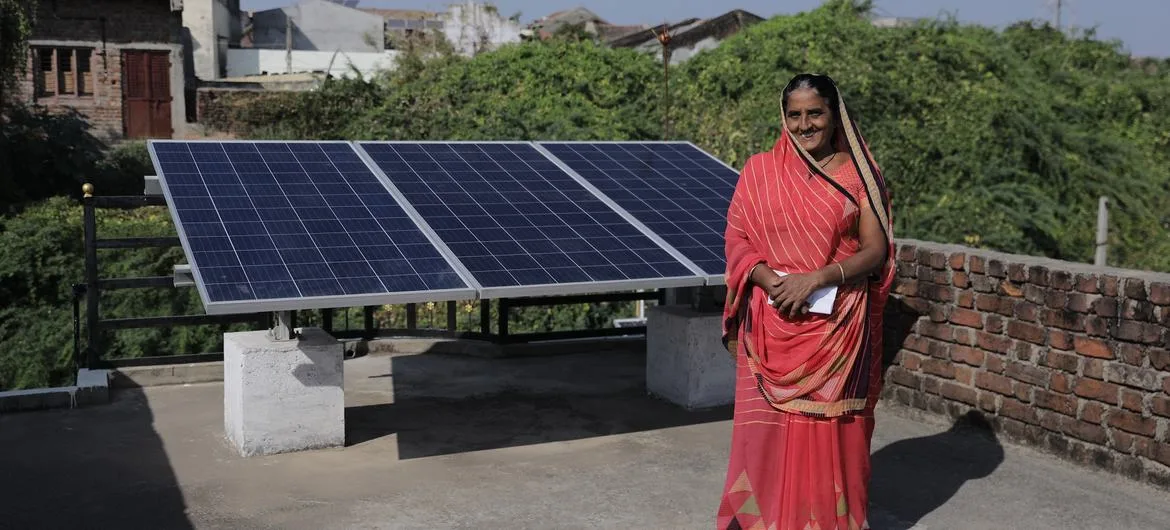
India has achieved a historic milestone of 100 gigawatts (GW) of solar PV (photovoltaic) module manufacturing capacity under the Approved List of Models and Manufacturers (ALMM), a forty-fold increase from a mere 2.3 GW in 2014. The achievement represents a remarkable step towards the nation’s renewable energy aspiration and places India at the forefront of the global solar supply chain.
Union Minister of New and Renewable Energy Pralhad Joshi termed the achievement as a “historic milestone” due to the vision of Prime Minister Narendra Modi as well as the policy thrust of the government, including the Production Linked Incentive (PLI) for high-efficiency solar modules. Prime Minister Modi termed it “yet another step towards self-reliance,” highlighting India’s transformation into a manufacturing base for clean energy technologies.
This is yet another milestone towards self-reliance! It depicts the success of India’s manufacturing capabilities and our efforts towards popularising clean energy. https://t.co/ZLMkhtSx8u
— Narendra Modi (@narendramodi) August 13, 2025
The ALMM structure, launched in January 2019 and being executed for the first time since March 2021, was aimed at providing quality-approved solar modules and manufacturers alone to government and utility-scale schemes. The original list of ALMM had around 8.2 GW capacity of 21 manufacturers. It now has 100 manufacturers from 123 manufacturing units spread across the country, an increase of 12 times in approved capacity within four years as of August 2025.
This increase in domestic manufacturing capacity complements India’s goal of having 500 GW of non-fossil fuel energy capacity by 2030. Policy interventions like the imposition of a 40% basic customs duty on Chinese solar module imports and the proposed addition of solar cells to the ALMM framework from June 2026 have given an additional boost to local manufacturing.
This is an important step towards achieving India’s energy independence. Rishabh Jain, Senior Programme Lead at the Council on Energy, Environment and Water (CEEW), stated that the increased capacity would assist in developing a diversified solar supply chain, lower dependence on imports, and increase India’s competitiveness in the international market.
The production expansion will generate thousands of direct and indirect employment opportunities while allowing India to supply its increasing domestic needs for solar power. With a record 107 GW of solar installed by April 2025, India produced over 144 terawatt-hours of solar power during 2024–25. The new capacity of manufacturing will assist in maintaining the level of fresh installations and facilitate exports to other economies.
The accelerated growth under ALMM is a demonstration of consistency in policy as well as private sector involvement. Ensuring quality, keeping up with competitiveness, and expanding exports is now the challenge for the government, even as the solar storage and efficiency upgrades come into focus.
This is Bharat’s Energy Journey
In 2014, Bharat’s solar manufacturing capacity stood at a modest 2.3 gigawatts (GW), enough to meet only a fraction of the nation’s ambitious renewable energy needs. Just over a decade later, in 2025, that figure has skyrocketed to an unprecedented 100 GW of solar photovoltaic (PV) module production capacity. This 40-fold surge is not merely a statistical milestone; it is the culmination of a decade-long vision, political will, and relentless policy execution under the leadership of Prime Minister Narendra Modi.
When PM Modi first took office, he made it clear that renewable energy, particularly solar, would be at the heart of Bharat’s development strategy. His conviction was rooted in both civilisational reverence for the Sun and a forward-looking commitment to combating climate change while ensuring energy self-reliance.
The results have been transformative. From being a net importer of solar modules in 2014, Bharat is now not only meeting its own rapidly growing solar demand, already at 107 GW installed capacity by April 2025, but also preparing to become a major exporter in the global clean energy supply chain. The ALMM list, which in 2019 featured just 8.2 GW from 21 manufacturers, now boasts 100 manufacturers operating from 123 facilities across the country.
PM Modi’s leadership in international solar diplomacy has also placed Bharat firmly at the centre of global renewable energy conversations. Initiatives like the International Solar Alliance (ISA), co-founded by Bharat, have enabled dozens of countries to tap into solar power expertise and financing, further cementing Bharat’s role as a solution provider to the world’s energy and climate challenges.
This journey from 2.3 GW to 100 GW is more than an industrial success story; it is a symbol of Bharat’s rise as a nation that leads with innovation, resilience, and purpose.










Comments