





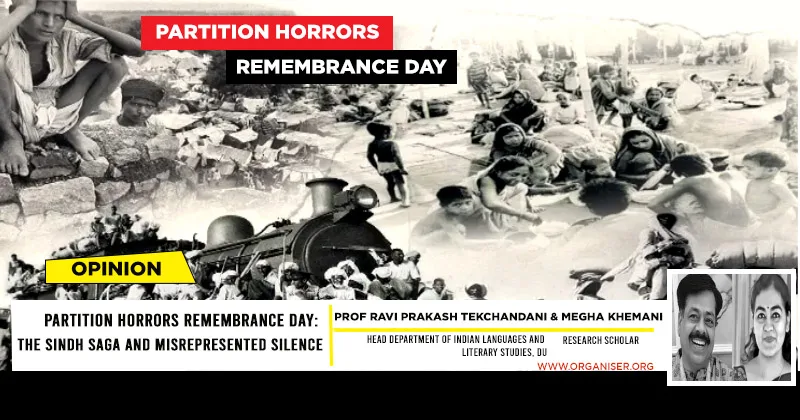
August 2025 marks 78 years since the harrowing Partition of a once-unified Bharat. The traumatic rupture of 1947 left deep scars across the subcontinent and fractured countless lives. When it comes to remembering the ‘horrors of Partition’, the dominant discourse on Partition tends to focus on massacres in Punjab and Bengal, often neglecting the traumatic violence that unfolded in Sindh. Sindhi Hindu experience of Partition is either absent or is frequently portrayed as a migration which was ‘peaceful’ and ‘by choice’, rather than being seen as a catastrophe which forced the Sindhi Hindus out of their own motherland by targeted intimidation, infused insecurity, gradual religious polarisation and violence—which was both physical and psychological in its manifestation. Such dominant narratives perpetuate the myth of a non- violent Sindhi Partition, thereby undermining the legitimacy of Sindhi displacement.

This historical ignorance and narrative marginalisation is oblivious to the oral histories and autobiographical accounts that vividly document the violence and fear that unfolded during the Partition vis-a-vis Sindhi Hindus; echoing the fear and violence-led desecration, economic dispossession and symbolic erasure. The narratives of Partition-era violence in Sindh through the autobiographical testimonies of Sindhi writers Popati Hiranandani and Thakur Chawla, as well as prominent Sindhi figures Lal Krishna Advani and Ram Jethmalani, whose personal and familial memories challenge the myth of a peaceful Sindhi migration are worth noting.
Truth of History Knowingly Overlooked
The short stories by Chawla and Hiranandani provide horrifying depictions of how violence, in its various forms, played a catalytic role in the displacement and migration of Sindhi Hindus. These narratives not only reflect the physical violence faced by the community but also delve into the psychological and socio- political shifts that facilitated their mass exodus. For instance, in Thakur Chawla’s narrative, the violence is quite immediate and brutal, with mobs looting, assaulting and destroying the lives of the narrator and his near ones.
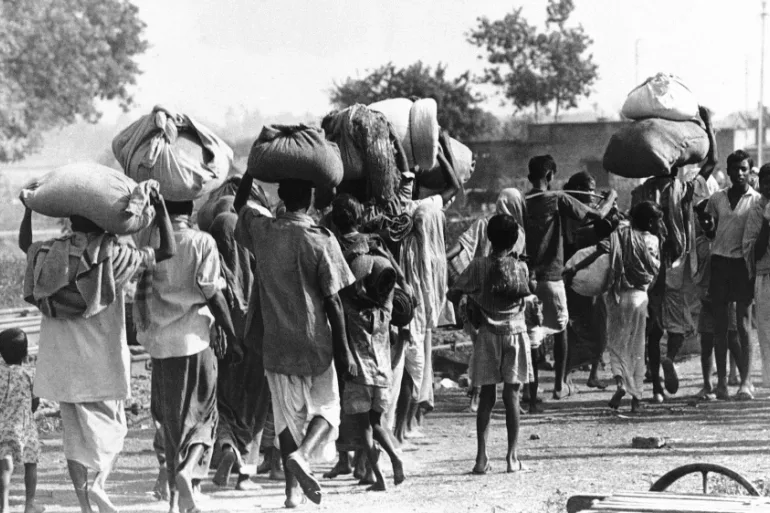
In the story, “6 January 1948,” Chawla recounts the harrowing experience of his family as they are engulfed by the violence of Partition. The family’s house in Karachi, once a symbol of stability and prosperity, became the site of violent looting and physical attack by mobs of Muslim migrants, known as Mohajirs. January 6, 1948 marked the beginning of a traumatic chapter. The family, who had once been able to offer refuge to migrants who were forced to leave Sindh, found themselves vulnerable as their own home was destroyed.
Chawla describes that the mob, driven by religious and ethnic animosities, robbed and attacked them, causing significant loss. “It was horrifyingly evident from the way they spoke and acted that these were Muslims who had migrated from UP or Bihar and they intended to kill and rob us,” the narrator recalls, highlighting the brutality and sectarianism underlying the violence. The police and authorities claimed to be of help and support, but their delayed arrival tells a different story.
In her autobiographical story, ‘When I experienced the simultaneity of Life and Death’, Hiranandani describes that as soon as the news of Partition was announced, the atmosphere became fearsome and ‘misgiving’, leaving the hearts of Sindhi Hindus gripping with terror. “Hand over the beauties of the beautiful Hyderabad to us”, she mentions the chants of young Muslim men across the street. The young girls were warned, “the moment a Muslim enters your house, you must shove your fingers in the nearest electric socket, turn the switch on and end your life.” She mentions that small packets of poison were also distributed — all this clearly highlights the extent of terror and an impending violence.
Little girls and women in the house survived with utmost diligence by not creating any noise, not turning the radio on and leaving the verandah light turned off. When her brother, Hashu announced that the women of the house will have to leave Sindh overnight, as a riot had started in Lahore, little Popati was left scared and perplexed.
Unimaginable Experiences Unheard
Lal Krishna Advani was elected the President of Jana Sangh in 1973, was jailed during Emergency and has served in several positions of prominence as far as Indian Polity is concerned, including being the Home Minister of Bharat. In his autobiography, ‘My Country, My Life’, he shares that he too, like many Sindhis was forced to abandon his beloved Sindh after the partition of Bharat. His is also the first-person account of the tragedy and therefore, quite significant and valid in our understanding of the same.
He describes that while working for freedom as an RSS Pracharak in Karachi, he was simultaneously being made aware of the gripping reality which would, like clouds of anxiety, hover over the skies of Karachi. The notion of partition was received with the reactions of disbelief, shock and strong sense of uncertainty amongst Sindhi Hindus. At this instance in life, he heard of the ‘Two Nation Theory’ for the first time and also the name ‘Pakistan’ which did not exist before that time.
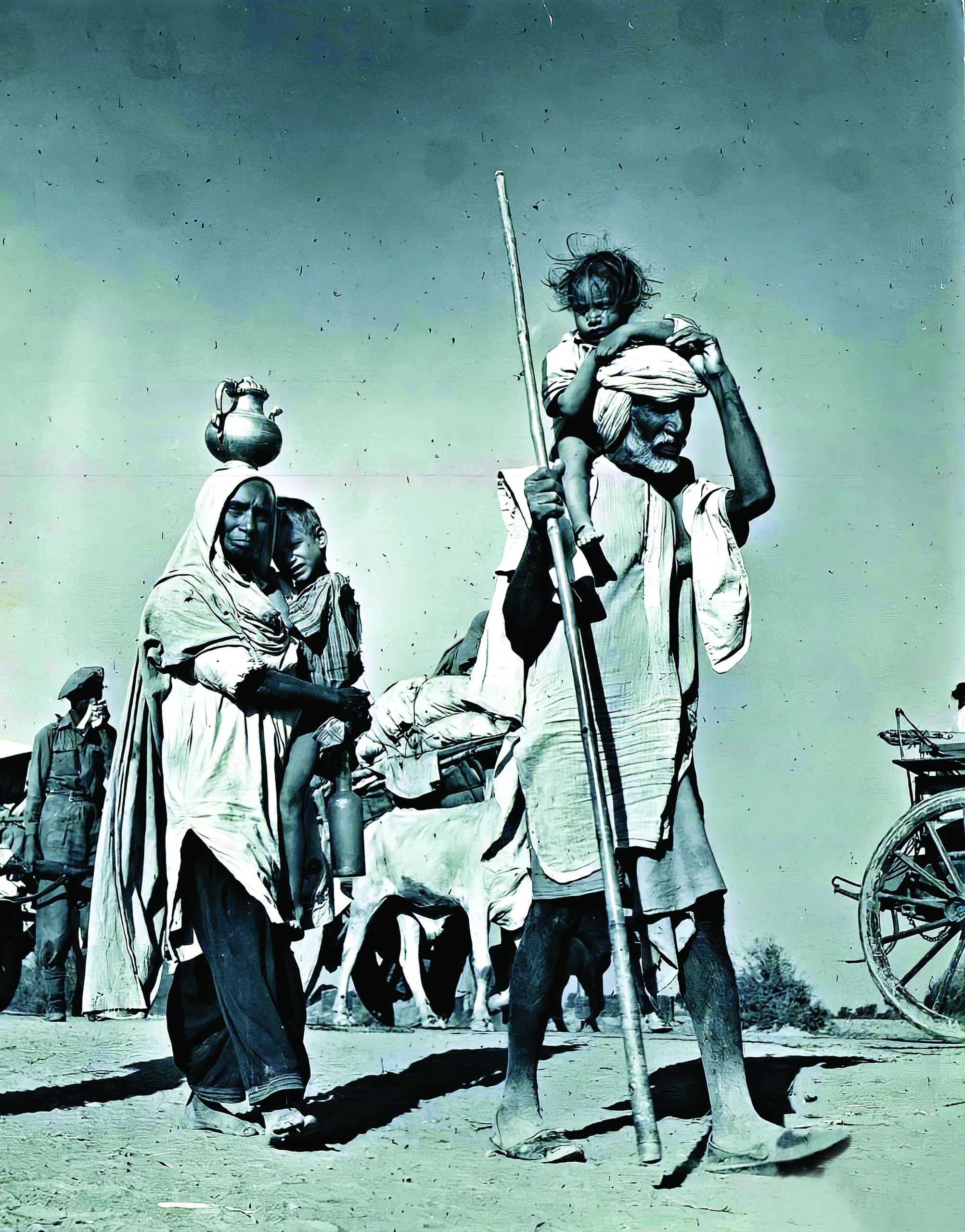
Advani also quotes a saddening incident that perfectly delineates the psychological implication of partition and the fact that the fear, anxiety and panic had seeped down even into the minds of innocent children. He writes that on the fateful day of August 15, when he went on his motorcycle to distribute sweets in the schools of Karachi, every child had refused to eat it. He rightly quotes that when children refuse to eat sweets en masse, we need to comprehend that something terrible had happened and here, it was a historical wrong to the whole nation and its people. He would experience the same heart-rending response from Hindu colonies of Karachi wherein everyone would flood him with questions like – What to do next? Looking at the gripping reality and impending violence, RSS, through Advani, had to pass on the message to Hindus- “Leave Sindh without any further delay”. Another extremely traumatic experience, out of many narrated by him in his book, is that one day while he was passing by Karachi Railway station, he found a corpse of a man stabbed to death and as he kept passing, he came across several corpses at every small distance. It must have been a terrifying experience to say the least and highlights the violence Sindh experienced. Advani had also left Karachi forever along with his family on September 12, 1947.
Jethmalani had received his degree in law at the age of 17 and was practicing law at his hometown Shikarpur, Sindh. He calls his experience of partition ‘heart wrenching’. Due to partition, he had to send his wife Durga along with his daughters to stay with his father-in-law at Bombay through a refugee ship in custody of his friend. Like other Sindhi refugees Jethmalani’s grandparents, parents and sisters were assigned lodgings in deserted World War II army barracks in refugee camps of Bombay; while he continued his practice in Karachi. Mostly, every head of the household did this to safeguard their house and business, hoping the family could either return or at least sell the property properly.
Purusharthi Spirit of Sindhi Community
In 1948, riots broke again and Sikhs and Sindhis reached Karachi port to ship out to Bharat. It is believed 206 Sindhis were butchered, with legs and arms cut off, and the attackers were Muslim refugees from Bharat. This was the Karachi pogrom. Jethmalani was in office when he heard of these riots and could only make it home safely through the mad streets as he grabbed a Jinnah-style hat off the office clerk. His biographer describes, “Ram hid in his house on Artillery Maidan Road with his brother-in-law for three days, expecting a mob to break down and kill them any minute”. They had all believed that ‘the Madness of Partition was temporary’ but it was not so. Finally, Jethmalani left for Bharat on February 18, 1948.
Uprooted from his motherland Sindh, he also felt terrible as he had to leave his legal milieu. It is noteworthy that when Jethmalani left for Bharat, he had no bank account of his own and only Rs 10 in his pocket. “I am trying my manhood here”, he had said. This is something which reiterates the ‘Purusharthi’ spirit which the Sindhis possessed, even when the tragedy of partition befell them, as also highlighted by Advani.
All these first-person narratives capture the essence of the Sindhi Hindu experience – marked by emotional upheaval, chaos and the violent reconfiguration of identity and belonging. These real- life experiences provide a lens through which we can understand not only the socio-political transformation of the time but also the personal, often tragic and violent manifestations of the partition, leading to forced displacement. While 1947 marked the birth of a new nation for millions, for Sindhi Hindus, it signified the abrupt loss of homeland without the consolation of a territorial claim. Unlike other Partition-affected communities, they became ‘displaced’ from an undivided province, forced to abandon Sindh not due to formal redrawing of borders, but due to slow, insidious violence and an atmosphere of fear that made staying untenable. These experiences serve as testimonies which counter the myth of a non-violent Sindhi experience of Partition.














Comments