





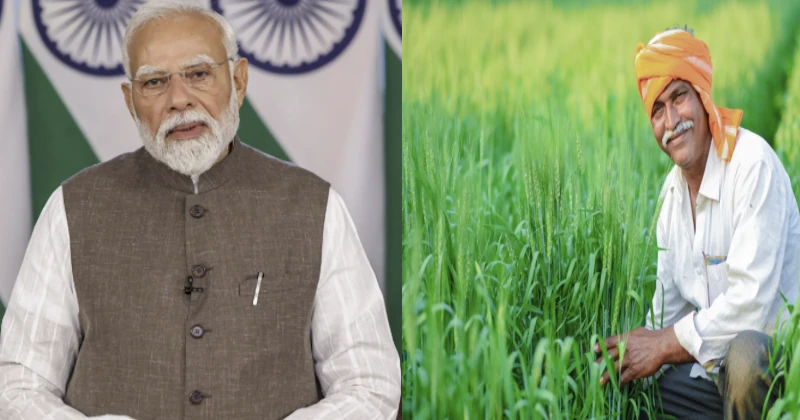
Farmers’ organisations from every corner of the country have come together to applaud Prime Minister Narendra Modi’s firm refusal to compromise India’s farming interests in the face of mounting international pressure over trade agreements.
At the heart of the dispute are demands from foreign lobbies primarily exporters of wheat, maize, rice, and soybeans from countries that rely heavily on genetically modified (GM) seeds, large-scale mechanised farming, and massive landholdings. These countries were pushing for broader market access in India under upcoming trade negotiations.
Farmers from across India thank PM @narendramodi for his bold decision in trade agreements despite foreign pressure.
Farmers describe PM Modi’s and Union Agriculture Minister @ChouhanShivraj’s leadership as unparalleled.
Leaders of all major farmers’ organisations said they… pic.twitter.com/RqGXYTRiLi
— DD News (@DDNewslive) August 12, 2025
Union Agriculture Minister Shivraj Singh Chouhan, speaking in Delhi, exposed the deep imbalance in the playing field:
“They hold 10,000 to 15,000 hectares each, use GM seeds, and have production costs far lower than ours because their yields are higher. Here, most of our farmers have between one acre and three acres, many with just half an acre. Is this competition fair? If their products entered our market freely, our crop prices would collapse. Where would our farmers go?”
#WATCH | Delhi: Union Agriculture Minister Shivraj Singh Chouhan says, "The whole country was apprehensive, tariff…You know how much land they hold: 10,000 hectares, 15,000 hectares. Meanwhile, our farmers have land ranging from one acre to three acres, with many having just… pic.twitter.com/WvV7lQWGR6
— ANI (@ANI) August 12, 2025
Chouhan noted that the cost of production per hectare in India is significantly higher than in these export-oriented economies. Without strong trade protections, Indian farmers—already facing rising input costs would be forced to compete against artificially low prices driven by foreign agricultural subsidies and large-scale farming efficiencies.
“No matter what happens,” Chouhan declared, “there will be no compromise with the interests of the farmer.”
The Prime Minister’s clear line in the sand has electrified India’s farming community. Leaders of all major farmer groups have not only welcomed the government’s decision but have openly pledged full support for the far-sighted, farmer-first policy.
“This is not just about economics it is about national survival,” said one farmer leader from Punjab, recalling how global grain markets are dominated by corporate giants that can flood developing economies with cheap imports to wipe out domestic competition.
In Maharashtra, sugarcane growers called PM Modi’s move “a declaration of agricultural sovereignty,” pointing out that earlier governments had buckled under global trade pressures, harming rural livelihoods. Both PM Modi and Chouhan used the moment to rally the nation behind the Swadeshi movement, calling for collective rejection of dependency on foreign agricultural goods.
“This is a moment of trial for us,” Chouhan said. “Let Swadeshi become a mantra and a movement. Whatever we use let it be made in India. It will strengthen our economy, give jobs to our youth, and empower our mothers and sisters in self-help groups.”
The Minister linked self-reliance directly to India’s growing global stature, reminding citizens that the country has become the fourth-largest economy and is poised to take the third spot soon. “That day will come when India is the world’s largest economy, but only if we all contribute.”
The Modi government’s position also reflects a broader commitment to food sovereignty protecting not just the economic viability of farmers but also the security and quality of India’s food supply.
Global agribusiness interests have long eyed India’s vast consumer market. In past trade deals, some countries have pushed for relaxation of restrictions on GM crop imports. By refusing to yield, the government has sent a strong message, India’s agricultural policy will be dictated in Delhi, not in foreign capitals.
On the domestic front, Chouhan also assured farmers that the Ministry of Agriculture is coordinating closely with the Ministry of Fertilizers to ensure timely supply of urea, DAP, and other essential inputs. “The distribution is handled by state governments, but wherever complaints arise, we will investigate and take action. We will leave no stone unturned to ensure farmers get what they need in time,” Chouhan said.
In his closing remarks, Chouhan evoked the deep cultural reverence for farmers in Indian society. “Food is our life, and food is divine. The farmer provides food, and thus he is both the giver of food and the giver of life. Serving farmers is worshipping God, and there can be no greater worship than this. Farmers are woven into every fibre of my being—they reside in every breath I take.”













Comments