





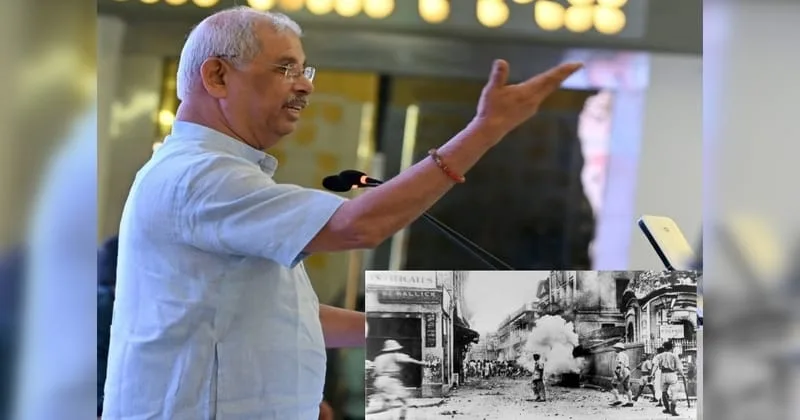
Kerala Governor Rajendra Arlekar has issued a circular directing all universities in the state to observe Partition Horror Day on August 14. The Raj Bhavan has instructed vice-chancellors to prepare special action plans for programmes that highlight the scale and brutality of the Partition of India. The objective is to raise awareness about the immense human suffering caused by the event.
The central government has been commemorating August 14 as Partition Horror Day since 2021. Prime Minister Narendra Modi had first called for this day to be observed in remembrance of the tragedy, and last year the University Grants Commission (UGC) also issued directions to educational institutions to mark the occasion. As part of these ongoing efforts, the Governor has now extended similar instructions to universities in the state. Suggested activities include seminars, plays, and other events depicting the horrors of the Partition.
The Partition of India in 1947 is widely regarded as one of the ten greatest tragedies in human history. It is estimated that nearly two million people were killed in communal violence and mass displacement, while around 20 million were uprooted from their homes. The trauma left deep scars across the subcontinent, and for many, the wounds remain unhealed even after more than seven decades.
In Kerala, the Governor’s directive has reignited political controversy. The Congress and Communist parties have opposed the move, arguing that it serves a Sangh Parivar agenda. The state’s ruling leadership, including the Chief Minister, has expressed disapproval, suggesting that the aim is to push a particular political narrative under the guise of historical remembrance. Raj Bhavan, however, contend that the initiative simply seeks to remind citizens, especially younger generations of the magnitude of the tragedy.
The Partition was a direct outcome of the British decision to divide the subcontinent along religious lines. On June 3, 1947, the last Viceroy of British India, Lord Mountbatten, announced the plan to create two separate nations, India and Pakistan, under the Indian Independence Act 1947 passed by the British Parliament. The plan was endorsed by the Indian National Congress, the Muslim League, and Sikh community leaders.
Independence came at a devastating cost. The announcement triggered one of the largest mass religious migrations in recorded history. Entire communities were uprooted almost overnight. Hindus and Sikhs fled from regions that became part of Pakistan, while Muslims in India moved in the opposite direction. What followed was a wave of brutal violence where neighbours turned on each other, lifelong friendships dissolved in bloodshed, and countless families were torn apart.
Trains from Punjab and Bengal, meant to carry refugees to safety, often arrived at their destinations filled only with the bodies of those massacred en route. Villages were razed, women were abducted, and religious structures destroyed. For survivors, the Partition was not just a political event but a personal catastrophe that altered lives forever.
By urging universities to observe Partition Horror Day, the Raj Bhavan seeks to ensure that this chapter of history is neither forgotten nor repeated. Yet, in Kerala’s charged political climate, the commemoration itself has become part of a broader ideological battle, reflecting how the memory of Partition continues to stir strong emotions across India.














Comments