





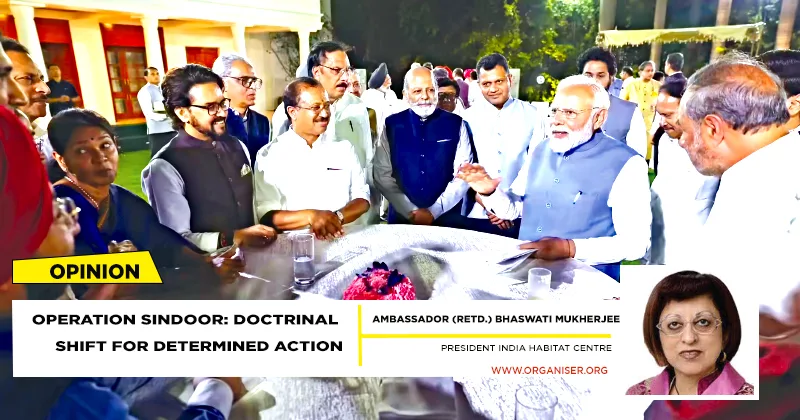
Prime Minister Narendra Modi, after inaugurating the world’s highest arch bridge over the Chenab on June 6, 2025, noted the heinous and cowardly terrorist attacks on April 22, 2025, in Pahalgam that killed 26 male civilians, targeted for their religion. It symbolised an attack on “Insaniyat and Kashmiriyat” and was intended to “engineer communal clashes across the country and deprive people of Kashmir of their livelihood”.
Nipping Pak’s Plan in the Bud
Pakistan’s sinister aim was totally thwarted. India, including the people of J & K, stood as one to oppose this visceral attack on India’s soul. After holding in abeyance the Indus Waters Treaty and a slew of other diplomatic measures, India launched ‘Operation Sindoor’, a calibrated military response targeting terrorist infrastructure and terrorist hubs across the border, without physically crossing the LOC.
The operation’s name, ‘Sindoor’, held deep symbolic resonance, since the victims, many newly married, were singled out for their religion and executed in cold blood in front of their women folk, thereby destroying sindoor, symbolic of marital status of widowed wives. As explained in Washington by Shashi Tharoor, MP and leader of one of our outreach delegations: “It is no accident that the colour of sindoor is bright red—close to the colour of blood. Here, it was sindoor
ka badla khoon”.
Neutralising Pakistan
Commencing on May 7, 2025, Indian Armed Forces conducted a four-day operation that destroyed at least nine Pakistani aircraft, including surveillance and combat platforms. Drones and missile systems were also neutralised. The scale of retaliation compelled Pakistan to sue for a ceasefire within days, marking a tactical and psychological victory for India. After the Pakistan DGMO requested for a halt to operations to India’s DGMO, there was a suspension of Operation Sindoor. It was not, however, a permanent ceasefire.
Operation Sindoor marked a pivotal moment in India’s foreign policy, one that fused swift retaliatory action with an ambitious diplomatic offensive. Its message was forceful and unambiguous and marked India’s new war doctrine. India would in future regard such acts of terrorism, emanating from across her borders, as an act of war and deal with them accordingly.
Successful Mission
After briefing our strategic partners, India launched a global diplomatic campaign. Multi party delegations consisting mainly of MPs, accompanied by retired career diplomats were sent to over 30 countries. It successfully countered the false and fake narrative of the Pakistanis, who were also trying to play the victim card. Supported by India’s Missions, the delegations had high level meetings and interaction with the foreign media.
The strength of India’s global campaign lay in its internal unity. Leaders from different parties—including Shashi Tharoor, Milind Deora, Asaduddin Owaisi, Salman Khurshid, Abhishek Banerjee and Kanimozhi Karunanidhi—spoke in one voice against terrorism. They framed India’s military response as one of restraint and necessity, in contrast to Pakistan’s alleged patronage of terrorism. India’s lonely but principled path in its foreign policy was finally vindicated. The Russia Ukraine conflict continued. It is now clear that Russia is the victor and that certain parts of Ukraine which were historically Russian, and an intrinsic part of Russia’s culture, civilisation, history and literature, would not be given back to Ukraine. The conflict has stalemated to ‘Lines of Actual Control’, similar to the Korean conflict. In our neighbourhood, on our East, the situation continues to fester. Yunus is trying to activate the Jamaat and the students to form a new party and delay elections till Ramadan next year, i.e. February 26. The attacks on Awami League supporters continue as well as on Hindus, Buddhists and other minorities. Concerted efforts continue to push Bangladeshis across the border. Clearly, West Bengal and Assam cannot accommodate Bangladeshis who may cross, along with Jehadis and terrorists. The situation in neighbouring Myanmar is of concern. A swath of territory has fallen to the Rakhine army, which is supported by China.
As for Pakistan, it became clear during Operation Sindoor that it was a proxy war on India by China. Pakistan had sophisticated intelligence provided by China, drones, aircraft and much more. India under PM Modi and our patriotic and resolute Armed Forces fought a decisive campaign, with precision and took out specific targets. In doing so, it became clear that this was a continuing conflict. In the next one, much more of Pakistan’s military and nuclear infrastructure will have to be decimated.
Since the India-US nuclear deal and India’s recognition as a nuclear power, both sides, particularly under the present Government, now in its third term, had carefully built and nurtured the India/US strategic partnership. India, the world’s fastest growing economy, with a GDP growth this year expected at 6.5 per cent, had estimated that through strategic autonomy and carefully crafted strategic partnerships, and with US support, would emerge, like Japan, as the pivotal American partner in South Asia and the Indo Pacific. The success of the G-20 Delhi Summit, further cemented our hopes. Quad, whose summit we are hosting in September this year, we had visualised as another opportunity, to move in the direction of ensuring a rule based order in the Indo Pacific.
Operation Sindoor marked a pivotal moment in India’s foreign policy, one that fused swift retaliatory action with an ambitious diplomatic offensive
Developments in the past month and half have made it clear that certain course shifts and changes may be required. A country which emerged looted, portioned and bleeding after 180 years of colonial rule, does not take kindly to public hectoring or perceived bullying. India’s decisions are based on core national interests, be it security, trade, tariffs, FTA’s or choice of strategic partners. It becomes more perplexing when such pressures are put on Bharat, with regard to, as an example, of purchasing Russian oil, when the West, including USA, continues to buy strategic products, including uranium from Russia. The West is fully aware that India’s legal purchase of Russian oil has helped to stabilise oil prices globally, which is to the benefit of all, including the USA. Can Bharat succumb to blackmail and double standards now, when she did not do so when she was economically much weaker?
Pioneering Book on Altering Global Power
Every patriotic Indian, on August 15, 2025 will answer that question with a resounding ‘No’. What then does the emerging global order look like from Bharat’s perspective?
In The New World: 21st-Century Global Order and India, Ram Madhav ji, an influential thinker associated with India’s strategic establishment brings ideological clarity and realpolitik/ pragmatism to his writing. It is a timely and thought-provoking assessment of the shifting tectonic plates of global power.
The Pax Americana that underpinned the post-1945 liberal international order anchored in Western values, institutions like the UN, IMF and World Bank, and the dominance of the dollar is losing coherence. Multilateralism is weakening, and global institutions often appear paralysed. A key theme in the new world is the transition from unipolarity to multipolarity. This multi-polar world, however, is not yet stable; it is fluid, uncertain, and contested. In this environment, India has a rare opportunity to carve out a significant strategic and normative role. India’s strategy must be rooted in realism but guided by civilisational confidence. India is a “civilisational state,” capable of offering alternative leadership based on its democratic ethos, pluralism, and cultural depth. India must move beyond non-alignment to “multi-alignment,” engaging constructively with multiple centres of power while remaining firmly anchored in its national interest.
New Assertiveness to Counter Challenges
Bharat requires a more assertive Indian foreign policy that is not reactive but visionary, shaping rather than merely adapting to global changes. Bharat that is India must rise to address these new challenges.
One may recall that in exhorting India and to Indians to unite against colonialism (September, 1905), Nobel Laureate Rabindranath Tagore had said:
“If they answer not to thy call, walk alone, If they are afraid and cower mutely facing the wall, O thou unlucky one, open thy mind and speak out alone.” Bharat on August 15, 2025, has come of age. No longer is it a lone warrior in its struggle for international recognition of the threats posed by cross border terrorism, emanating from Pakistan supported by China and others. Bharat will protect her core national interests. She will address the new challenges to her sovereignty and territorial integrity.
As written in Bhagavad Gita (2-38-39)
“Prepare for war with peace in thy soul.
This is the wisdom of Sankhya-the vision of the eternal”.












Comments