





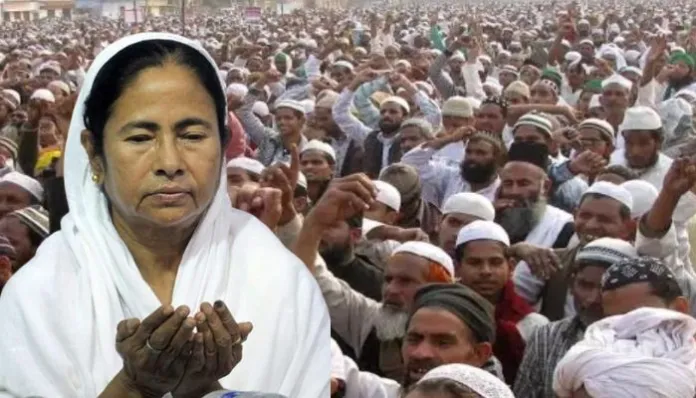
In the midst of a politically charged atmosphere across India, the Special Intensive Revision (SIR) of electoral rolls in Bihar has once again brought the issue of bogus voters, illegal immigrants, and electoral roll inflation to the forefront. While the Election Commission of India (ECI) uncovered over 60 lakh unverified voters in Bihar, a recently published research paper titled, “Electoral Roll Inflation in West Bengal: A Demographic Reconstruction of Legitimate Voter Counts (2024)” by professors from the Indian Institutes of Management (IIMs) has revealed a staggering finding, West Bengal’s electoral rolls for 2024 may contain over one crore excess voters, exposing a severe credibility crisis in the Trinamool Congress-ruled state.
This revelation comes at a time when West Bengal Chief Minister Mamata Banerjee remains vocally opposed to the SIR exercise and the crackdown on illegal immigrants, an opposition that many view as a desperate attempt to protect a bloated voter base largely fueled by infiltration and electoral manipulation.
West Bengal: The epicentre of illegal infiltration and electoral manipulation
West Bengal has emerged as the state with the highest number of illegal Bangladeshi immigrants who have managed to obtain forged documents and integrate into the local population with tacit or active support from political entities. According to official figures, 2,688 Bangladeshi nationals were apprehended and deported in the last three years alone.
Despite these numbers, the state government’s reluctance to cooperate with national-level electoral reforms raises the spectre of a deeply flawed electoral system that enables vote bank politics through demographic manipulation. While the Election Commission of India has publicly stated West Bengal is “ready” for the SIR exercise, the TMC government’s repeated requests for clarifications and signals of resistance have only delayed the process.
It is important to note that West Bengal has not undergone an SIR since 2002, making the electoral rolls ripe for scrutiny and revision. The last SIR laid the foundation for electoral rolls used in the 2004 elections, highlighting the urgent need for a fresh and thorough review.
IIM research paper reveals 1 crore excess voters in West Bengal electoral rolls
Adding concrete academic evidence to the suspicion surrounding West Bengal’s voter list, a research paper titled “Electoral Roll Inflation in West Bengal: A Demographic Reconstruction of Legitimate Voter Counts (2024)” was published on August 7, 2025. Authored by Dr. Milan Kumar of IIM Visakhapatnam and Dr. Vidhu Shekhar of SP Jain Institute of Management & Research, the study reconstructs legitimate voter numbers using official census, civil registration, and electoral roll data.
Key findings of the research:
The research looked closely at the voter list of West Bengal for the year 2024. According to the official records, there are about 7.61 crore (76.1 million) people registered as voters in the state.
However, the researchers used a special method called demographic reconstruction to estimate how many of these voters are actually legitimate, meaning real, eligible residents who should be on the voter list. This method looks at factors like the number of people who were registered in the past, how many new voters have reached voting age, how many people may have died or moved away, and how migration affects the population.
Based on this careful analysis, the researchers found that the real number of eligible voters in West Bengal in 2024 should be around 6.57 crore (65.7 million), which is far less than the official 7.61 crore.
This means there are over 1 crore (10 million) extra names on the official voter list. In other words, the voter list is inflated by about 13.69 percent. This inflation means that more than one in eight names on the list may be false, outdated, or invalid.
Importantly, the researchers took a conservative approach in their calculations. They assumed a high survival rate (meaning they estimated fewer deaths) and steady migration numbers, which means the actual number of fake or extra voters could be even higher than their estimate.
Such a large number of extra voters is not just a minor mistake, it is a serious problem. The number of extra voters far exceeds the margin of victory in many constituencies. This means that the inflated voter list could easily influence election results.
Methodology of the research paper
The researchers analysed West Bengal’s electoral roll in three stages:
Survivors from the 2004 voter roll: The 2004 electoral roll had approximately 4.74 crore registered voters. Using age-specific survival rates based on Census 2001 data, the team estimated around 3.74 crore surviving voters from that roll in 2024.
New eligible voters (1986-2006 births): Approximately 3.01 crore new voters would have been added in the last 20 years due to new cohorts reaching voting age.
Net migration: Census data from 2001 and 2011 showed West Bengal experienced a net permanent out-migration of around 17.86 lakh people during the decade.
Synthesising these figures, the estimated legitimate electorate was calculated as 6.57 crore compared to the official 7.61 crore, highlighting the discrepancy.
Implications for West Bengal’s democracy and electoral process
The over-inflation of the electoral roll by such a significant margin undermines the democratic process in multiple ways:
- It creates room for fraudulent votes and impersonation, diluting the value of each legitimate vote.
- The inflated rolls serve as a mechanism for political parties to manipulate outcomes, especially in a highly polarised and competitive state like West Bengal.
- The credibility of electoral administration under the Trinamool Congress regime is called into question.
- It raises the urgent need for data integration between electoral rolls, civil registries, Aadhaar, and migration records to improve accuracy.
- The study recommends quarterly demographic audits and algorithmic checks to detect and remove implausible entries.
Most importantly, the research underscores the necessity for a Special Intensive Revision (SIR) in West Bengal, which would enable door-to-door verification, linking voter lists with death records, and focused purging of fraudulent entries at the constituency level.
Mamata Banerjee’s defiance: A shield for illegal immigrants?
West Bengal CM Mamata Banerjee has been one of the most vocal opponents of the SIR exercise and the nationwide crackdown on illegal immigrants, particularly those from Bangladesh and Myanmar’s Rohingya community. Unlike states governed by the BJP that have welcomed or complied with the SIR and immigration drives, Mamata’s government has consistently obstructed these efforts.
In July 2025, Mamata made headlines for reminding Booth Level Officers (BLOs) in West Bengal that they serve the state government, not the Election Commission, warning them not to arbitrarily remove names from the voter list. Speaking at an administrative meeting in Birbhum district, she stated:
“The ECI takes over only after poll dates are announced. Until then, and even after that, the administration lies with the state government. You are employees of the state government. Do not harass any individual needlessly.”
This directive was widely interpreted as a veiled threat aimed at obstructing the SIR process. She further accused the Election Commission of acting on BJP’s instructions, alleging that the voter list revision was being conducted by “people sitting in Gujarat.”
Why is Mamata Banerjee afraid of the SIR exercise?
Given these facts, Mamata Banerjee’s vocal opposition to the SIR exercise and her attempts to shield her cadre of illegal immigrants are hardly surprising. A comprehensive SIR would expose the TMC’s alleged electoral manipulation practices, jeopardising their hold on power.
Her tactics of “reminding” BLOs that they are state employees and warning against cooperation with the Election Commission reflect a political leadership desperate to maintain the status quo. This stance not only obstructs democratic reforms but also compromises the integrity of the electoral process in one of India’s most politically significant states.
SIR in Bihar: Opening pandora’s box on Electoral Fraud
The Special Intensive Revision (SIR) of the electoral rolls in Bihar, a poll-bound state, was launched by the Election Commission of India as a robust mechanism to clean up the voter list. The exercise unearthed startling facts: approximately 60 lakh names on the voter rolls were found unverified or suspicious.
Of these, around 35 lakh were untraceable or had permanently moved, 22 lakh were marked as deceased, and 7 lakh voters appeared on multiple lists, creating ample scope for fraud, impersonation, and political manipulation. The SIR exercise also revealed over 1.2 lakh pending cases requiring verification.
Opposition parties such as the Rashtriya Janata Dal (RJD) and Congress quickly slammed the exercise as a “conspiracy” aimed at disenfranchising Muslim voters, claiming the ECI was being used as a tool by the Bharatiya Janata Party (BJP). Yet, the undeniable numbers laid bare the rot in the electoral system, echoing concerns raised earlier by an IIM research paper which estimated that over 70 lakh bogus voters exist in Bihar alone.
The Bigger Picture: Electoral Roll inflation across India
West Bengal is not the only state grappling with inflated voter lists. The SIR exercise in Bihar has already demonstrated the scale of the problem nationally. Similar concerns have been raised in other states with large migrant populations and porous borders.
Yet, the political rhetoric around the SIR and anti-illegal immigrant drives has been manipulated to stoke communal tensions, particularly targeting Muslims, under the guise of “secularism” by opposition parties. While such politics may win short-term electoral gains, they threaten the very foundation of India’s democratic process.
The need for urgent Electoral reforms
The findings from Bihar’s SIR exercise and the IIM research paper on West Bengal’s voter rolls highlight a national crisis of electoral roll inflation fueled by illegal immigration and political patronage. Mamata Banerjee’s resistance to cleaning up the rolls is a glaring example of how electoral manipulation hampers democracy.
For India’s democracy to thrive, there is an urgent need for robust, transparent, and independent mechanisms like the SIR to cleanse electoral rolls periodically, ensure voter lists are accurate, and prevent fraudulent voting. Only then can elections be truly free, fair, and reflective of the legitimate will of the people.
As West Bengal gears up for the next assembly elections, the SIR exercise may well prove to be a watershed moment in dismantling decades of electoral malpractice and restoring faith in the democratic process.










Comments