





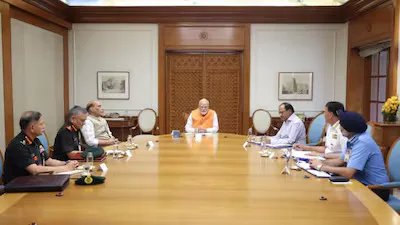
On May 10, 2025, Prime Minister Narendra Modi met the chiefs of the Army, Navy, and Air Force to review Operation Sindoor, launched in retaliation to the Pahalgam terror attack that killed 26 civilians.
Praising Army Chief General Upendra Dwivedi and Air Chief Marshal Amar Preet Singh for their decisive roles in the operation, PM Modi turned to Navy Chief Admiral Dinesh Tripathi and, with a smile, remarked:
“Humne aapke mooh se niwala cheen liya, aapko mauka phir milega” (I have snatched the morsel out of your mouth, but your turn will come).
According to a Hindustan Times report, the remark referred to the Navy being asked to hold back from a reportedly planned BrahMos missile strike on Karachi port during the operation.
Planned Karachi Port Strike Shelved
Sources said Admiral Tripathi, a firm believer in the Navy’s offensive capabilities, had prepared to launch BrahMos missiles on May 10. However, strategic considerations led to the strike being postponed despite PM Modi granting the three service chiefs complete operational autonomy.
The decision was taken despite the risk of Pakistani missile retaliation on Gujarat, with PM Modi reportedly remaining unfazed by the threat.
Operation Sindoor
India launched Operation Sindoor on May 7 with pre-dawn precision strikes on terrorist camps in Pakistan and Pakistan-occupied Kashmir (PoK), killing at least 100 militants. The strikes were a direct response to the Pahalgam attack, which had sent shockwaves across the nation.
Over the next four days, India and Pakistan engaged in intense cross-border fighting involving fighter jets, missiles, and artillery.
Heavy Damage to Pakistan’s Military Assets
Between May 8 and 10, the Indian Air Force (IAF) targeted 11 military air bases across Pakistan in a coordinated campaign, destroying:
- Fighter aircraft, including two F-16 jets at Jacobabad.
- An AEW&C (Airborne Early Warning and Control) aircraft in Bholari.
- A hangar housing C-130 Hercules transport aircraft at Chaklala Airbase in Rawalpindi.
IAF Chief Singh later confirmed that India’s air defence missile systems shot down five Pakistani fighter jets and crippled their early warning capability.
India’s Air Defence holds firm against drone barrage
Pakistan retaliated with waves of drone and missile strikes targeting military bases in Jammu & Kashmir, Punjab, Rajasthan, and Gujarat, using UAVs supplied by Turkey.
India’s Integrated Counter-UAS Grid and S-400 and Akash missile systems intercepted 99% of incoming threats, protecting key military and civilian installations.
On the morning of May 8, Indian forces struck back by neutralising Pakistani air defence radars at multiple sites, further weakening their retaliatory capacity.
Operation Sindoor showcased India’s joint forces, synergy and defensive resilience in the face of large-scale threats, while also revealing moments of restrained military decision-making. PM Modi’s remark to the Navy Chief hinted that while the Karachi strike was paused, the Navy’s turn in future operations is far from ruled out.














Comments