





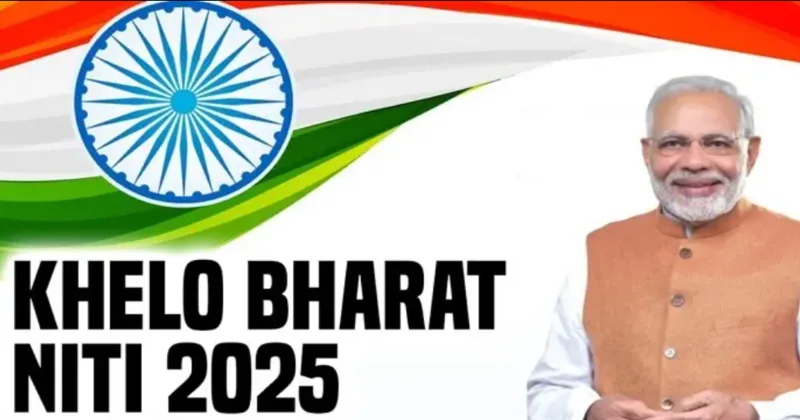
University Grants Commission (UGC), through an official notification dated August 13, 2025, has called upon all Higher Education Institutions (HEIs) to take appropriate steps for the successful implementation of this policy “in its true letter and spirit.” The Government of India has introduced the Khelo Bharat Niti 2025, a new National Sports Policy designed to bring about transformative change by integrating sports into the heart of the country’s development model. Announced on July 1, 2025, this progressive policy has drawn attention from across sectors for its ambitious and inclusive vision.
The policy stems from the recognition that sports, beyond being a recreational or competitive activity, possess immense potential to drive holistic development: physical, mental, emotional, and social. The government’s new policy emphasizes using this power as a catalyst for national growth, youth empowerment, and international sporting excellence. The Khelo Bharat Niti 2025 is not just a roadmap for athletic progress but also a visionary attempt to weave sports seamlessly into India’s educational fabric.
📢 UGC Updates
The Government of India announced the Khelo Bharat Niti–2025, a new National Sports Policy aimed at integrating sports with education for holistic development.
🎯 UGC urges Higher Education Institutions to take necessary steps to implement the policy in its true… pic.twitter.com/hmHfcTtFf6
— UGC INDIA (@ugc_india) August 4, 2025
A Policy Born from Nationwide Consultations
The Khelo Bharat Niti 2025 is the result of extensive, multi-level consultations involving a wide array of stakeholders. These include Central Ministries, State and Union Territory Governments, National Sports Federations, and other prominent partners in the ecosystem. The policy shows a unified and collaborative approach to design a future-ready sports framework.
This wide-ranging consultation process helps to ensure that the policy is grounded in real-life situations, takes into account actual challenges faced at the grassroots level, and meets both local requirements and international standards. It also represents a strong effort to unify scattered initiatives into a single, well-coordinated national strategy, a goal India has long aimed for in its pursuit of becoming a leading nation in sports.
Khelo Bharat Niti 2025 also acknowledges that the development of a sportsperson begins in schools and colleges, and hence, early exposure, structured training, and academic encouragement must be embedded into the education system itself.
UGC’s directive to Higher Education Institutions (HEIs) is in alignment with this central vision. Colleges and universities are urged to act as crucial enablers in this transformation by upgrading infrastructure, adopting sports-friendly curricula, incentivizing participation, and supporting talented athletes through mentorship and scholarships.
By positioning sports as a mainstream activity within educational institutions, the government aims to unlock a host of benefits from improving students’ physical and mental health to building leadership skills, discipline, and teamwork qualities that are indispensable in all walks of life.
Role of Higher Education Institutions (HEIs)
In its official notice, the UGC has highlighted the important role that colleges and universities will play in the policy’s success. These institutions are not only learning hubs but also social spaces where young minds are shaped. By nurturing a culture of sports and physical activity, HEIs can significantly influence societal attitudes toward fitness and healthy lifestyles.
UGC has urged Higher Education Institutions (HEIs) to actively adopt measures such as:
- Including physical education as a core component of curricula
- Reserving quotas and financial aid for talented athletes
- Organizing inter-college and inter-university tournaments regularly
- Collaborating with sports federations and government bodies
- Establishing state-of-the-art fitness centers and training grounds
- Facilitating research in sports management, psychology, and science
The success of the Khelo Bharat Niti 2025 will greatly depend on how effectively educational institutions implement these measures on the ground.
The UGC notice also states that a copy of the policy has been attached for reference and is available on the official website of the Ministry of Youth Affairs and Sports. This shows a clear commitment to transparency, allowing students, educators, sports bodies, and the wider public to easily access and understand the goals and details of the policy.
Openness like this is a key part of democratic governance. It helps ensure that everyone involved knows their roles, duties, and rights, promoting active participation and a shared sense of responsibility in carrying out the policy.















Comments