




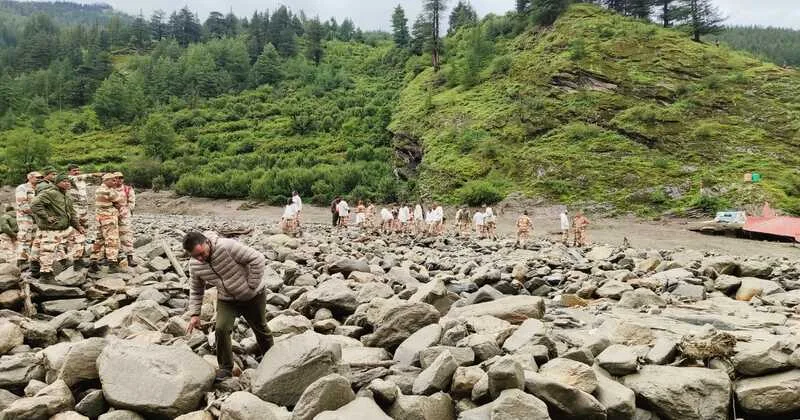
The morning of August 5, 2025, began like any other in the serene mountain village of Dharali in Uttarkashi. Pilgrims prepared for their journey to Gangotri, hotel owners welcomed guests, and families went about their daily routines. But at 1:30 PM, nature unleashed its devastating fury in the form of a catastrophic cloudburst that would test not just the resilience of the people, but also reveal the depth of humanity in government response and community spirit. Official reports confirm that at least four precious lives have been lost to the raging waters, but the full scope of the tragedy extends far beyond these confirmed fatalities. Between 59 to 100 people remain missing, their fate unknown as rescue teams work tirelessly through debris and mud that in some places reaches 15 meters deep. Among those unaccounted for are 9 to 11 brave soldiers from the Harsil Army camp, men who were stationed to protect others but found themselves victims of nature’s unpredictable wrath. The anguish is compounded by the knowledge that 20 to 25 hotels and homestays – places where families sought shelter and pilgrims found rest – have been completely destroyed, potentially trapping guests and staff whose numbers may never be fully known. Local residents, their voices heavy with grief, estimate that up to 60 people could still be trapped under the massive debris, while at least 10 to 12 individuals are believed to be buried beneath the rubble that was once their homes
When the Sky Fell: Voices from the Heart of Disaster
The horror began with a sound that 60-year-old Subhash Chandra Semwal from nearby Mukhba village will never forget. “Never seen such horrific scene in life,” he said with tears in his eyes, describing the moment when massive torrents of water and debris came rushing down the Kheer Ganga valley. As he and other villagers heard the thunderous roar of approaching destruction, they desperately tried to warn the people of Dharali market below.
“When we saw a huge amount of water flowing down in Kheer Ganga, we all panicked. Then we blew whistles to alert the people living in Dharali market and shouted at them to run away from there,” Semwal recalled, his voice breaking as he described watching many people run out of hotels only to be overtaken by the rushing flood waters. These ordinary villagers became unlikely heroes, their urgent warnings saving countless lives even as they watched helplessly as some could not escape in time.
The videos that emerged from the disaster site captured the raw terror of the moment – people screaming “Bhaag bhai bhaag” (Run brother run) as massive walls of water, mud, and debris crashed through the village. In one particularly heart-wrenching video, a voice could be heard saying “Everything is over” as homes, hotels, and dreams were swept away in minutes. Families desperately tried calling their loved ones as communication lines went down, not knowing if their relatives were safe or had been consumed by the flood.
Heroes Emerge from the Chaos: When Service Becomes Sacrifice
In the midst of this devastation. The Indian Army’s Ibex Brigade, stationed just four kilometers away at Harsil, faced their own tragedy when their camp was also hit by a cloudburst. Yet, without hesitation, 150 army personnel rushed to Dharali within ten minutes of the disaster, even as they dealt with their own missing comrades.
Colonel Harshvardhan, Commanding Officer of 14 RAJRIF, led his men in what can only be described as a mission of pure humanity. Despite knowing that 8-10 of their own soldiers were missing from the Harsil camp, these brave souls focused on saving civilian lives first. “The Indian Army column located at Harshil Post was the first to respond and reach the village within 10 minutes,” said Brigadier Mandeep Dhillon, his voice reflecting the pride and pain of military sacrifice.
The rescue operations that followed were nothing short of miraculous. In the first 24 hours alone, over 130 people were pulled from the debris and rushing waters. Army personnel were seen using ropes to pull survivors from collapsed buildings, NDRF teams worked through the night with specialized equipment, and local volunteers formed human chains to help in the rescue efforts. Each rescue was a victory of human spirit over natural disaster, each saved life a testament to the dedication of those who chose service over safety.
Leadership with a Human Heart: When Duty Meets Compassion
The response from the highest levels of government revealed a deeply human side of administration that often goes unseen. Chief Minister Pushkar Singh Dhami was in Tirupati, Andhra Pradesh, attending a religious ceremony when news of the disaster reached him at 2:00 PM. Without a moment’s hesitation, he cancelled his official program and began his journey back to Uttarakhand, his actions speaking louder than any political rhetoric about where his priorities lay.
“The news of heavy damage caused by a cloudburst in the Dharali (Uttarkashi) region is extremely sad and distressing,” CM Dhami said, his words carrying the weight of genuine concern rather than mere political formality. By evening, he was at the State Emergency Operations Centre in Dehradun, not in the comfort of his official residence, but working alongside disaster management teams to coordinate relief efforts.
The emotional resonance of leadership became even more apparent when Prime Minister Narendra Modi personally called CM Dhami to assess the situation. “I express my condolences to the people affected by this tragedy in Dharali, Uttarkashi. Along with this, I pray for the well-being of all the victims,” the PM said, his words reaching grieving families across the nation. Union Home Minister Amit Shah’s immediate directive to deploy NDRF and ITBP teams showed how quickly the government machinery can move when driven by genuine concern for human life, the government’s use of communication systems during the Uttarkashi disaster showed how technology can become a lifeline of hope. Multiple helpline numbers were activated immediately – 1077, 112, and district-specific numbers like 01374-222722. These aren’t just numbers; they are voices of hope for families desperately seeking news of their loved ones.
The State Emergency Operations Centre is working around the clock, becoming a nerve center not just for coordination, but for human connection during the crisis. Every call answered, every piece of information relayed, every update shared was a thread connecting anxious families to hope, showing that government systems can indeed have a heart.
Perhaps nothing demonstrates genuine concern more than the immediate release of financial resources without bureaucratic delays. Rs 20 crore was released from the State Disaster Response Fund within hours of the disaster. This isn’t just money being moved from one account to another; it is the government putting its resources where its promises were, ensuring that rescue operations wouldn’t be hampered by financial constraints.
Medical Mercy: Opening Hearts and Hospital Doors
The healthcare response revealed the soft side of India’s medical system. Beds were immediately reserved at AIIMS Dehradun, AIIMS Rishikesh, and Doon Hospital. Ambulances were mobilized not just as vehicles, but as mobile units of hope racing against time to save lives.
The medical teams worked throughout the night, treating injuries and providing psychological support to traumatized survivors, embodied the true spirit of healthcare
The disaster also revealed the beautiful side of human nature as local communities opened their hearts and homes to survivors. Villagers who had lost everything themselves shared what little they had with rescue workers and fellow survivors. The sight of people forming human chains to help pull survivors from debris, neighbors helping neighbors despite their own losses, showed that compassion is indeed the greatest human strength.
Hotel owners who had lost their establishments worked alongside rescue teams, pilgrims whose journeys had been disrupted stayed to help in relief efforts, and even children contributed by helping identify missing persons. These weren’t organized relief efforts; they were spontaneous expressions of human solidarity in the face of tragedy.
Challenges That Test the Human Spirit
Despite the overwhelming response, the disaster exposed the very real limitations that even the most compassionate government faces. Weather conditions prevented immediate helicopter rescues, challenging terrain made road access difficult, and the scale of destruction overwhelmed initial assessment capabilities. These challenges didn’t diminish the response efforts; instead, they highlighted the extraordinary dedication of those who continued working despite seemingly impossible conditions.
The early warning system limitations became painfully apparent, as experts confirmed that “it is very difficult to predict cloudbursts due to its very small scale in space and time”. This reality check didn’t discourage authorities but rather strengthened their resolve to improve prediction and preparedness systems for the future.
The government’s commitment extended far beyond the immediate rescue phase. The promise of rehabilitation support for affected families, the assurance of rebuilding assistance, and the commitment to improving disaster preparedness infrastructure showed that this response was about long-term healing, not just short-term relief.
The voices of survivors like Subhash Chandra Semwal, the dedication of rescue workers who worked through the night, and the immediate response of leaders at all levels created a show of human resilience that was as beautiful as the disaster was devastating.















Comments