





When the month of August arrives, there is usually one date that holds special significance in the minds of the people, and that date is ‘August 15’. And rightly so, for it was on this day that Bharat attained independence, earned through countless sacrifices and supreme acts of bravery.
However, during the second term of Prime Minister Narendra Modi’s government, something subtle yet deeply significant occurred, making another date in August equally important. That date is ‘August 5’ i.e. Today. In the times to come, August 5 will be remembered as a landmark day in Indian history, written in golden letters after Independence.
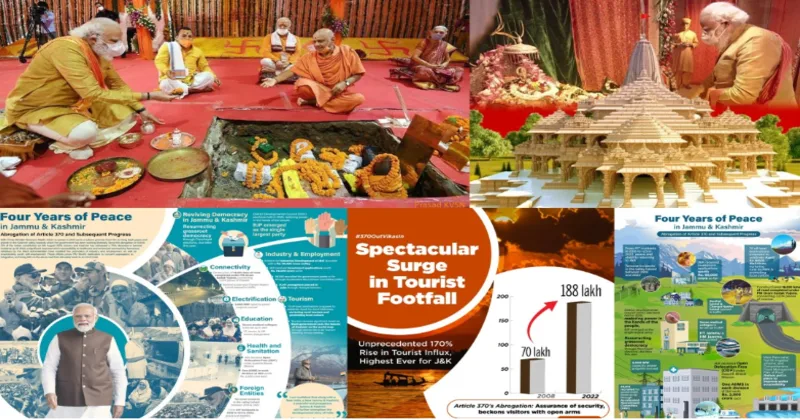
Why has August 5 become a historic and momentous day for India? The answer lies in two landmark events: the revocation of Article 370 in J&K on August 5, 2019, and the ‘Bhoomi Pujan’ ceremony held on August 5, 2020, at Ayodhya for the construction of the Sri Ram Mandir, a sacred mandir revered by the majority Hindu community in Bharat.
August 5 is a date of global historical significance for multiple reasons. On this day in 1921, the United States and Germany signed the Berlin Peace Treaty. In 1945, the U.S. dropped an atomic bomb on Hiroshima, Japan. August 5, 1960, marked the independence of the African country Burkina Faso. Furthermore, in 1963, the Soviet Union, the United Kingdom, and the United States came together in Moscow to sign the Nuclear Test Ban Treaty.
In the Bhartiya context, August 5 has indeed become a historic, extraordinary, and unforgettable day. Although political leaders frequently proclaimed that “J&K is an integral part of Bharat,” the reality was quite different. J&K remained bound by the constraints of Article 370, effectively isolated from the rest of Bharat. This article barred the direct application of decisions made by the Bhartiya government in the region.
Thus, prior to August 5, 2019, the frequently repeated claim that “J&K is an integral part of Bharat” was more rhetorical than real. Article 370 acted like a venomous thorn lodged in the crown jewel of Bharat Mata. Due to this, only a handful of elite families in the Kashmir Valley prospered, accumulating wealth and influence, even as the fire of separatism continued to burn the state fiercely.
Young people in the Valley were being radicalised and turned into stone-pelters, and the Bhartiya Army faced relentless challenges. Political leaders in Kashmir, who treated Article 370 as untouchable due to their vested interests, were brazen in their defiance. Farooq Abdullah, President of the National Conference and former Chief Minister of J&K, arrogantly proclaimed, “No power on earth can touch Article 370.” Similarly, former Chief Minister Mehbooba Mufti had stated, “No one can dare touch 370.” She went a step further and even issued a veiled threat, declaring: “If you don’t understand, then you will be wiped out, O people of Hindustan; your story won’t even be recorded in the annals of history” (ना समझोगे तो मिट जाओगे ऐ हिन्दुस्तान वालो, तुम्हारी दास्तान तक भी ना होगी दास्तानों में).
The Congress party had its own stance on the issue. However, on August 5, 2019, to everyone’s surprise, the Government of Bharat abrogated Article 370, marking the beginning of a new era in Jammu & Kashmir and Ladakh. The people of the country celebrated this historic moment.
August 5, 2019, delivered a decisive blow to the rising separatist sentiment in the Kashmir Valley. The impact of this move was so intense that even Pakistan reacted with visible fear and uncertainty. The abrogation of Article 370, a veiled barrier once placed by Congress against J&K’s full integration with India marked a truly historic moment. On this day, August 5, it’s important to remember and reflect on that landmark decision which reshaped the future of the region and strengthened the unity of the nation.
On August 5, 2020, a momentous event unfolded, one that Hindu society had been striving for over the past 491 years. Back on March 21, 1528, the Mughal invader Babur had commanded his general, Mir Baqi, to demolish the Ram Mandir and build a structure in its place. That structure was finally uprooted by the Hindu community on December 6, 1992.
Subsequently, legal battles followed, ultimately resulting in a victory for Hindu society. This long-standing stain on the pride of Hindu culture was finally erased on August 5, 2020, marking a historic moment of restoration and triumph.
Generations of Ram devotees had long awaited this divine moment of the ‘Bhoomi Pujan’ for the construction of the Ram Mandir. Many had departed with unfulfilled desires to see the mandir of their revered Prabhu Sri Ram built. But on August 5, 2020, that auspicious moment arrived, and under the hands of Prime Minister Narendra Modi, the decades of struggle, sacrifice, and penance of countless Sanatan Dharm devotees reached their culmination.
On that day, the happiness of the entire Hindu community was overwhelming. For Hindus, August 5 has since come to symbolise a modern-day ‘Diwali’, a festival of triumph, hope, and new beginnings. After the ‘Bhoomi Pujan’ ceremony on August 5, 2020, the grand construction of the Sri Ram Mandir began in Ayodhya. Devotees of Sri Ram from across Bharat and around the world generously contributed to the mandir’s construction. Rashtriya Swayamsevak Sangh launched a widespread campaign to collect funds. Following this, a campaign was also carried out to distribute the sacred ‘Akshat’ rice from Ayodhya to homes everywhere. Finally, on January 22, 2024, the installation and Praan Pratishtha of Prabhu Ram’s Vigrah at Ram Janmabhoomi took place. It was a joyous occasion that felt like a festival for Hindus all around the globe.
Thus, the events of August 5 in both 2019 and 2020 are destined to be etched as golden and joyous milestones in the history of Bharat. These moments have greatly uplifted the spirit of the nation and its devotees, while delivering a resounding blow to those who stand against the country and its faith. Narayanayeti Samarpayami…











Comments