





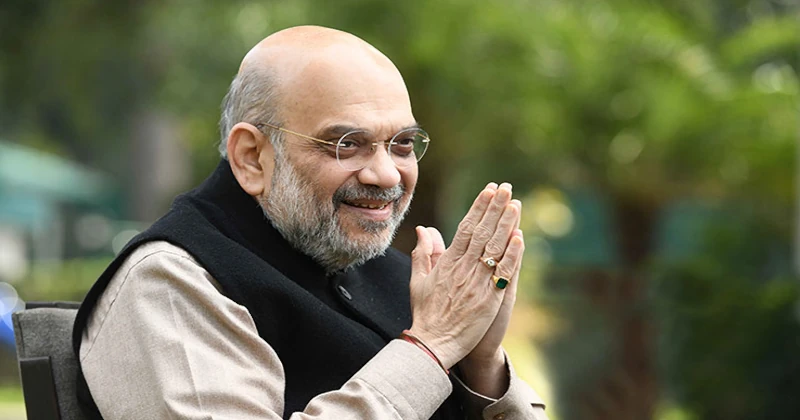
As the nation marks six years since the historic abrogation of Article 370, Union Home Minister Amit Shah scripts a parallel chapter in India’s political history. With 2,194 days in office, Amit Shah today becomes the longest-serving Home Minister at the Union, surpassing BJP veteran and his political mentor Lal Krishna Advani, who held the post for 2,193 days across two terms under Atal Bihari Vajpayee’s Prime Ministership.
The date is not just numerically significant it is politically and ideologically symbolic. On August 5, 2019, Amit Shah announced in Parliament the revocation of Article 370, effectively erasing Jammu and Kashmir’s special constitutional status and paving the way for its full integration into the Indian Union. Six years later, he marks a personal and national milestone, capping a tenure defined by decisive action, ideological consolidation, and far-reaching structural reforms in India’s internal security and governance.
Amit Shah Surpasses Advani
In 2019, when Amit Shah succeeded LK Advani as the BJP MP from Gandhinagar a seat the veteran leader held six times—it was widely seen as a generational transfer of ideological responsibility. Today, that transition is complete in symbolism and substance. Amit Shah has not only inherited Advani’s vision but implemented it with surgical precision, achieving what the BJP’s ideological predecessors—Jana Sangh, Rashtriya Swayamsevak Sangh, and stalwarts like Syama Prasad Mookerjee had long demanded: the abrogation of Article 370.
Advani had once said, “The BJP lives to fulfil nationalistic goals, not just govern.” In Amit Shah, that sentiment has found its most uncompromising executor.
August 5, 2019
On the floor of the Rajya Sabha, on August 5, 2019, Amit Shah made what would become a defining speech in the annals of India’s parliamentary history. Quoting Article 370(3) and armed with a Presidential Order from then-President Ram Nath Kovind, Amit Shah introduced the Constitution (Application to J&K) Order, 2019—nullifying the 1954 order that extended special provisions to the erstwhile state.
With J&K under President’s Rule, Parliament assumed the powers of the State Assembly. The Rajya Sabha passed the resolution with 125 votes in favour, followed by a thumping majority in the Lok Sabha 370 votes for and 70 against. This numerical symmetry with Article 370 was poetic justice for the BJP’s ideological camp.
Following this, the J&K Reorganisation Act, 2019, also piloted by Amit Shah, bifurcated the state into two Union Territories—Jammu & Kashmir (with legislature) and Ladakh (without legislature). Six years later, Amit Shah’s resolute move remains the most profound constitutional reordering since the Emergency.
With his 2,194-day tenure, Amit Shah overtakes:
- LK Advani – 2,193 days (1998–2004)
- Govind Ballabh Pant (Congress) – Just over six years in the 1950s
- P Chidambaram – Nearly 4 years under the UPA
- Rajnath Singh – 5 years in PM Modi’s first term
Amit Shah’s record reflects consistency, continuity, and control over India’s complex internal security landscape—managing terrorism, insurgency, communal tensions, and border unrest, all under the pressures of geopolitics and populist expectations.
Beyond Article 370: The Amit Shah Doctrine of Internal Security
1. Kashmir: From Militancy to Mainstream
Since the abrogation of Article 370, terror-related deaths in J&K have dropped by 70 per cent, according to MHA data. Security personnel casualties have also significantly declined. Amit Shah’s policy of zero tolerance towards terror was seen in robust cross-border operations, a strong hand against separatists, and unprecedented record tourist inflows.
However, Pakistan-sponsored attacks, including the Pahalgam terror strike on April 22, 2025, reveal ongoing attempts to derail normalcy in the region. Speculation is now rife that statehood for J&K may be restored in the near future a move seen as the logical culmination of the integration process Amit Shah began in 2019.
2. Maoist Crackdown: From Red Corridor to Recovery
Between 2009 and 2014, India recorded 5,225 deaths due to left-wing extremism. Under Amit Shah’s leadership from 2019 to 2024, the number fell below 600, marking a dramatic drop in Maoist violence. Development projects, better coordination with state police, and aggressive targeting of top Maoist leadership have shrunk the Red Corridor to a handful of districts.
The number of districts under Maoist influence has reduced by over 75 per cent, according to MHA records.
3. Legislative Tsunami: Criminal justice reimagined
In 2023, Amit Shah tabled three pathbreaking legislations, replacing colonial-era laws with Bharatiya frameworks:
- Bharatiya Nyaya Sanhita (BNS) – Replacing the Indian Penal Code
- Bharatiya Nagarik Suraksha Sanhita (BNSS) – Replacing CrPC
- Bharatiya Sakshya Adhiniyam (BSA) – Replacing the Indian Evidence Act
These changes redefined India’s legal philosophy prioritising victim-centric justice, faster trial mechanisms, and removing colonial biases from criminal procedures.
4. Citizenship Amendment Act (CAA), 2019
The CAA remains one of the most politically bold and socially polarising moves. It grants fast-track Indian citizenship to persecuted Hindus, Sikhs, Christians, Jains, Parsis and Buddhists from Pakistan, Afghanistan, and Bangladesh—excluding Muslims. Amit Shah stood firm despite protests, saying, “We must shelter those escaping religious persecution, and that is our civilisational duty.”
The Act has already resulted in thousands applying for citizenship, even as international watchdogs and opposition parties cry foul over its exclusionary tone.
5. Other Key Legislative Moves
- Triple Talaq Abolition (2019): Declared instant triple talaq a criminal offence, ending an era of gender injustice.
- Uniform Civil Code Push: Several BJP-ruled states have now implemented or are drafting UCCs, with the Centre reportedly planning a national rollout.
- Police Modernisation: Over Rs 8,200 crore invested between 2019–2024 to digitise, equip, and train law enforcement agencies.
Before his ministerial avatar, Amit Shah served as BJP President (2014–2019), where he:
- Engineered BJP’s entry into the Northeast, winning in Assam and Tripura
- Revived the party in Uttar Pradesh, helping it win a majority in 2017 after 15 years
- Delivered a 303-seat landslide victory in 2019 Lok Sabha elections
His understanding of ground-level politics, data analytics, and ideological mobilisation made him Modi’s most trusted strategist.














Comments