





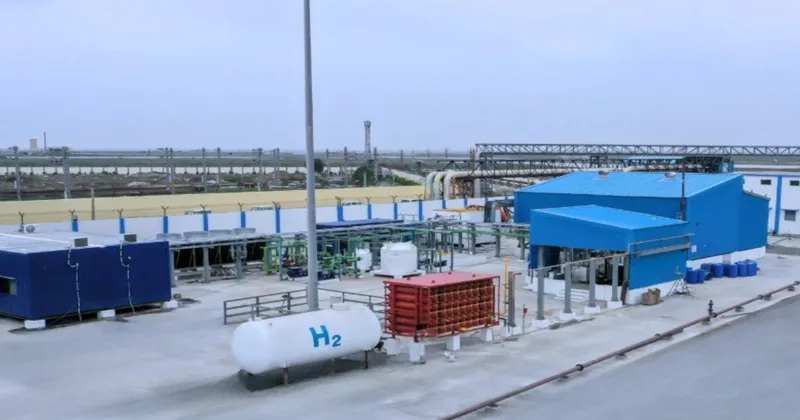
India is marching ahead in its pursuit of going net-zero by 2070. Green hydrogen is the top priority in the government’s vision, a clean and renewable energy solution that has the potential to revolutionize India’s energy sector and reduce the nation’s dependence on fossil fuels. The government is committed to develop a robust green hydrogen ecosystem. The recent inauguration of a green hydrogen unit at Deendayal Port Authority (DPA) in Gujarat is a live example of how policy, technology and infrastructure are coming together to create a sustainable future.
Net-Zero Vision and the Role of Green Hydrogen
The commitment of India to reaching net-zero carbon emission by 2070, announced by Prime Minister Narendra Modi during the Glasgow COP26 Summit (2021), establishes the country’s determination towards climate action at the international level. To achieve this long-term goal the industry, transportation and energy sectors of India must reduce carbon emission. Green hydrogen is critical to the process of decarbonization, especially for sectors where it is hard to decarbonize using the conventional renewable electricity.
Green hydrogen is produced through renewable energy sources like wind or solar using water electrolysis which is carbon emissions-free. It is different from grey or blue hydrogen, which are fossil fuels but with high grade carbon capture, green hydrogen is a truly clean source. Green hydrogen has the potential to be used for heavy transport fuel, industrial feedstock, grid storage and remote power generation. India has focused on its vast renewable energy resources potential particularly solar energy, which can be best placed in the production and export of green hydrogen.
Inauguration of a green hydrogen plant at Deendayal Port Authority (DPA) in Kandla, Gujarat has made India to stand in the key player for green energy. This plant is set up of Union Ports, Shipping & Waterways. Union Minister Sarbananda Sonowal sees it as a key milestone in India’s green hydrogen sector. Prime Minister Narendra Modi laid the foundation of this plant which is a 10 MW green hydrogen plant in May 2025.
This is a commendable effort, championing sustainability and powering our Net-Zero vision. https://t.co/lmT17VOSBo
— Narendra Modi (@narendramodi) August 3, 2025
With combined effort from Ministry of Ports and Shipping & Waterways, the DPA plant has begun operations with a 1 MW module and is projected to produce approximately 140 metric tonnes of green hydrogen annually. Sarbananda Sonowal described the initiative as “a new benchmark for implementation in India’s green hydrogen ecosystem” and hailed this commissioning as “a major step towards fulfilling PM Shri Narendra Modi ji’s 2030 vision.”
Larsen & Toubro (L&T) carried out the project, and the minister welcomed their engineering expertise and project speed. The Minister of State for MoPSW, Shantanu Thakur, said “This is a proud moment not just for Gujarat, but for the entire country. The commissioning of this Green Hydrogen plant at DPA highlights India’s growing leadership in clean energy, innovation, and self-reliance. I congratulate the entire team for taking this bold step towards a sustainable maritime future.”
Government’s Support to the National Green Hydrogen Mission
The DPA unit is a part of the overall National Green Hydrogen Mission, which was initiated in January 2023 with an outlay of ₹19,744 crore (or around $2.3 billion). The mission is among the key pillars of India’s overall plan for decarbonizing its economy and becoming a global green hydrogen leader.
The objectives of the mission are:
• Setting up a production capacity of 5 million metric tonnes (MMT) of green hydrogen per year by 2030
• Enabling the installation of 125 GW of renewable energy capacity
• Creating more than 600,000 jobs
• Lowering fossil fuel imports and related emissions
It is organized under components like SIGHT (Strategic Interventions for Green Hydrogen Transition) and includes incubation programs for innovation in fuel cells and electrolyzers. The government has also made a statement to bring in compulsory green hydrogen consumption requirements for refineries, steel, and fertilizer to improve local demand.
Maritime India Vision 2030 and Green Ports
The DPA project is part of the Maritime India Vision 2030, a mission that outlines the transition of country through a greener and technologically advanced operation in Indian ports. These Two major port infrastructure projects of ₹570 billion (approximately $6.6 billion) were opened in January 2025 at Kandla Port. The projects aim to boost dry and liquid cargo handling capacity, improve efficiency and create new jobs while integrating clean energy systems.
Strategic Investments and International Cooperation
Green hydrogen mission has collaborative effort with private and international interest. Indian corporate giants like Reliance Industries, Adani Group, NTPC, Indian Oil Corporation and L&T have already committed billions of dollars towards green hydrogen production, electrolyzer manufacturing and export corridor development.
India is also promoting bilateral ties with countries such as Germany, Australia, the UAE and Japan with an aim to create cross-border hydrogen supply chains. India and Germany have signed a Hydrogen Task Force MoU for collaboration in green hydrogen trade exploration and technology sharing.
Besides, India’s membership in organizations such as International Partnership for Hydrogen and Fuel Cells in the Economy (IPHE) and International Solar Alliance (ISA) is a testament to its commitment on international collaboration.
The push for green hydrogen holds tremendous possibilities. India can save between 3.6 gigatonnes of cumulative CO₂ emissions by 2050 by embracing green hydrogen, according to a report by NITI Aayog and Rocky Mountain Institute (RMI). It can also save over $246 billion of fossil fuel imports.
Still there are some challenges such as expensive cost of green hydrogen ( approx. Rs 320–330/kg) in comparison to grey hydrogen (₹150–180/kg). Installation and production of electrolyzers remain import-dependent where private entities can play their crucial role. Lack of storage, transportion and pipeline infrastructure with safety regulatory mechanisms are required. To overcome these challenges, the government is providing production-linked incentives (PLI) and encouraging public-private partnerships to ramp up domestic electrolyzer manufacturing.
Hydrogen at the Core of Energy Strategy: Road to 2070
While India is going towards a net-zero target by 2070, green hydrogen is one of the key pillars that can play a decisive role in that direction. The plan is to engage hydrogen in refineries, steel, city transportation, long-distance transportation, and shipping. The blending of hydrogen into natural gas grids and ammonia production will also be at the forefront to green the entire energy value chain.
The DPA plant is a working example of this broader vision. With its 140 metric tonnes per annum capability, the plant itself represents a scalable template for integrating hydrogen into industrial and port infrastructure.
India’s net-zero journey is not just an environmental obligation but a strategic necessity to take the lead in the clean energy revolution. Green hydrogen is the solution for decarbonization of those sectors that can’t be electrified directly. The forthcoming production commencement of the Deendayal Port green hydrogen facility is a significant milestone, demonstrating the country’s ability to commission complex green energy assets at pace and scale.
Backed by green-thinking policies, international collaborations, monumental investments, and visionary leadership, India is poised to become a world green hydrogen hub. Where national missions overlap with private sector momentum and clean fuel tech breakthroughs, the world will look to India for its green destiny and delivery of climate commitments.
















Comments