





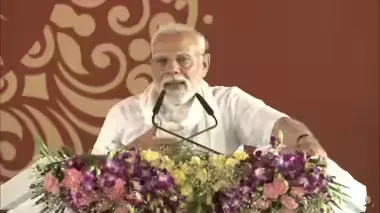
Prime Minister Narendra Modi, during his latest visit to his parliamentary constituency Varanasi, made a series of major announcements that reflect the government’s sustained efforts towards financial inclusion and national security. Among the key updates was a nationwide drive to update Know Your Customer (KYC) details for Jan Dhan account holders. PM Modi revealed that over 55 crore Jan Dhan accounts have been opened since the launch of the Pradhan Mantri Jan Dhan Yojana (PMJDY) in 2014, marking a monumental step in banking the unbanked across India.
The visit, his first since the launch of Operation Sindoor, blended emotional appeals, a resolute stance on national security, and a renewed push for financial inclusion.
Addressing a gathering of citizens during the auspicious month of Sawan, PM Modi expressed his deep emotional connection with the people of Varanasi, calling them part of his extended family. He shared his anguish over the April 22 Pahalgam terror attack, where 26 civilians were brutally killed, and recalled praying at the Kashi Vishwanath temple for strength to the grieving families. Modi reaffirmed that the promise to avenge the sindoor of the daughters had been fulfilled through Operation Sindoor, which he dedicated to Mahadev, saying the mission was successful because of divine blessings and the unyielding resolve of Indian forces.
KYC campaign for Jan Dhan accounts
In a major update, PM Modi announced that Jan Dhan account holders across India are being encouraged to attend special KYC camps being organised by banks in their respective gram panchayats. Since July 1, 2025, nearly one lakh gram panchayats have been covered, and lakhs of beneficiaries have already updated their KYC records.
Highlighting that over 55 crore Jan Dhan accounts have been opened since the scheme’s launch in 2014, PM Modi informed the public that account verification after 10 years is mandatory as per banking rules. The KYC renewal initiative, therefore, is essential to keeping these accounts active and connected to government welfare services.
The Prime Minister urged all Jan Dhan beneficiaries to attend the camps and complete the KYC process without delay, warning that failure to do so could lead to service disruptions. He emphasised that these camps are not only updating accounts but also helping citizens enrol in key social security and insurance schemes.
🚨 HUGE:
PM Modi asked banks to organise special camps for Jan Dhan Yojana and KYC .
Moren than 55 Crore bank accounts have been opened since 2014!
Since 1st July 2025, banks have covered nearly 1,00,000 Gram Panchayats 😱.
People with bank accounts can come forward,… pic.twitter.com/pjIMUNouy9
— Megh Updates 🚨™ (@MeghUpdates) August 3, 2025
Multi-scheme enrollment and mobilisation
These special bank outreach camps are providing citizens an opportunity to register for government-backed welfare schemes such as:
Pradhan Mantri Suraksha Bima Yojana (PMSBY): Offers accident insurance of Rs 2 lakh at just Rs 20 per year. Over 50.30 crore individuals have enrolled.
Pradhan Mantri Jeevan Jyoti Bima Yojana (PMJJBY): Provides Rs 2 lakh life insurance for Rs 436 annually, with 23.21 crore beneficiaries so far.
Atal Pension Yojana (APY): Designed for the unorganised sector, offers monthly pensions ranging from ₹1,000 to Rs 5,000 post-retirement; 7.49 crore citizens are enrolled.
PM Modi encouraged those who have not yet joined these schemes to make use of the ongoing camps. He appealed to public representatives, especially elected leaders from his party, to mobilise participation, assist bank teams, and ensure no one is left behind.
Jan Dhan Yojana: A decade of transformative success
Launched in August 2014, the Pradhan Mantri Jan Dhan Yojana (PMJDY) has emerged as the world’s largest financial inclusion program, targeting the unbanked and underserved across India. As of March 7, 2025, 55.02 crore accounts have been opened, including 36.63 crore in rural and semi-urban areas. The scheme rests on four foundational pillars: banking the unbanked, securing the unsecured, funding the unfunded, and serving the underserved.
Through zero-balance accounts linked with Aadhaar, Jan Dhan has enabled direct benefit transfers (DBT), removed middlemen from welfare delivery, and empowered millions, particularly women, marginalised castes, and rural poor. With access to RuPay debit cards, mobile banking, micro-insurance, and overdraft facilities, Jan Dhan accounts have become a gateway to a range of government schemes and financial tools.
In times of crisis, like the COVID-19 pandemic, these accounts were instrumental in delivering emergency cash support directly into the hands of beneficiaries. The scheme has not only reduced dependency on informal lenders but also helped India’s formal banking ecosystem expand into regions previously untouched by institutional finance.
Empowering small businesses and artisans
Complementing PMJDY, the Pradhan Mantri Mudra Yojana (PMMY) has sanctioned 52.07 crore loans worth Rs 33.19 lakh crore to small entrepreneurs, self-employed individuals, and micro-enterprises, facilitating income-generating activities in both rural and urban areas.
Similarly, under the Stand Up India Scheme, launched to promote entrepreneurship among Scheduled Castes, Scheduled Tribes, and women, 2.67 lakh loans amounting to Rs 60,504 crore have been sanctioned for greenfield projects.
The PM Vishwakarma Yojana, introduced in September 2023, continues to uplift traditional artisans engaged in 18 identified trades. It offers training, tool kits, collateral-free credit, and digital support. This initiative is jointly operated by the Ministries of MSME, Skill Development and Financial Services, aiming to integrate traditional skills into the modern economy.
Sustained support for urban workers
Urban informal workers, particularly street vendors, are benefiting from the PM Street Vendor’s Atma Nirbhar Nidhi (PMSVANidhi) scheme. Launched in June 2020 to mitigate the pandemic’s economic impact, the scheme provides working capital loans and support for digital transactions and credit upgrades. The scheme has proven essential in stabilising livelihoods in urban India, especially for self-employed individuals.
PM Modi’s address in Varanasi showcased a powerful blend of service-oriented governance and national security resolve. While highlighting developmental works worth Rs 2,200 crore, he also spoke from the heart about the cost of terror and the promise of justice for the families of Pahalgam victims.
As India celebrates a decade of the Jan Dhan Yojana, the renewed outreach for KYC and multi-scheme enrollments reflects a deeper resolve: to not just open bank accounts, but to open pathways to dignity, protection, and opportunity for every citizen.














Comments