





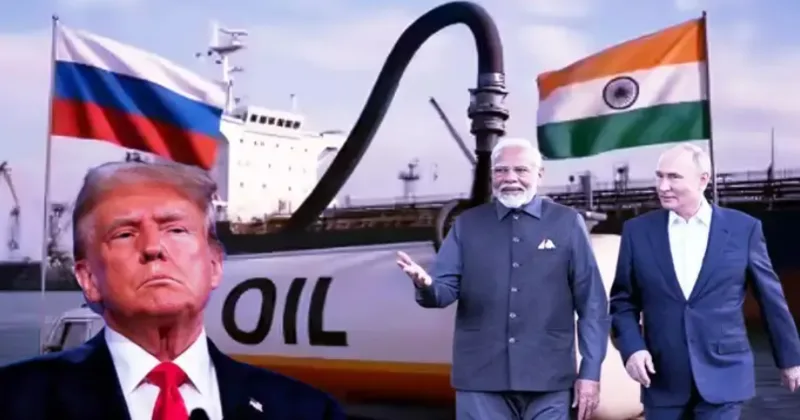
The Union government has categorically denied reports that India has stopped importing crude oil from Russia. Government declared that India’s decisions in this regard are driven by market dynamics and national interest and clarified that oil purchases from Russia will continue as before.
This clarification comes in the wake of US President Donald Trump imposing a 25 per cent tariff on Indian goods, citing India’s continued defence and energy trade with Russia as a justification. Trump claimed that the move was necessary because India still buys significant military equipment from Moscow.
Following the tariff announcement, reports had surfaced suggesting that major Indian public sector refineries, including Mangalore Refinery and Petrochemicals Limited (MRPL), Bharat Petroleum Corporation, Indian Oil Corporation, and Hindustan Petroleum Corporation, had suspended purchases of Russian crude. However, the government has firmly denied these claims.
Despite a long-standing relationship, the US has conducted relatively limited trade with India in recent years. Defending the new tariff regime, Trump posted on his official Truth Social account that India is a friend of the US but continues to maintain some of the highest tariffs in the world. He reiterated that India’s defence dependence on Russia, at a time when the global community wants Moscow to end the war in Ukraine, has triggered concern. Consequently, Trump said, a 25 per cent tariff and additional penalties would take effect from August 1.
US Secretary of State Marco Rubio further elaborated on Washington’s concerns, stating that the issue was not solely about India purchasing petroleum products from Russia. Speaking to Fox Radio, Rubio said that India’s continued energy trade with Russia is helping Moscow fund and sustain its war in Ukraine, which has raised serious concerns for the US administration.
Rubio noted that although many countries have energy needs, India’s choice to source oil, gas, and coal from Russia, where petroleum is available at discounted rates due to Western sanctions, effectively supports the Russian war effort. “This is a disturbing factor in our relationship with India,” Rubio remarked, adding, “And this is not the only one. There are other areas where we are cooperating, but this stands out.”
Since the onset of the Russia-Ukraine conflict, India has faced repeated criticism from the United States and its Western allies for maintaining energy ties with Russia. Responding to such pressure, External Affairs Minister S Jaishankar has consistently defended India’s position, asserting that the country’s energy decisions are driven by national interest, not geopolitics.
In a sharp rebuke to the Western narrative, Jaishankar stated, “Somewhere Europe has to grow out of the mindset that Europe’s problems are the world’s problems, but the world’s problems are not Europe’s problems. That if it is you, it’s yours, if it is me, it is ours. I see reflections of that.”
Earlier, in August 2024, when questioned about India’s continued purchase of Russian crude, Jaishankar was equally firm: “India is a big oil consumer… We are a big oil importer because we don’t have oil. Now, it is not like there is a political strategy to buy oil… There is an oil strategy to buy oil… There is a market strategy.” He added that India would always prioritise the needs of its citizens first.
Despite mounting Western pressure, India continues to hold a strong and independent position on its energy policy. Guided by market dynamics and national interest, India has made it clear that it will not succumb to external dictates, especially when it comes to securing affordable energy for its growing economy. This assertiveness reflects India’s rising stature as a sovereign global player committed to strategic autonomy.












Comments