





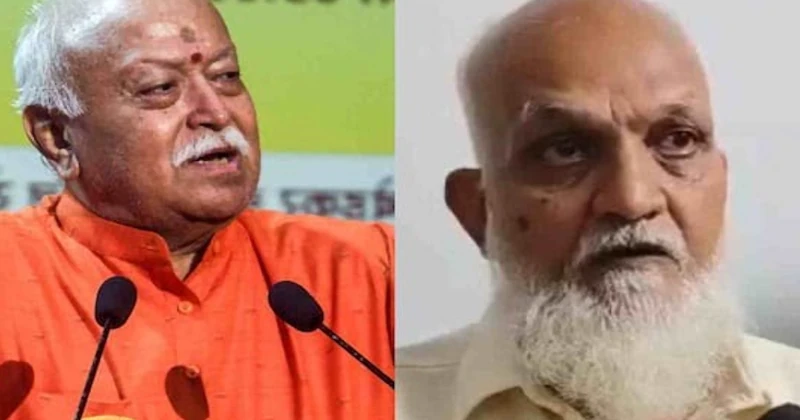
A former Maharashtra Anti-Terrorism Squad (ATS) officer Mehboob Mujawar has alleged that he was ordered to arrest Rashtriya Swayamsevak Sangh (RSS) Sarsanghchalak Dr Mohan Bhagwat during the early stages of the 2008 Malegaon blast investigation. The explosive claim has reignited serious concerns about political interference, misuse of investigative agencies, and a calculated effort to manufacture the theory of “saffron terror” during the UPA regime.
Mehboob Mujawar, a retired Inspector of Maharashtra Police, who was part of the ATS team that initially investigated the Malegaon blast that killed six people and injured over 100 on September 29, 2008. Speaking to the media following the special NIA court verdict that acquitted all seven accused—including BJP MP Sadhvi Pragya Singh Thakur and Lt Col Prasad Purohit Mujawar exposed what he called a “fabricated investigation” carried out under direct political pressure.
Mujawar stated that the Investigating Officer, then senior IPS officer Paramveer Singh, directed him to arrest Dr Bhagwat along with other figures like Ramji Kalsangra, Sandip Dange, and Dilip Patidar all accused at various points in the Malegaon case.
“I was given verbal instructions to arrest RSS Sarsanghchalak Dr Mohan Bhagwat. It was beyond my capacity to arrest such a prominent figure with no evidence,” Mujawar said, alleging that these were orders from “people above Singh,” implying a larger political agenda. Dr Bhagwat formally took charge as the RSS Sarsanghchalak on March 21, 2009, months after the Malegaon blast.
All my investigation was under the orders of Param Bir Singh & even higher authorities. I was given funds from the Service Secret Fund – Former ATS officer Mehboob Mujawar
He was asked to frame RSS Chief Mohan Bhagwat ji in Malegaon blast case.pic.twitter.com/lfE1iGljpu
— Mr Sinha (@MrSinha_) August 1, 2025
Currently residing in Solapur after his retirement, Mujawar is also listed as a witness in the Malegaon blast case. The former officer alleged that the purpose of implicating the RSS Sarsanghchalak was to establish a narrative of “saffron terror” to counterbalance the growing public discourse around Islamic Jihadist terror attacks. “There was no saffron terrorism. Everything was fake. I was forced to be part of a politically driven operation,” he asserted.
Mujawar claimed that when he refused to obey the unlawful directive, he was framed in a false case by the ATS. “They asked me to file a charge sheet showing dead people as alive. When I protested, they fabricated cases against me. My 40-year career was destroyed,” he lamented, adding that he was later acquitted of all charges. He also claimed to possess documentary evidence supporting his assertions and expressed hope that the truth would now be re-examined.
On July 28, 2025, a special NIA court in Mumbai acquitted all seven accused in the Malegaon blast case. The court, led by Special Judge A. K. Lahoti, declared that there was “no reliable and cogent evidence” to support the prosecution’s charges. The verdict delivered a crushing blow to the original ATS probe, highlighting serious procedural lapses, coercion of witnesses, contradictory testimonies, and a general lack of material evidence.
In its 3,000-page judgment, the court observed that the prosecution failed to even prove basic claims such as the accused storing or assembling the explosives or that the motorcycle allegedly used in the blast actually belonged to Sadhvi Pragya. Judge Lahoti also made a crucial observation: “Terrorism has no religion. Conviction cannot be based on suspicion or moral perceptions.”
Mujawar’s revelations are now being viewed in the context of the broader strategy allegedly employed during the UPA years to label ideological opponents and nationalists as extremists. The term “saffron terror” was popularised during this period, most prominently by Congress leader and then Home Minister P Chidambaram in 2010 a move that drew sharp criticism from security experts and political analysts for diluting the focus on global Jihadist threats.
Senior officials and opposition parties have repeatedly alleged that the Malegaon blast investigation, among others, was twisted to serve this political narrative. The NIA, which took over the investigation in 2011, had dropped several stringent charges including the Maharashtra Control of Organised Crime Act (MCOCA) and had found major flaws in the original ATS probe.
Following the court’s judgment, legal experts and former security officers have called for a thorough investigation into the conduct of the ATS officers involved in the original probe. “This is not just a failure of investigation it is a deliberate miscarriage of justice. Innocent individuals lost years of their lives, and the country was pushed into a manufactured debate about imaginary extremist threats from nationalists,” said a former IB officer on condition of anonymity.
“The weaponisation of terrorism narratives for political mileage must be investigated. The truth must prevail, and those who misused their position must be held to account,” BJP spokesperson said.












Comments