





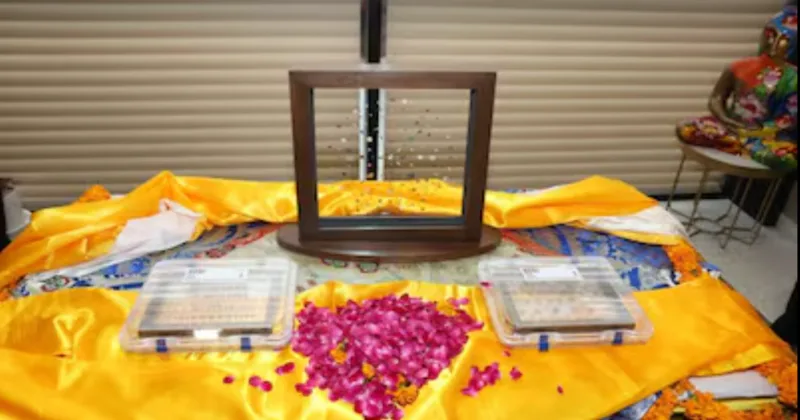
In a monumental moment for India’s cultural diplomacy and spiritual heritage, the sacred Piprahwa relics of Bhagwan Buddha have returned to their rightful home after 127 years in the United Kingdom. Believed to include fragments of the Buddha’s mortal remains, these relics were excavated from a stupa in Piprahwa, Uttar Pradesh, in 1898 and have since held immense spiritual value for Buddhists across the world.
Prime Minister Narendra Modi hailed the relics’ homecoming as a “joyous day for our cultural heritage,” sharing a photo of the artefacts on social media with the message:
A joyous day for our cultural heritage!
It would make every Indian proud that the sacred Piprahwa relics of Bhagwan Buddha have come home after 127 long years. These sacred relics highlight India’s close association with Bhagwan Buddha and his noble teachings. It also… pic.twitter.com/RP8puMszbW
— Narendra Modi (@narendramodi) July 30, 2025
Hailing the return of Piprahwa relics, PM said, “It would make every Indian proud that the sacred Piprahwa relics of Bhagwan Buddha have come home after 127 long years.” He further added, “These sacred relics highlight India’s close association with Bhagwan Buddha and his noble teachings. It also illustrates our commitment to preserving and protecting different aspects of our glorious culture. When they appeared in an international auction earlier this year, we worked to ensure they returned home. I appreciate all those who have been involved in this effort.”
The relics, which include bone fragments, crystal and soapstone urns, and over 1,800 precious gems—pearls, rubies, sapphires, and topaz—were returned to India earlier this week and are now enshrined at two locations: the Piprahwa Buddha Temple near the original excavation site in Uttar Pradesh, and the National Museum in Delhi.
Excavation, Controversy, and Colonial Legacy
The Piprahwa relics, thought to be the remains of Bhagwan Gautam Buddha, were unearthed in the late 19th century in Piprahwa, situated in Uttar Pradesh’s Siddharthnagar district, near the border of Nepal and in proximity to the ancient site of Kapilavastu, where Prince Siddhartha spent his childhood.
The story of the Piprahwa relics begins in 1898, when British civil engineer William Claxton Peppé led an excavation of a stupa at Piprahwa, believed to have been built by the Shakya clan—the family of Siddhartha Gautama, who became the Buddha. Inside the stone casket unearthed during the dig were sacred bone relics and thousands of precious stones, along with inscriptions believed to identify the remains as those of the Buddha.
While many of the artefacts were sent to the Indian Museum in Kolkata under the Indian Treasure Trove Act of 1878, a portion was retained by Peppé’s family in the UK with the British government’s permission. These relics passed down through generations until Chris Peppé, a descendant, prepared to auction them through Sotheby’s in Hong Kong in 2025.
Government Intervention and Legal Pushback
Upon learning of the impending auction earlier this year, the Ministry of Culture swiftly intervened. On May 5, 2025, the Government of India served a legal notice to Sotheby’s, citing violations of Indian and international heritage protection laws, including UNESCO’s conventions on the illicit trade of cultural property.
The Ministry declared that “these relics are an invaluable religious and cultural heritage of India and the global Buddhist community. Trading them is illegal and immoral.”
Widespread global outrage followed, with Buddhist organisations, scholars, and cultural activists condemning the sale. Under increasing diplomatic and public pressure, Sotheby’s withdrew from the auction, stating that their aim had been preservation rather than sale.
Homecoming and Diplomatic Triumph
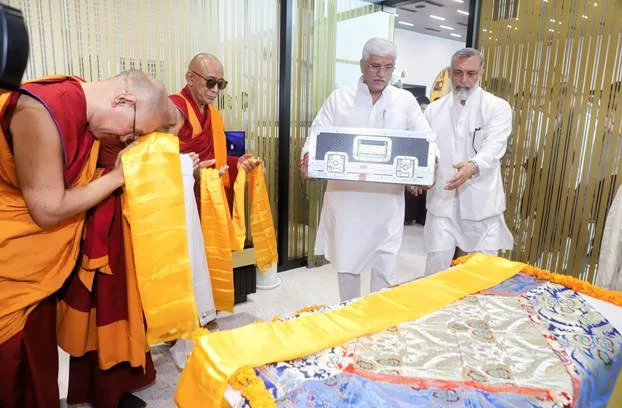
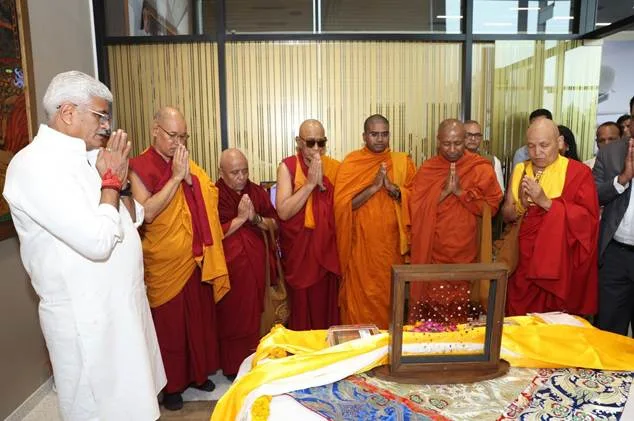
Following discreet negotiations between Indian authorities and the Peppé family, the relics were formally handed over to India. Union Minister of Culture Gajendra Singh Shekhawat oversaw the ceremonial installation at Piprahwa, calling it “one of the most significant repatriations of India’s lost heritage.”
“This proud moment reflects the vision and resolve of Prime Minister Shri Narendra Modi in restoring Bharat’s ancient spiritual legacy,” he said.
The relics were divided between two sites:
Piprahwa Buddha Temple, where the excavation originally occurred, offering pilgrims a sacred space for veneration.
National Museum, New Delhi, where the relics will be preserved under state-of-the-art security and climate-controlled conditions for public viewing.
Corporate and Cultural Support
Industrialist Pirojsha Godrej, Executive Vice Chairperson of Godrej Industries Group, lauded the effort, saying: “The Piprahwa gems are not just artefacts—they are timeless symbols of peace, compassion, and the shared heritage of humanity. Our partnership with the Government reflects our commitment to preserving cultural legacies for future generations.”
The return of the relics also showcased successful collaboration between government agencies, corporate stakeholders, and legal experts, setting a benchmark for future repatriations of Indian heritage items scattered across the globe.
Spiritual and Geopolitical Symbolism
Beyond the cultural and legal dimensions, the return of the Piprahwa relics carries deep spiritual significance. Buddhists across Asia, particularly in India, Nepal, Sri Lanka, and Southeast Asia, view such relics as sacred links to the Enlightened One and his teachings. Many have described this event as a powerful act of karmic restoration.
The relics will soon be unveiled in a special public ceremony, allowing people of all faiths and nations to pay homage to Lord Buddha and witness one of the most important artefacts of ancient India.











Comments