





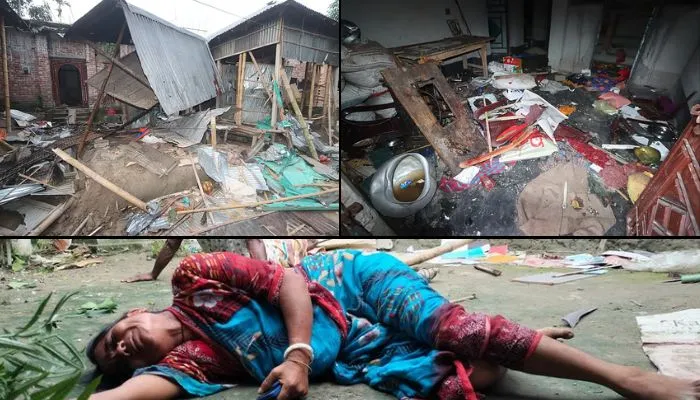
In yet another grim reminder of the rising communal tensions in Bangladesh, a violent Muslim mob targeted Hindu families in the Betgari Union of Gangachara Upazila, Rangpur, on July 27, 2025. The attack, which began the previous day, left over 15 Hindu homes looted, vandalised, and reduced to rubble. More than 50 families were forced to flee in terror, carrying only the clothes on their backs.
The trigger for this large-scale destruction was an unverified allegation of “blasphemy” against an 18-year-old Hindu boy named Ronjon Roy.
According to locals, the violence was sparked by claims that Ronjon had made derogatory comments about Prophet Muhammad on Facebook. However, subsequent investigations have cast serious doubts on the authenticity of this accusation.
The violence began on the evening of Saturday, July 26, when Ronjon’s home was the first to come under attack. Hundreds of Muslim men, allegedly numbering between 500 and 600, gathered after the afternoon Namaz, armed with sticks, rods, and makeshift weapons. In what witnesses describe as a premeditated act, they began to selectively target Hindu households.
Eyewitnesses have likened the horrifying scenes to earlier episodes of anti-Hindu violence, such as the May 2025 arson in Jessore, where similar allegations led to widespread destruction of Hindu property. “It was the same pattern again,” said a local woman, trembling as she stood in front of the ashes of her destroyed home. “They came shouting slogans, broke into our homes, and took everything. Then they set them on fire.”
By Sunday evening, the carnage intensified. Entire neighbourhoods were turned into war zones. Hindu men, women, and children ran for their lives, leaving behind generations of belongings and ancestral homes. A young girl, speaking to Ajker Patrika, recalled how the police initially tried to calm the mob but later withdrew, allowing the rioters free rein.
“Why were the homes of innocent people like us vandalised and looted?” she asked tearfully. “We did nothing. Yet, they punished all of us for something we didn’t even understand.”
The local police’s response raised further concerns. Officer-in-Charge Al Emran made an alarming admission. “We allowed the crowd to gather, thinking it was a peaceful protest. Suddenly, they launched the attack,” he said. One police officer was seriously injured in the chaos. Though the army was eventually called in, their intervention came too late to prevent the destruction.
As of July 28, no arrests have been made, and the perpetrators have disappeared without a trace.
The so-called triggering incident, the alleged blasphemous Facebook post, has now been exposed as a likely digital fabrication. Investigative journalist and fact-checker Sohan RSB revealed that the Facebook account named ‘Ronjon Roy Lrm’ was not operated by the 18-year-old Hindu boy. It was a fake account using Ronjon’s photos and identity to upload derogatory content, clearly designed to incite communal hatred and violence.
Despite this revelation, police arrested Ronjon. Officer Emran defended the move: “We arrested him to control the locals’ anger and stabilise law and order,” an action that has drawn severe criticism from rights groups who argue that the victim of a digital frame-up is being punished while the real culprits roam free.
The events in Gangachara follow a familiar, disturbing pattern. Just two months earlier, mobs in Jessore district had used the same “blasphemy” pretext to burn down homes and displace dozens of Hindu families. In both cases, mobs gathered after prayers, staged aggressive demonstrations near local markets, and swiftly descended on Hindu areas. In Gangachara, too, local residents like Pramod Mahant confirmed that the mob pretended to be peaceful protesters before turning violent. “We thought it would end with slogans. Suddenly, they stormed our homes,” he said.
The timeline of the latest incident lays bare the scale of the disaster:
- Dates: 26–27 July 2025
- Location: Betgari Union, Gangachara Upazila, Rangpur
- Alleged Trigger: Fake Facebook post attributed to 18-year-old Ronjon Roy
- Attackers: 500–600 Muslim men
- Weapons Used: Sticks, rods, and country-made weapons
- Homes Destroyed: At least 15
- Families Displaced: Over 50
- Police Action: Minimal; one officer injured, no arrests
- Status of Ronjon Roy: Arrested, under interrogation despite evidence of digital forgery
Rights organisations and digital investigators have raised pressing questions. Why are the authorities arresting a victim of cyber-fabrication? Why are mobs being allowed to gather under the pretext of “peaceful protests” without intelligence checks? Why is the justice system failing to address digital manipulation that leads to real-world violence?
This is not just about one boy or one village. This is about a growing pattern of digital terror being weaponised to target vulnerable minorities. Facebook accounts are being cloned, fake posts planted, and mobs mobilised, all while the police watch helplessly or, worse, try to justify their inaction.
The Gangachara violence is not an isolated communal clash; it represents a deep-rooted ecosystem of hatred, digital misinformation, and mob justice. It exposes the fragile existence of Hindus in Bangladesh, where a social media post, even if fake, is enough to sentence an entire community to destruction.
The implications are grave. Blasphemy accusations, increasingly based on fake screenshots and impersonated accounts, have become a lethal tool in the hands of extremists. The targeting of minorities under this pretext is not just systematic but also premeditated. And despite international concern and past media coverage, justice in such cases remains elusive.
Rights groups have demanded the immediate arrest of the attackers, a thorough investigation into the fake Facebook account, the release of Ronjon Roy, and rehabilitation for all displaced Hindu families. Some have called for an international probe into the systemic failures of Bangladesh’s digital policing and law enforcement mechanisms in communal matters.










Comments