





When a crime is committed, the first duty of the hand that committed it is to own it. You may drape the table with bouquets of good deeds, but the stench of blood will always dominate the room. Post World War II, humanity did not gather to celebrate Hitler’s brush strokes or his “remarkable watercolours”; it summoned the Nuremberg Tribunal to interrogate the abyss. No one dared to suggest that his paintings be placed in textbooks to “balance” the narrative so children might “see the good” in him. Yet, in Bharat, we still carry the burden of a cognitive dissonance: until very recently, roads were named after Aurangzeb—the butcher of Hindus—while history was forced to sip syrupy tales of “syncretism” through gritted teeth.
I searched long and wide, and nowhere on this earth is there a single public square named after Adolf Hitler. That collective silence is the world’s verdict. But in the very land where the temples of Kashi and Mathura still bear scars of desecration, generations of children were taught to murmur “Akbar the Great” with reverence. This is not history; this is civilisational Stockholm syndrome, a hypnotic lullaby sung by those who inherited chains but now wear them like necklaces of pride. And yet, I know there are those who call themselves “liberals” who disagree. They are restless gardeners, always pruning history so that only the soft petals remain, while the thorns are buried deep in footnotes. For them, truth is a matter of aesthetic—if it cuts too sharply, dull it; if it stings, perfume it.
A Much-Needed Textbook Storm
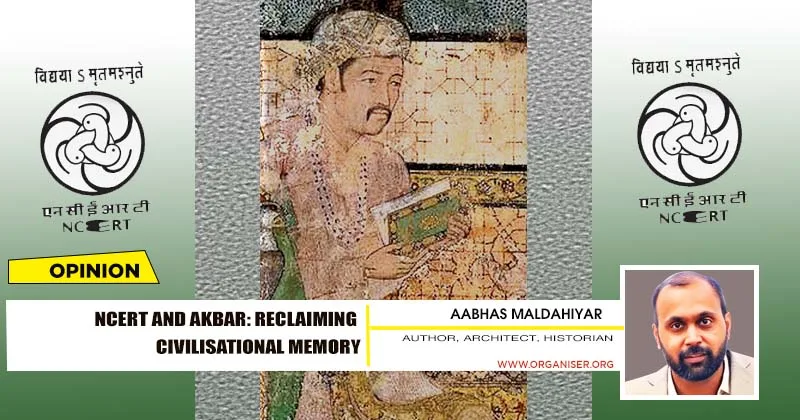
The latest tempest broke when NCERT revised its history books. Bābur, now labelled barbaric. Akbar’s reign, described as a blend of barbarism and tactical tolerance. Aurangzeb, finally named for what he was–a die-hard bigot. Liberal throats convulsed. The revisions, they claimed, were “agenda-driven,” a conscious attempt to demonise the so-called “Mughals” (a Western fabrication; they were Timurids). Some even conceded the truth of the accounts yet balked at the idea of exposing twelve-year-olds to “negativity.” Children, they argued, should be nurtured on stories of cultural richness, not conquest and cruelty. But this reasoning is nothing more than an attempt to find moral redemption in Hitler’s watercolours. Does the brushstroke redeem the gas chamber? Should we teach children about his artistic flair to “balance the narrative” and “spread positivity”? History is not a therapist; its purpose is not to make us feel good but to confront us with what was, unflinchingly. Children must know the crimes committed against their ancestors—not to incubate hatred for today’s world, but to liberate themselves from historical amnesia. To heal, a civilisation must first remember where it was wounded.
The Silence That Binds Us
The tragedy of Bharat is not only that its temples were shattered and its women enslaved, but that centuries later, many among its own children look at the perpetrators as “heroes.” Cultural memory was not merely erased; it was overwritten, turned into a palimpsest of romantic myths—where conquerors are visionaries, and the blood of our ancestors is simply “the price of progress.”
Consider this: Hindus today must still go to court to reclaim temples razed by Aurangzeb. The very need for litigation exposes the fissure: there exist living factions who stand by the destruction, who refuse to see the desecration for what it was. Why does this rift persist? Because our textbooks have been afraid to speak plainly.
If Islamic theology underpinned the ideological zeal of the conquerors, then acknowledging that fact is the first step towards blunting its hold on the present. Denying children that truth in the name of “harmony” is to deny them the vocabulary with which to articulate their own history.
Babur’s Own Words: Blood on the Page
These are not “Hindutva fabrications” or partisan inventions. Let us hold up the mirror to the conquerors’ own words. Bābur, in his Baburnāma, swore to destroy Hindu idols just as he destroyed wine vessels on the eve of Khanwa. After his victory at Chanderi, he proclaimed the obliteration of Dar-ul-Harb—the “land of war”—and raised towers of severed heads, grim milestones of imperial triumph. In Bajaur, he slaughtered Muslims whom he deemed insufficiently faithful, their “heresy” marked for annihilation.
Centuries later, a forged will—the so-called Bhopal Wasiyat—would emerge in the 18th century, a clumsy fiction intended to recast Bābur as tolerant. Even its seal bore obvious errors, yet it continues to be cited by apologists.
Humāyūn, far from upholding any fabled bond of honour with Rani Karnavati, refused to assist her against Bahadur Shah, justifying his betrayal on the grounds that his rival was engaged in jihad against “kāfirs.” His allegiance to religious expediency trumped the mythical “rakhi.”
Akbar, often held aloft as the patron saint of tolerance, presided over his own catalogue of horrors. His court historian, ʿAbd al-Qādir Badāʾūnī, records that in his empire, an unveiled woman or one accused of deceiving her husband was forced into prostitution by imperial decree.
In 1568, Akbar’s siege of Chittor culminated in a massacre so ghastly that even Abul Fazl, his fawning chronicler, could not mask the carnage: nearly 30,000 perished. Rajput women, on the eve of Holi, immolated themselves in jauhar; the men, wrapped in saffron, embraced sākha, the brotherhood of death. From dawn till noon, corpses turned the fort’s passages into rivers of ash.
Nagarkot’s Kalika Mata temple met a fate soaked in sacrilege: Akbar’s troops butchered two hundred cows that had sought shelter in the sanctum, then smeared their blood across the goddess’s image. The temple’s spoils were gifted as trophies to the Ajmer shrine of Muinuddin Chishti.
In Gondwana, Rani Durgavati fell by her own sword, her young son slaughtered, and her sister Kamala Devi consigned to the imperial harem. If Akbar were indeed the paragon of morality he is painted to be, why did he perpetuate the trafficking of women as war spoils? Jesuit missionary Monserrate, no stranger to cultural accommodation, wrote plainly in his travelogue: “The religious zeal of the Mussalmans has destroyed many Hindu temples.”
Akbar was not the enlightened secularist of popular imagination; he was a consummate politician, obsessed with being perceived as preeminent. His flirtation with Din-i-Ilahi only came after his hopes of being named Caliph were dashed by the Ottomans. Even this creed bore deep Islamic imprints, far removed from any genuine universalism.
The Mirage of Syncretism
The much-vaunted Ganga–Jamuni Tehzib, that embroidered myth of cultural harmony, unravels under the weight of historical evidence. It was not a confluence of rivers but a flood—its currents eroding temples, drowning identities, and inscribing submission onto the land’s very bones.
Under Jahangir, Hindu daughters could enter Muslim households only by abandoning their faith; otherwise, they were consigned to the harem as concubines. Muslim daughters, however, remained off-limits to Hindus, their marriages punishable by death. Jahangir’s own Tuzuk contains his decree: “Taking [Hindu] girls is good, but giving them—God forbid! Whoever does so shall be capitally punished.”
Shah Jahan codified this inequality into law. Apostasy warranted death; conversion of Hindus was celebrated, but a Muslim returning to ancestral faith was butchered. His governor Shujāʿ converted thousands by sword in Kābul, temples gutted to make way for mosques. Rebel princes like Jujhar Singh watched their sons renamed Imam Quli and Ali Quli at knifepoint, while women of their households chose self-immolation over imperial captivity.
Dalpat of Sirhind, who renamed his Muslim wife Ganga and raised their children as Hindus, was ordered to convert or die. He chose death; his wife and children were torn away. This was the syncretism of the so-called Ganga–Jamuni Tehzib: a monsoon of conquest masquerading as cultural rain. And what of Jodha Bai, Bollywood’s beloved emblem of harmony? No contemporary Timurid record mentions her. The name first surfaces in James Tod’s 19th-century Annals and Antiquities of Rajasthan, a colonial fantasy woven from bardic folklore. Akbar’s Hindu consort converted to Islam before marriage and was renamed Mariam-uz-Zamani. Her tomb near Agra, an Islamic maqbara, still bears that name. No Hindu princess who entered the Timurid zenana retained her faith or name; their identities were annexed; their wombs enlisted in dynastic conquest. The Timurid empire was not a tapestry of cultures; it was a furnace of conquest, its heat blistering any notion of mutual respect.
The Economics of Tyranny
Even the architectural marvels of this period drip with the sweat and blood of the dispossessed. The Taj Mahal, commissioned by Shah Jahan as a mausoleum for Mumtaz Mahal—who died in childbirth bearing her fourteenth child in nineteen years—cost 41.8 million silver coins. All while Surat and the Deccan reeled under famine, 7.4 million lives reduced to famine-stricken shadows. The marble monument became an enduring emblem of aesthetic opulence erected upon a foundation of human suffering.
Why the Gory Past Must Be Remembered
The debate over NCERT’s revisions is not about vilifying a dynasty; it is about reclaiming civilisational memory. A nation that cannot agree upon the crimes committed against it is doomed to fracture along inherited fault lines. Children must learn of Babur’s towers of heads, Akbar’s sacrilegious desecrations, Jahangir’s decrees of forced conversion, and Shah Jahan’s intolerance—not to stoke animosity, but to cauterize the wound of collective amnesia.
History must not be whitewashed into soothing bedtime stories. To tell children only of the conquerors’ “goodness” while concealing their atrocities is akin to teaching them Hitler’s palette without Auschwitz. Let them see the whole canvas—the violent strokes, the spattered crimson, and the stark reminder of what unchecked supremacy costs.
At twelve, a child can grasp moral complexity. Shielding them from the darker hues of history only ensures they grow up blind to the patterns that shaped their present. For if they never learn who erased their temples, they will never understand why so many remain in ruins.
The Verdict of Memory
The NCERT has done what history owes to truth: to call the Timurids by what they were, not by the romantic sobriquets of colonial historians. There is no virtue in forgetting the crimes of those who sought to erase you.
Civilisations that bury their wounds fester; civilisations that clean them heal. We owe it to every child in Bharat to show them the ledger of their past—not as propaganda, but as inheritance. Let them weigh the accounts for themselves and choose what kind of future they will build.
For in the end, no civilisation ever found redemption in the prettiness of its conquerors’ watercolours.













Comments