






Bomb threat hoaxes have disrupted numerous schools across Bharat over the past five years, causing repeated evacuations, exam postponements, and widespread panic. The incidents span multiple cities – from metropolitan Delhi, Bengaluru, Mumbai, and Chennai to others like Hyderabad, Jaipur, Ahmedabad, Pune, and Kanpur – and often involve anonymous emails or calls claiming explosive devices on school premises. Fortunately, all of these threats turned out to be hoaxes, with no bombs found, but they have strained law enforcement and alarmed parents and students.
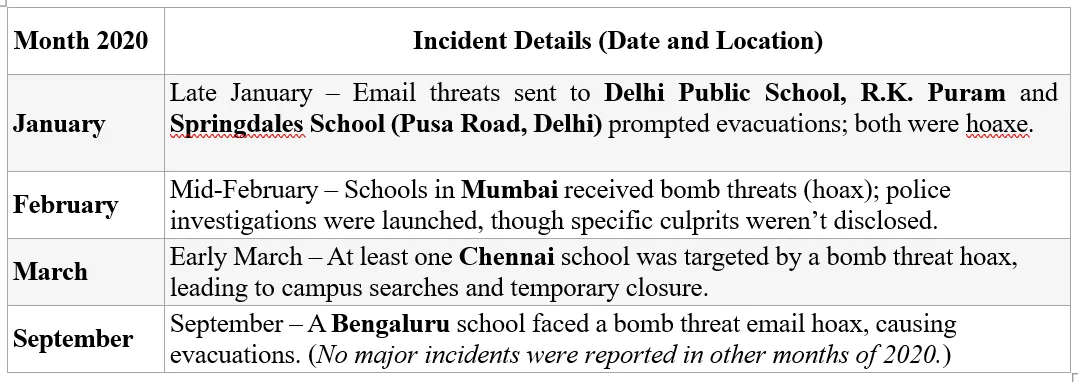
2020
Despite pandemic disruptions in 2020, a few early bomb scare incidents were reported in schools:
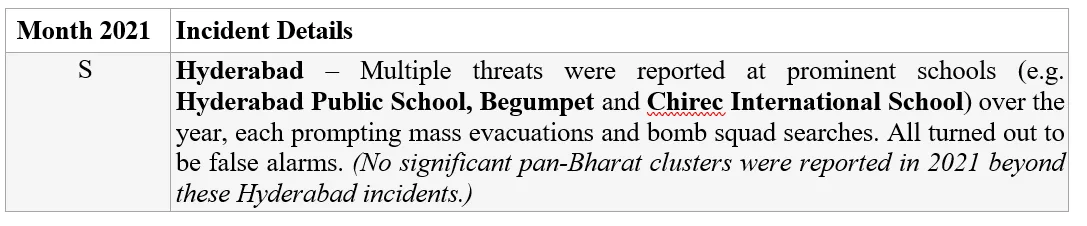
2021
In 2021, bomb hoaxes were sporadic but did occur outside the Hyderabad:
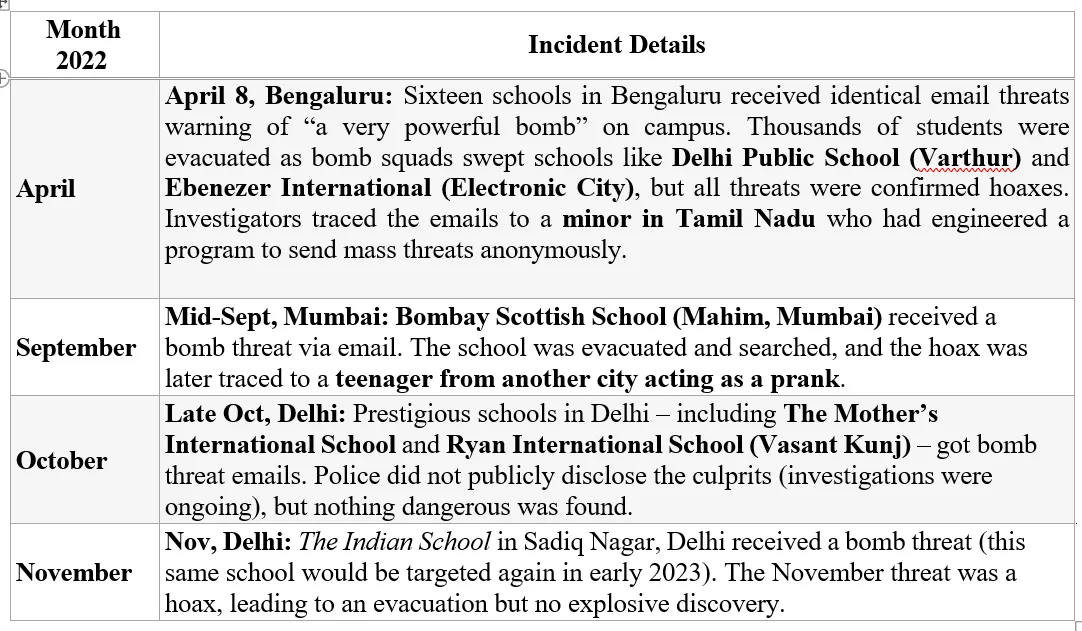
2022
Bomb threat emails emerged as a worrying trend in 2022, hitting schools in several cities:
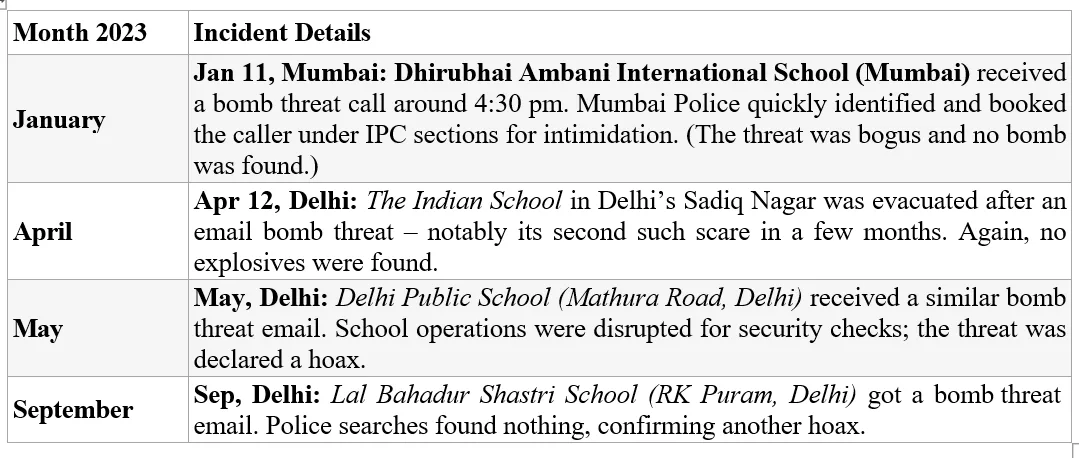
2023
Bomb hoaxes in schools became more frequent and geographically widespread in 2023:
2024
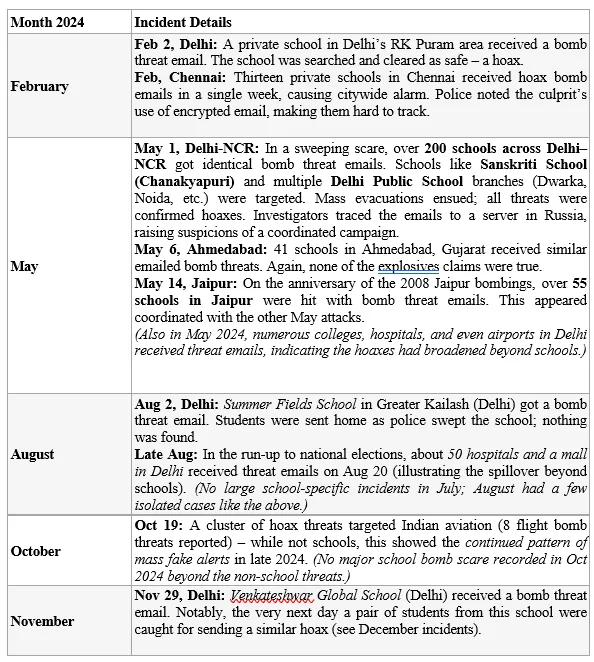
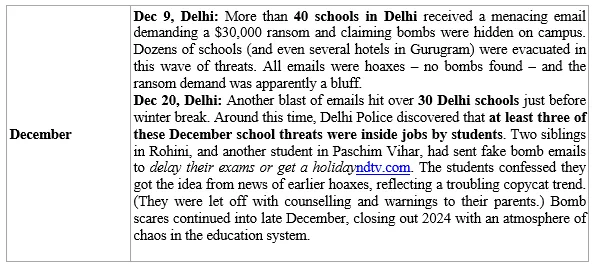
By 2024, Bharat saw an unprecedented surge of school bomb hoaxes, often in large coordinated waves:
2025 (Jan–July)
In 2025, the hoax bomb threat epidemic persisted, especially in Delhi and Bengaluru:
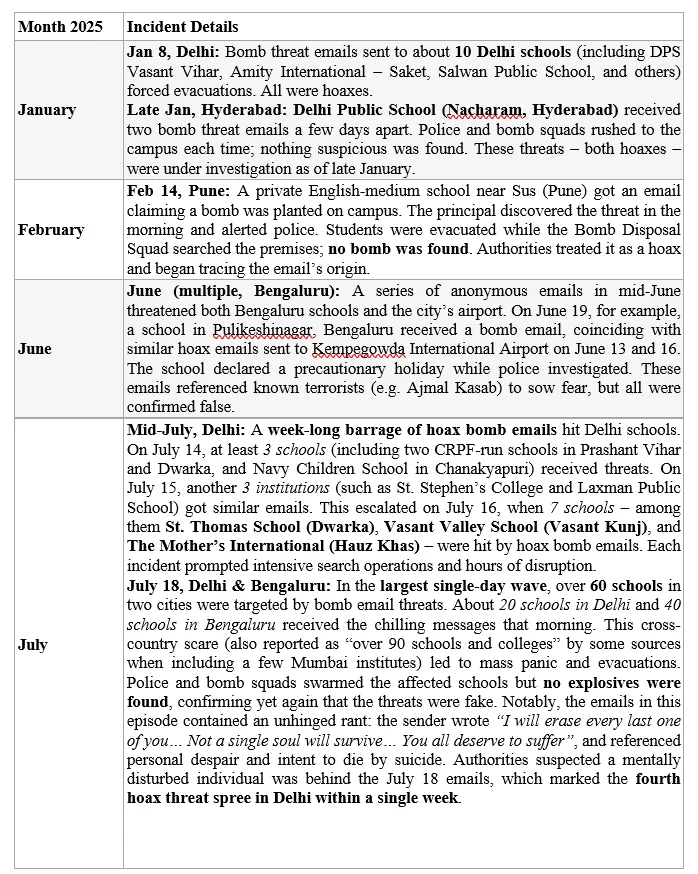 (Note: Data for 2025 covers January through mid-July. The pattern of hoax threats was ongoing as of July 2025, with investigators intensifying efforts to identify the perpetrators.)
Patterns and Trends in Bomb Threat Scares
- Clusters Around Exam Season: A clear pattern is the timing of many threats around school exam periods. In multiple cases, students themselves orchestrated bomb hoaxes to escape exams. For example, in December 2024, two teenage siblings emailed a bomb threat to their own Delhi school hoping to postpone their tests. Similarly, Delhi Police found that at least three hoax emails in late 2024 (targeting schools in Rohini and Paschim Vihar) were sent by students who “wanted the exams to be postponed” or to force a holiday. These incidents, motivated by academic pressure, show a spike in bomb threat hoaxes during pre-board and final exam months (typically December–March). Exam-driven hoaxes have been identified elsewhere too – a student in Paschim Vihar admitted to a similar stunt earlier in 2024. The desperation to dodge exams has thus emerged as a troubling trigger for some of these threats.
- Political or Historical Dates: Another pattern is clustering around sensitive periods such as elections or anniversaries of past incidents. In May 2024, during the run-up to Bharat’s general elections, a wave of threats swept schools in Delhi, Gujarat, and Rajasthan in quick succession. Investigators noted the hoax emails in Ahmedabad mirrored those in Delhi and likely originated from abroad, fueling speculation of a coordinated campaign to cause disruption during election season. The Jaipur school threats on May 14, 2024 explicitly coincided with the anniversary of 2008 Jaipur bombings, possibly an attempt to amplify fear by tying into a historical terror date. We also see that ahead of the 2024 Lok Sabha elections, not only Delhi and Ahmedabad but even Kanpur saw about 10 schools targeted with threat emails. These timings suggests perpetrators may choose moments of heightened public anxiety (elections, terror attack anniversaries, national holidays, etc.) to send threats, maximizing the psychological impact. However, it is important to note that all such threats remained hoaxes, with no real explosives ever found in schools during these clusters.
- Geographic Spread and Copycat Effect: What began as isolated incidents in one city has evolved into simultaneous multi-city threat waves. Early on, specific cities had localized scares (e.g. Bengaluru in April 2022, Chennai in early 2020, Mumbai in late 2019). But by 2024–25, hoax threats often came in batches affecting dozens of schools across different states at once. For instance, the coordinated emails on July 18, 2025 hit Delhi and Bengaluru (and a few in Mumbai) on the same morning. This points to either one entity targeting multiple cities together, or a copycat phenomenon where news of one city’s bomb scare triggers others to jump in. Indeed, police have noted that students who sent prank threats were inspired by previous incidents they saw in the news. The rapid proliferation of cases in late 2024 (nearly 1000 hoax bomb alerts across sectors by November 2024 as per one report) marks a tenfold increase from the prior year, indicating a contagion or copycat effect. Delhi and Bengaluru have been hardest hit by volume (e.g. Karnataka recorded 133 school/college bomb hoaxes in Bengaluru alone from 2022– 24, and Delhi saw over 250 school threats in just a couple of months in 2024–25), but other cities like Mumbai, Chennai, Hyderabad, Ahmedabad, Jaipur, Kanpur, and Pune have all faced incidents, underscoring that this is a nationwide trend.
- Evolving Methods and “Network” Fears: The hoaxers have grown more sophisticated in masking their tracks. Early cases (e.g. 2019–2020 calls/emails) were often traced to disgruntled students or ex-students fairly quickly. But recent threats are routed through VPNs, encrypted email services, and foreign servers (Russia, Estonia, etc.), frustrating investigators. For example, the July 2025 Delhi hoax emails came via a German-based secure mail provider (Tutanota) and required police to seek help from that service. The April 2022 Bengaluru emails used a service based in Europe (atomicmail.io) to hide the sender. Such tactics have led authorities to suspect some organized online groups could be facilitating these threats – possibly via the dark web or shared hacking tools. In mid-2025, Bharat’s Intelligence Bureau stepped in, probing what they called an “expanding international email threat network” behind the school and college bomb scares. Police in Ahmedabad even arrested one person (a 17-year-old dropout in 2024) who they allege was involved in hoax threat emails across 12 different states. This hints at some level of coordination or at least the availability of hoax-sending tools being shared widely. The frequency of threats also dramatically increased – authorities reported waves of emails targeting not just schools, but also hospitals, malls, courts, airports, and flights in 2024. This broader context shows the school threats are part of a larger hoax epidemic testing Bharat’s emergency response systems.
- Psychological and Social Factors: The content of some threat messages provides clues to possible motivations. Many emails are generic terror-like warnings (claiming “bombs planted, not a joke, call police” etc., as seen in the April 2022 Bengaluru email). But a few stand out: The July 2025 email, for instance, was a vitriolic rant by someone expressing personal rage, misery, and a desire for vengeance on society and self-harm. This suggests that at least one hoaxer had personal grievances or mental health struggles, viewing the threats as a form of catharsis or attention-seeking. On the other hand, the December 9, 2024 batch of emails actually demanded ransom money, implying a possible extortion motive (even though it appears no follow-up or real capability was shown by the sender). In some cases, pranks and mischief are the simple explanation: e.g. the Mumbai teen who threatened his former school in 2022 “as a prank, or the minor in Tamil Nadu who wrote a bomb threat program “for fun” in 2022. Thus, motivations seem to range from students’ exam stress, to pranksters and hackers seeking thrills, to individuals harboring anger or seeking disruption, and even attempted extortion. The common denominator is that these are low-tech, anonymous crimes exploiting email/ phone to trigger high anxiety.
Over five years, bomb threat hoaxes in Indian schools have evolved from isolated pranks into a disturbingly routine phenomenon. They often spike around exams or notable events and have required schools and police to remain on high alert. The scares have caused regular school days to be upended, exams interrupted, campuses evacuated, parents terrified, all for threats that turned out false. The pattern suggests a mix of copycat behavior and possibly loosely organized online actors spreading these emails. Authorities are responding by enhancing cyber trace techniques and even involving national agencies to track the source of threats. Meanwhile, schools are being urged to bolster cyber safety and educate students on the serious consequences of such hoaxes.
While no actual bombs were found in any school case, the psychological toll on students and staff is undeniable. The repeated trauma of evacuations and police drills can impact children’s mental well-being. The hoaxes have also strained law enforcement resources with each incident treated as real until proven otherwise.















Comments