





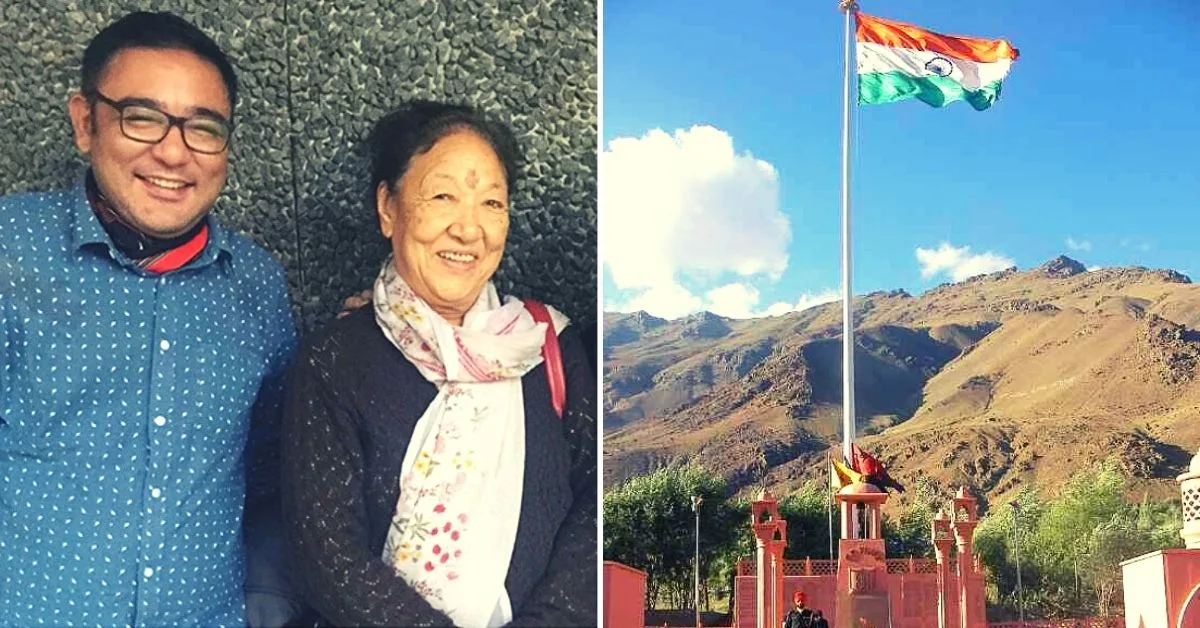
“Come forward to help; the country needs you,” rang out in Ladakh during intense mortar shelling during the Kargil War. The woman with the mic was T. Angmo Shuno, the determined station director of All India Radio Leh and Kargil.
Her voice cut through the eerie silence and the faint boom of bullets miles away, beckoning Ladakhi families to entrust their sons to join the Indian Army. It was not a planned declaration. It was an appeal for bravery by one who would show the way. She had already sent her own 18-year-old son, Stanzin Jaydun, fondly named Ricky, to the battleground, not with a gun, but with the spirit of a soldier to serve.
This is the overlooked chapter of Kargil. As India’s troops fought their way up snow-covered cliffs and regained strategic heights, a similarly crucial tale was being played out in the villages and valleys of Ladakh. Driven by a mother’s appeal and a people’s pride, scores of young boys became porters for the Army, and a small radio station became the conscience of a nation in conflict.
While the frozen winds howled across the desolate mountains of Ladakh, war was brewing in the heights beyond. Kargil had burst into conflict, and as the world watched the Indian troops take back post after post, an unseen, equally valiant effort was being written in the dusty Polo Grounds of Leh by shepherd boys, tomato growers, and an unbowed radio station manager.
A Call from the Airwaves
June 6, 1999, was the day when Indian soldiers were moving in to recapture occupied summits, and AIR Leh broke its routine programming with an unprecedented call.
“The Indian Army needs porters to carry loads to the front. Please come forward to help; the country needs you.” (Rawat, Rachna Bisht. “Ladakhi Boys Turn Porters in War,” in “Kargil: Untold Stories from the War”, p. 35)
The appeal was made by Col. Vinay Dutta, who had visited Angmo the previous day. The Army did not have mules, porters, or roads in the mountains. It needed to carry essential supplies, ammunition, food, medical kits, on foot. And there were not enough hands.
“I told him that I would do my best,” Angmo recalled years later in Rachna Bisht Rawat’s book Kargil: Untold Stories from the War.
She didn’t just broadcast appeals. She inspired action
A Mother’s Appeal: Sending Her Son to Serve
The call to serve came in its most intimate expression when Tsering Angmo Shunu, Station Director at AIR Leh and Kargil, persuaded her 18-year-old son Stanzin “Ricky” Jaydun to become a volunteer porter. “How could I request others to send their children to the battlefront if I was not sending my own?” she attests in the book (p. 36).This was anything but maternal pressure, it was an act of solidarity with the country.
Ladakhi Youth as Lifeline Unexpected
In four short days, close to 200 Ladakhi youth between the ages of 18 and 35 had offered their services. They were transported by Army trucks to Biama, a far-flung village between Dah and Hanu, some eight hours from Leh. They camped in tented shelters erected on step farms provided by local tomato growers.
Their ranks soon grew to 600. In contrast to conventional porters who could manage 10 kg loads, these high-altitude acclimatised youths were easily managing 30 kg loads (p. 37). They acted as lifelines, transporting supplies to attacking units in the dangerous Batalik-Yaldor-Chorbat La sector.
“We knew what a heavy cost our soldiers were paying in the war,” Ricky says. “We wanted to do our bit” (p. 37). Some of the boys also helped in evacuating wounded and martyred soldiers.
But the mission was not free from risk. Biama, where they were based, was within the reach of enemy shells.
“There used to be a water tank close by and we would dash and take shelter in it when shelling began,” remembers Ricky (p. 38).
When the Radio Became a Weapon
Just as much as bullets and bombs, the war was being waged on the airwaves. Pakistan Radio was disseminating lies regarding killed soldiers, smashed choppers, even the smell of putrid flesh.
“Radio Pakistan would say that so many Indian soldiers had died that civilians were fleeing their villages,” Angmo recounts (p. 39). They lied about these in Hindi, Urdu, and even Shina, a language used both in Indian and Pakistani border areas.
It was left to AIR Kargil to be India’s counter-propaganda army. “We did a lot of work in dousing rumours and morale-boosting,” says Angmo. She and her team used to broadcast in Hindi and Shina, read out motivating messages to troops from their relatives, and even placed calls to locals to gift mules for Army use.
In the midst of all this, they operated under constant danger. The radio station was shelled continuously.
“We used to always have a car waiting. When shelling began, we would quickly get in and head to Mingi village, 15 km away, where we had rented a room. Then, after the shelling ceased, we would go back and resume our transmission,” she remembers (p. 39).
On one night, there was such heavy shelling that all the engineers ran away. There was no one to switch on the generator for the 5 p.m. broadcast.
“I rang up the Brigade Commander in Kargil. He sent soldiers immediately and they started the generator. We went on the air by 8 p.m.,” she remembers (p. 40).
Bharatiya Pride and Patriotism in Her Broadcasts
Angmo’s communications were based on a fundamentally Bharatiya understanding of patriotism, reminding her people that war does not just involve soldiers but is waged by every citizen’s effort. Her appeals on TV and daily broadcast reminders were not objective, they legitimised a sense of responsibility across generations: mother, youth, and community.
Though AIR Kargel and the Ladakhi volunteers played a crucial role, Angmo and her team were not awarded any medals. But the reward they received was in the form of recognition, a visit and appreciation by the then Information and Broadcasting Minister, Pramod Mahajan, who witnessed their hard work in person.
According to India Today on July 26, 1999, Mahajan also provided 30 colour TVs, 1000 transistors, and a computer to wounded soldiers recuperating in Srinagar, upon discovering that they did not have any access to entertainment.
Her Personal life
Born to a big family that worked on farms in Leh district, Angmo’s father was a Naib Tehsildar. She studied up to middle school in Leh and later shifted to Kashmir. “After finishing my MA first year, I got married and, hence, had to leave my studies. I joined AIR Leh in 1975 as a program officer.”
Since the initial shell hit the compound, Angmo took a deliberate decision: to remain at the station and continue broadcasting. Despite the advice of colleagues to run, she held her ground. Lights were turned off; curtains drawn at night to remain undetected. When the hostel was destroyed and employees ran away, she continued with makeshift support from army engineers to ensure that the station never fell silent.
Legacy of a Quiet Bravery
Twenty-six years down the line, the guns have quietened down, but the remnants of that war still reverberate in the hearts of Ladakhis who experienced it, not as victims, but as brave contributors.
Angmo is retired now. Ricky, the lad who used to run rations to the warfront, remains in Leh. Their tale, revived in Rachna Bisht Rawat’s gripping book, tells us that wars are fought on the battlefield, but won in the hearts of citizens who act on courage rather than comfort.
Her story, and the stories of those boys, are the soul of Kargil. They remind us that wars are not won by bullets alone, but by courage that crackles through radios, walks barefoot on rocky slopes, and dares to rise above fear in service to the motherland.
Kargil Vijay Diwas: Remembering the Many Faces of Bravery
As we celebrate Kargil Vijay Diwas today, let us pay tribute not only to the soldiers who climbed snowy peaks but also to the young porters who carried the Army on their backs and the radio correspondents who brought hope in times of turmoil. Their courage, unrecorded in war documents but remembered by the country, serves as a silent reminder of what patriotism feels like away from the field of battle.










Comments