





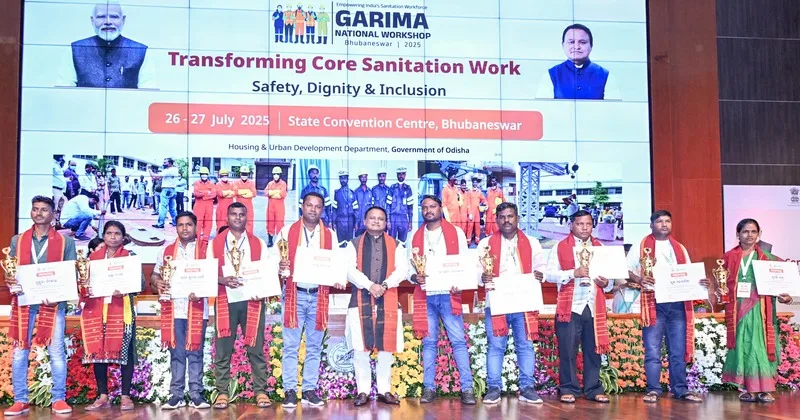
In a significant move to enhance the welfare, dignity, and safety of sanitation workers, Odisha Chief Minister Shri Mohan Charan Majhi unveiled a series of initiatives during the ‘Garima’ programme at Lok Seva Bhawan in Bhubaneswar on Saturday. Speaking at a national workshop attended by sanitation workers and officials from seven states, as well as various districts of Odisha, the Chief Minister reaffirmed the state government’s commitment to improving the living conditions of sanitation workers.
Among the key announcements, the Chief Minister stated that sanitation workers involved in cleaning sewers and septic tanks will receive Rs 10 lakh in life insurance coverage. Additionally, in the unfortunate event of a worker’s death while on duty, their family will be entitled to Rs 30 lakh in compensation. To bridge the digital divide and enhance communication access, all sanitation workers will also be provided with smartphones. Furthermore, permanent housing will be made available under the Pradhan Mantri Awas Yojana (Urban) for sanitation workers residing in urban areas.
Highlighting the success of the state’s flagship ‘Garima Scheme,’ CM Majhi noted that it has become a national model for the welfare of sanitation workers. The scheme includes the issuance of ID cards, distribution of safety gear, skill development training, establishment of emergency sanitation service units, and various social security measures. So far, over 10,000 sanitation workers across 115 urban local bodies have been recognized as skilled and highly skilled professionals.
Drawing on cultural significance, CM Majhi emphasized that the tradition of cleanliness holds a sacred place in Jagannath culture, referencing the symbolic ‘Chhera Panhara’ ritual performed during the Rath Yatra as a testament to the dignity of sanitation work. He also acknowledged the visionary leadership of Prime Minister Narendra Modi, noting that the launch of the Swachh Bharat Mission on August 15, 2014, marked a pivotal moment in India’s focus on hygiene and sanitation. “Until effective sanitation reaches every home, city, and village, true social and economic progress will remain incomplete,” the Chief Minister remarked.
During the event, CM Majhi inaugurated an exhibition showcasing modern sanitation tools and safety equipment, inspecting several stalls displaying innovations. He also recognised several sanitation workers for their exceptional service.
Housing and Urban Development Minister Dr Krushna Chandra Mahapatra described sanitation workers as the “invisible heroes” of towns and villages who often labor under hazardous conditions. He emphasised the collective responsibility to uphold their rights, safety, and dignity, calling the workshop an excellent opportunity for sharing experiences and fostering collaboration among states and institutions.
Chief Secretary Manoj Ahuja praised Odisha’s advancements in the sanitation sector, attributing the success to well-planned initiatives by the state government. He stressed that while urban sanitation is vital, equal attention must be given to improving sanitation infrastructure in rural areas to ensure a clean, safe, and inclusive Odisha.















Comments