





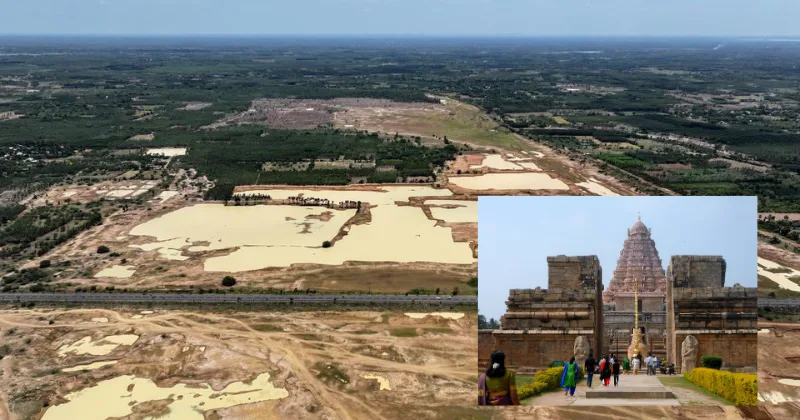
Days ahead of Prime Minister Narendra Modi’s scheduled visit to Gangaikonda Cholapuram in Ariyalur district on July 27, the DMK government has allocated Rs 19 crore to renovate the dying Chola Gangam lake—also known as Ponneri—dug by Tamil king Rajendra Chola I to commemorate his northern campaign. The lake is an engineering marvel of the Cholas’ water management, preservation, and planning.
PM Modi is to visit Gangaikonda Cholapuram on July 27 to take part in a function commemorating the 1000th anniversary of the conquest of the Gangetic plains by King Rajendra Chola I. A release from the government said, “It would be his first visit to Ariyalur. He would release a booklet on Thevaram songs published by the Sahitya Akademi and view a Bharatanatyam performance by a Kalakshetra artist based on the Thevaram theme.” The Aadi Thiruvadhirai festival at Gangaikonda Cholapuram has been ongoing since July 23 and will conclude on July 27.
A release from the government said, “The lake, spread over 700 acres, will be strengthened, and renovation of the surrounding channels and other maintenance works will also be carried out. This would help irrigate the area and benefit farmers cultivating around 1,374 acres in at least seven villages near Jayamkondam. The 15 km spillway carrying surplus water and the 38 km inlet canal will be desilted and redeveloped. The State Tourism Department will set up an information centre, walking tracks on the tank bunds, a public park for children, perimeter walls with fencing, green spaces with basic amenities, CCTV cameras, electricity, and other facilities for tourists.” The Tamil Nadu government also plans to set up a museum spread over 10 acres at a cost of Rs 22 crore.
The 1000-year-old lake, which once spread over 16 miles, is now in complete ruin and crying for renovation, according to locals. The grand lake has now shrunk to 17 km and remains dry for most of the year, as the inlet canals from the Kollidam River have long been abandoned. However, traces of these canals, which once brought water from Kollidam, are still visible as evidence. R. Komagan, Chairman of the Gangaikonda Cholapuram Development Council and an engineer by profession, told the media, “The lake depends on surface water collected during the rains. The lake once supplied water to Gangaikonda Cholapuram and the 60-acre palace. It is in a poor and pathetic condition.”
Historian K.A. Nilakanta Sastri, who wrote The Cholas, cited the Thiruvalangadu copper plates and, according to an English daily, recorded: “The lake was dug by Rajendra Chola at the end of the expedition. He erected a liquid pillar of victory (Ganga Jalamayam Jayasthambham) in his capital with the waters of the Ganga in the form of the lake Cholaganga.”
The Cholas, one of the longest-ruling dynasties, rose to power in the 9th century after defeating the Pallavas and ruled until the 13th century. Sastri, quoting a report published in 1855, said: “There is an embankment of 16 miles in length running north to south, provided with several substantial sluices and of great strength, which in former times must have formed one of the largest reservoirs in India.” He also noted, “It had been projected to restore that magnificent work, but the scheme has remained in abeyance for want of engineering officers.”
Komagan said, “The sluices are a great feat of engineering, constructed with the ability to trap sediment brought in by the inlet canal. Today, just one defunct sluice remains, protected by a concrete boundary from total destruction.”
Nothing was done in this direction for over 170 years since the publication of this report—not by the British, Congress, or Dravidian governments in Tamil Nadu. Without having preserved, protected, or redeveloped it for decades, the DMK government is now announcing schemes to renovate the site, only after learning of the Prime Minister’s visit to the temple. It is a move seemingly intended to score political points and pre-empt the BJP and others.
F.R. Hemingway’s Trichinopoly Gazetteer recorded that the Chola Gangam tank, also known as the Cholaganga tank, once irrigated 1,564 acres of land. It also notes that the tank’s primary purpose was to supply drinking water to Gangaikonda Cholapuram. The tank is described as a large reservoir with a long embankment and several sluices, playing a vital role in the prosperity of the city. It was an integral part of the city’s infrastructure, providing both drinking water and irrigation for the surrounding lands.
The lake exhibits the Chola kings’ sophisticated water management skills, with elliptical bunds made of laterite designed to resist hydraulic pressure. The square-shaped structure on the lower side of the tank contains a sediment trap linked with a silt ejector. The structure for releasing water (‘thoompu’), when the tank reaches its minimum capacity, is designed to create a vortex flow. This sucks the silt and deposits it into paddy fields, enriching them with nutrient-rich sediment. Once, it even served as a stopover for migratory birds en route to the Kodiakkarai Bird Sanctuary.
According to historical records, “Rajendra Chola ruled for 30 years, from 1014 CE to 1044 CE, and is often referred to as ‘Rajendra Chola the Great’. During his rule, the Chola Empire’s trade boundaries extended as far as the Song Dynasty in China, facilitated through connections with the Khmer Empire—renowned for constructing the world’s largest Hindu temple, Angkor Wat. Rajendra Chola’s expedition to Srivijaya (in present-day Indonesia) reflected the cultural and political influence of the Cholas in the Far East.”
Other Engineering Feats of the Cholas
A couple of years ago, Organiser Weekly published a detailed story highlighting Chola engineering marvels. It spoke of a 2,000-metre underground drainage system that directed water to the five-acre Chidambaram Natarajar temple tank, known as Thiruparkadal. This canal, which collects excess rainwater from the temple and drains it into a pond north of the temple, is an engineering wonder built by the Chola kings. The 10th-century canal carries water from a lower level to a higher pond. How was this achieved? The canal widens and narrows at specific intervals and curves like a snake at many points. This structure acts like a natural ‘electric pump’ that propels water against gravity. The 1,250-metre canal was built with bricks, topped with granite, and joined using a lime-based paste (chunam). The Veeranam lake also receives water in a similar manner.
Massive historical findings about Chola’s engineering skills surfaces at Chidambaram Natarajar Temple: https://t.co/GSfg43XNX7 via @eOrganiser
— Organiser Weekly (@eOrganiser) December 21, 2020
The Veeranam lake was created in the 10th century during the reign of the Greater Cholas, from 907–955 AD. It is a 16-kilometre-long reservoir. Rajaditya Chola named it after one of the titles of his father, Veeranarayanan, also known as Parantaka I Chola. His other titles included Chozha Sigamani and Sura Sigamani. The digging of the lake is believed to have started in 1011 and concluded in 1037 AD. Thousands of workers toiled with hand tools to complete the lake, which now has a capacity of 1,445 million cubic feet. Today, Chennai receives water from this lake under a project initiated by the late J. Jayalalithaa.
The Chola kings also used temples as community centres. They built hospitals with beds, staff, and dispensaries to provide medicines to those in need.











Comments