





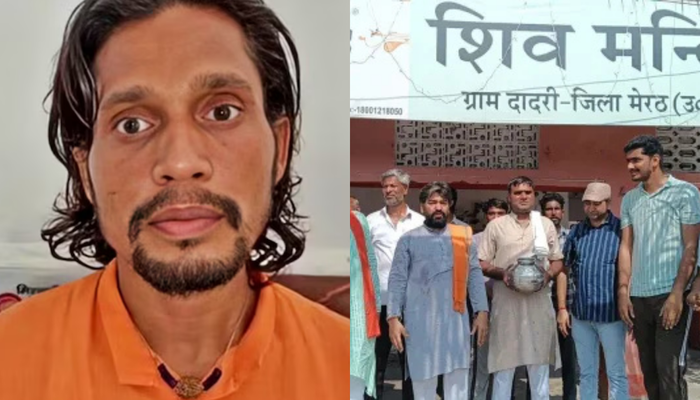
Members of Hindu organisations performed purification rituals at the Shiv Mandir in Dadri village, Daurala, after it was discovered that a Muslim man had been fraudulently living there by posing as a Hindu pujari. The mandir was cleansed using Gangajal, the Jalabhishek of the Shivling was performed, and Hanuman Chalisa was recited, marking what the locals termed as re-sanctification of the desecrated premises.
The man, identified as Qasim, a resident of Sitamarhi in Bihar, had been living in the temple for over six months, masquerading as a Hindu pujari named ‘Krishna’. Clad in saffron robes, Qasim engaged in traditional activities like reading palms and advising devotees, effectively winning their trust. He falsely claimed to be from Delhi to avoid suspicion.
The matter came to light after locals noticed inconsistencies in his behaviour and responses. When confronted with questions about his background, Qasim failed to provide convincing answers. He briefly disappeared from the temple, claiming he was retrieving his Aadhaar card, but returned without any proof of identity.
Eventually, under sustained questioning, Qasim confessed that he was a Muslim and not a Hindu priest, revealing his real name and origin. The confession triggered outrage among villagers, especially as the temple is located on a route frequently travelled by Kanwar Yatris during the holy month of Sawan. The Kanwar Yatra had just concluded on July 23, heightening emotions in the area.
Sachin Sirohi, a local member of a Hindu organisation, said, “This appears to be a calculated attempt to hurt Hindu sentiments. Thousands of Kanwariyas pass through this region. What if this had gone undetected?”
Following his confession, police were alerted and Qasim was taken into custody. A case has been registered against him under relevant sections of the law, and an investigation is currently underway to ascertain if others were involved in the identity fraud or if it was part of a larger conspiracy.
The temple purification ceremony was attended by several locals and members of Hindu groups, who reiterated the need for vigilance around places of worship and stricter enforcement to prevent religious impersonation.










Comments