





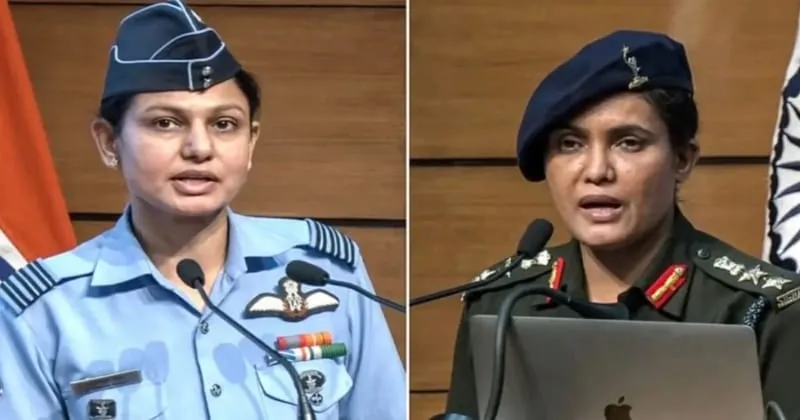
This study examines the confluence of gender politics and nationalism in South Asia via a sociological interpretation of the rise of Colonel Sofiya Qureshi and Wing Commander Vyomika Singh in the 2025 India–Pakistan border conflict, specifically their role as leaders of Operation Sindoor. Their leading visibility among military command disrupts traditional gendered roles and signals a turning point in the defence narrative of India from symbolic representation to strategic leadership by women. This shift, examining the contents, is reflective of deeper structural transformations in India’s national imagination in which women come to be recognised as an integral part of the nation’s security, sovereignty, and civic identity. Conquering a hybrid epithet of militarised patriarchy, feminist international relations theory Cynthia Enloe’s theory of “militarized patriarchy” most notably; this paper critically analyzes how gendered nationalism has traditionally been employed to maintain male superiority in defence and public discourse. It contrasts India’s broadening shift with Pakistan’s patriarchal response, as reflected in derogatory media reporting and political language used to delegitimise the authority of these Indian women officers. The gendered reactions reveal deeper anxieties about female agency within statecraft and geopolitics. Meanwhile, the discussion places India’s empowerment of women in defence within a longer civilisational timeline, from Rani Lakshmibai to Captain Lakshmi Sehgal, and locates it within the cultural ethos of Shakti. Instead of discarding tradition, India’s model synthesises it to valorise women’s leadership as both historic and necessary. The discussion concludes that empowering women in national defence is not symbolic but critical to developing an inclusive, strong, and democratically mature nation. Colonel Qureshi and Wing Commander Singh represent a transformational turn that recasts authority, overcomes patriarchal opposition, and reiterates India’s promise of gender balanced development within a culturally embedded nationalist paradigm.
In the wake of the 2025 India–Pakistan border skirmishes, the emergence of Colonel Sofiya Qureshi and Wing Commander Vyomika Singh as leading spokespeople of military representation represents a watershed moment in the sociological understanding of gender and national identity. As lead players in ‘Operation Sindoor,’ their assertive and expressive presence at national media conferences was a show of their personal strength and competence and a wider display of the extent to which women are assuming cornerstone positions in India’s defence establishment. Their uniforms are not insignia of war status but manifestations of India’s rekindled civilisational pride that sees no disparity between tradition and modernity (Kishwar, 1994). Sociologically, this visibility signifies a shift in the public imagination of women’s national service roles. Traditionally constructed on care, sacrifice, and symbolic potency, women are increasingly seen as authoritative contributors to the strategic and operational aspects of the national defence. Their visibility and presence in such a high-stakes environment redefine public discussion about citizenship, responsibility, and leadership. Apart from this, their presence also reminds one of the evolving narrative of Indian womanhood—a one in which intelligence, discipline, and duty are included. This is not only the story of two officers but of a Nation that observes the expansion of its definition of empowerment and equality to be inscribed in institutions hitherto regarded as lying outside the ambit of women’s access and leadership (Sinha, 2006).
The disparaging words and taunts by Pakistani media and politicians against these Indian women officers reveal more than the aspect of competitive politics. There is an underlying sociological current in operation, based upon patriarchal nationalism and gendered power. This form of opposition is reflective of a fractured worldview where female leadership is perceived as a deviation and not an evolution (Kandiyoti, 1991). Whereas they could have contested the essence of their statements or acknowledged their work towards national defence, both gender- and personal-based assaults became centre stage. This kind of public discourse is not by accident; it is a measure used in order to delegitimise women in power and restore traditional gender orders. These rhetorical assaults try to paint the empowered Indian woman as a threat and not an asset, an indication of the deep-seated insecurities of a patriarchal state (Enloe, 2000). In this regard, women are penalised for their visibility and capability, reminding us that gender continues to be a contested terrain in nationalist discourses.
Sociologically, such responses reflect what feminist scholar Cynthia Enloe refers to as “militarised patriarchy,” whereby women’s participation in political and military issues is accepted only to the extent that it adheres to gendered norms of silence, support, or symbolic value (Enloe, 2000). When women speak out as authoritative voices in national security matters, especially where geopolitical tension is involved, their presence disrupts conventional structures of male hegemony. But from a sociological perspective based on Indic culture, this visibility is not an interruption but a restoration, a return to the same totalising perception of gender roles that valour and wisdom are paradigmatically feminine values (Thapar-Björkert, 2006). The Pakistani political elite and media, by ridiculing these officers publicly, reinforce a narrative in which female agency is not merely challenged but punished by humiliation and mockery. Such actions aim to discourage women from occupying public, authoritative space, not just within the military, but across civil society. The critique, then, operates not simply as a nationalist rejection of the Indian narrative but also as a gendered policing regime that speaks on behalf of the nation. By so doing, it highlights the fragility of gender progress in national and regional discussions of power and legitimacy (Menon, 2012).
Worship of women goddesses such as Durga, Kali, and Saraswati in India is proof of a long-standing cultural belief in women’s power, wisdom, and strength. Goddesses are strong and courageous and are invoked most frequently for matters of national significance. The mere imagery of these goddesses in public life reinforces the underpinnings of a cultural nationalism that celebrates women’s potential (Hiltebeitel & Erndl, 2000). Nevertheless, still there is a stark discrepancy between this symbolic worship and society’s response to real women who manifest these characteristics in service to the nation. In an actual religious society, respect must go beyond ritual and find expression in policy and representation. This gap is gradually closing, and the Indian state, by incorporating women in the military leadership, is filling the gap between mythic respect and actual empowerment.
In recent national interest, this contrast has taken centre stage in the two top officers who played crucial roles during the 2025 border skirmishes, particularly in ‘Operation Sindoor’. Their composed and assertive behaviour at formal press conferences was received well in India and seen as a sign of professional excellence and dedication. But, across the border, their attempt was not met in the same manner. Some Pakistani media and political voices preferred making disrespectful and condescending remarks, focusing not on their achievement, but on inconsequential personal details. This once more illustrates how patriarchal insecurity responds to powerful women, particularly when they are powerful in positions of command in the defence field (Shaheed, 2002). These responses are not just gendered but are reflective of a crisis in masculine national identity.
These responses, rather than developing authentic dialogue, overlook the value of recognising professional accomplishment irrespective of gender. They overlook a deep and rich historical continuity as well. Indian women have been instrumental in defending and shaping the nation for centuries now: Rani Lakshmibai, who led her soldiers against colonial attack in 1857; Begum Hazrat Mahal, Awadh resistance leader; and Captain Lakshmi Sehgal, who commanded the Rani of Jhansi Regiment during the struggle for freedom (Forbes, 2022). These women were not mere symbols of resistance but also leaders in action. Sociological thinking views them not as exceptions, but as rightful heirs to India’s civilisational ethos of sacrifice and duty.
Now, really, when women in uniform like these two officers represent India to the world, they carry this legacy forward. Their presence is not a break from history but an extension of history. When public persons or commentators would rather disregard or diminish such efforts, it suggests a deeper discomfort with women holding positions of authority and national visibility. Their leadership subverts colonial and postcolonial patriarchal dualities that try to position women beyond power.
Being a society that holds the spirit of Shakti—the divine feminine force—India must bring that respect into tangible spaces. Respect must move beyond rituals and symbolism; it must express itself in everyday acknowledgement of women’s work, voice, and leadership. The success of women in uniform is not an individual achievement it is evidence of a nation moving ahead, guided by its triumphant past and committed to an inclusive future. The dharma ethos requires not just veneration of the feminine but active empowerment of it (Madan, 1997).
While India remains at the forefront of the women’s empowerment cause, the journey of these defence leaders is a testament to the country’s dedication to achieving gender equality in every area, including the armed forces. India’s vision for women’s empowerment is built on the principle that women can be leaders, not only within the family, but also on the national front. Such cultural transformation is needed to undermine deeply rooted gendered discourses that have long confined women to support roles. Both the officers are indicative of this transformation, showing that women’s contribution to national security is just as vital and significant as that of their male counterparts. Through actively inducting women into the armed forces and embracing liberal policies, India has made progress toward creating an inclusive and pluralistic society that is reflective of women’s evolving position in society (Roy, 2011).
Pakistan has taken a restrictive approach to gender in political and military terms, with no recognition of women as leaders, as evident from the misogynistic rhetoric directed at India’s women soldiers. Patriarchy continues to dominate the narrative, where women remain largely locked out of mainstream roles and denied equal contribution to national defence and political leadership (Kandiyoti, 1991). From a nationhood perspective, a nation that values the contributions of all its citizens regardless of gender can achieve more sustainable and inclusive growth. Pakistan can learn from India’s shifting pattern of women empowerment, whereby women are not only the family support system but can also lead the country ahead with military and political leadership.
To sum up, recent responses by Pakistan’s segments of politics and media towards India’s women officers indicate an endeavour to undermine progress by aping outdated gendered discourses. Instead, what was meant to be a moment of mature geopolitical thinking was undermined by attempts to make light of India’s expanding and inclusive defence leadership. These specific comments do not just destroy individual members of the military; they seek to undermine the very essence of India’s success in gender equality and national resilience. However, these attempts are likely to fail. India’s national power is founded in pluralism, cultural respect for feminine authority, and democratic values that ennoble every citizen, including all women (Sen, 2010). India’s dedication to the empowerment of women is not rhetorical; it is structural and strategic, and strengthening with each passing generation.
Commanders like Colonel Qureshi and Wing Commander Singh are not aberrations; they are part of an increasing number of leaders who are professional, brave, and accountable. Their presence in defence leadership indicates that India’s military is visionary, inclusive, and powerful. Pakistan and the world at large will benefit from recognising that strength is not in belittling others but in being respectful and inclusive. India is not going to be swayed by efforts to ridicule or discredit. The nation progresses respectful, resolute, and founded on the principles of equality and strength that no outside rhetoric can tear down.














Comments