





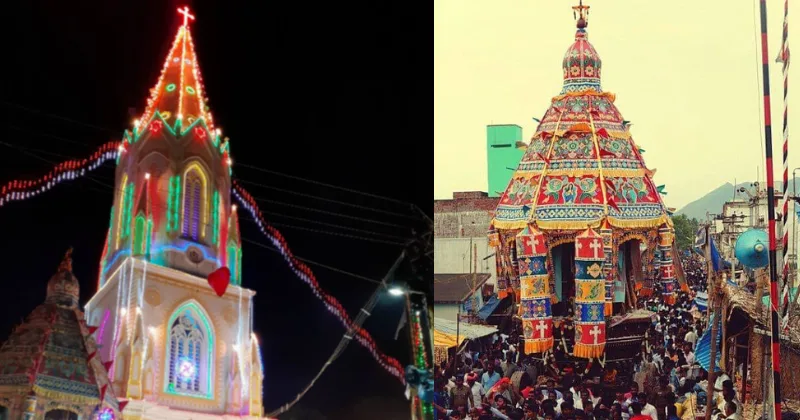
The Christians of Kottapalayam village near Thuraiyur launched a hunger strike near the district Collectorate on 21 July, alleging that they were not allowed to participate in the ongoing festival of the century-old St. Mary Magdalene Church and were barred from taking part in church-related activities.
Speaking to the media on 21 July, representatives of the group claimed that around 150 Scheduled Caste (SC) families who had converted to Christianity are residents of Kottapalayam village. “We were not permitted to pay subscriptions to the church and were excluded from planning committees. Only families belonging to the dominant community—other than SCs—were considered members of the parish, which comes under the Diocese of Kumbakonam. The church refuses to collect subscriptions from us as it does from others. Instead, we’re asked to make donations,” they said.
Raj Nobil added, “Though we take part in the feast, the chariot procession does not come to our street. We have to wait at the street corner to offer our prayers. There are separate cemeteries for the dominant caste and Dalits. We have taken up this issue with the Bishop of Kumbakonam. No steps have been taken to end this practice. We held a protest meeting in July 2022, following which Revenue Department officials visited our village and conducted peace talks. The situation remains unchanged. We have also sent a petition to the Pope as well as the Tiruchi Collector.”
According to media reports, Fr Augustine stated, “The issue has been ongoing for years. But the Dalits have not raised it with me so far. We will call a meeting with members of both castes and take appropriate steps to settle the issue amicably.”
The festival began on 14 July. Bishop Jeevanandam Amalanathan declared he would not take part in the chariot procession scheduled for 22 July to register his protest against the “persisting caste discrimination in the parish.”
Organiser had earlier carried a detailed report in February 2023 on a similar issue in Ayyampatti near Thiruverumbur in Trichy district. A section of Dalit Christians alleged caste discrimination at the local St. Mary Magdalene Church. Locals claimed that these converted Christians were not allowed to take part in the annual festival or use the common community hall for conducting marriages or other family functions. It was alleged that about 70 per cent of the 200 Christian families in the village are from Dalit communities, yet only families from the dominant community are considered parish members.
The report also mentioned: “In April last year, Dalit Christians staged a protest opposite the New Bus Stand in Trichy demanding equal rights and representation at all levels within the Church.”
Two years ago, E. D. Charles, National Secretary of the National Council of Dalit Christians (NCDC), appealed to the Tamil Nadu Bishops’ Council to appoint qualified Dalit priests as bishops in dioceses and to end casteism and discrimination within the Catholic Church.
Addressing reporters in Trichy, he said, “The Catholic Church is one of the biggest congregations in India, particularly in Tamil Nadu. Many Catholics in India are Dalits. However, among 188 bishops, only 11 are from the community across the country. In Tamil Nadu, only one of 18 bishops is from a Dalit background. No priest from a Dalit background has been nominated in the past 14 years in India. We also appealed to the Catholic Church, the Apostolic Nuncio to India, and the Pope to curb the visible and invisible untouchability practices that exist in the selection of bishops.”
“Organiser Has Always Taken Stand For ‘Dalit Christians’” Sh R L Francis, President Poor Christian Liberation Movement, shares his thoughts about Bharat's oldest National Weekly.#OrganiserAt75 #OrganiserWeekly
Subscribe Here: https://t.co/rrC0qlgNgm pic.twitter.com/aESzlMN96X— Organiser Weekly (@eOrganiser) March 21, 2022
According to a report released in April 2018 by the Tamil Nadu Untouchability Eradication Front (TNUEF), Dalit Christians face widespread discrimination within the Church. These findings were based on a public hearing into alleged atrocities and untouchability practices committed against Dalit Christians in the Catholic Diocese of Sivaganga district.
This episode reveals how Christianity has exploited the societal ills of Hinduism to the fullest extent, indulging in large-scale religious conversions among Dalits. While the Hindu society is making concerted efforts to end caste discrimination, the Church—despite pointing fingers at Hindus—practises the same discrimination blatantly. This contradiction exposes that many missionaries are more concerned with increasing the number of Christians than with social reform, all while maligning Hindutva.














Comments