





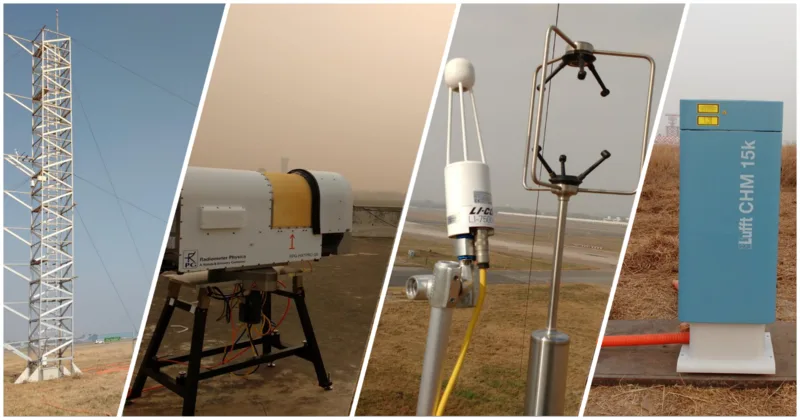
Each winter, the Indo-Gangetic Plain gets covered in a thick fog blanket that upsets millions of lives. Flights are delayed or cancelled, trains get delayed and highways turn into accident hotspots as visibility get extremely poor. Aviation centres such as the Indira Gandhi International Airport (IGIA), New Delhi suffers huge financial losses as diversions and cancellations increase. Apart from the economic cost, fog-related accidents seriously affect human life nearly thousands of lives are lost. Realizing the necessity for a precise forecasting technique to counter this danger, India initiated the Winter Fog Experiment (WiFEX) a specialized scientific experiment to analyse and predict fog with precision.
Prior to WiFEX, India uses primarily on empirical techniques for the prediction of fog, which did not give accurate or timely warnings. Airlines, railways and road transport authorities lacked sufficient information on the intensity and duration of fog events, leading to poor preparedness and to counter the problems arises due to fog. The increasing urbanisation of North India has increased air pollution levels. So, it is increasing the frequency of dense fog events, which compelled the scientists to study and design sophisticated modelling techniques. The Government of India merged science technology and metrology to undertook WiFEX to bridge this research void and introduce world-class meteorological knowledge to aviation and for better transportation management.
What is WiFEX
WiFEX is one of the world’s long-term open-field fog research programs. Starting support for IGIA, India’s busiest and most fog-affected airport, the program focused on collecting high-resolution atmospheric data to understand how fog forms and dissipates across North India. In last 10 years, it has expanded its operation to include Jewar Airport (Noida) and Hisar (Haryana), covering key aviation corridors of North India. Sophisticated equipment like micrometeorology towers, ceilometers, high-frequency sensors and aerosol samplers measure multiple parameters such as temperature gradients, humidity, wind patterns, turbulence, soil heat and particulate matter concentration are collected. This huge data is gathered and it’s increasing the foundation of WiFEX’s forecasting abilities.
The present government under PM Narendra Modi took a significant role in ideating and financing WiFEX to start its research. WiFEX launched during the winter season of 2015, led by the Ministry of Earth Sciences (MoES), to counter the weather and climate related issue. This project was part of the government’s plan to apply scientific innovation, to enhance public services and readiness for disaster. Through the availability of continuous funding and policy backing government facilitated the Indian Institute of Tropical Meteorology (IITM), India Meteorological Department (IMD) and National Centre for Medium Range Weather Forecasting (NCMRWF) to work together in coordination, so that the studies not to be limited in theoretical aspects but have practical solutions for transport and aviation safety.
Role of Research Institutes
WiFEX is a unique example of institutional coordination in Indian meteorology. IITM guides the scientific investigation and analysis so that results are applied on ground with high standards value. The IMD incorporates these results into its operational forecasts on a daily basis it facilitates real-time warning to airlines, rail traffic and state agencies. The NCMRWF makes a difference by improving the weather forecasting models with medium-range forecasts that are essential for advance scheduling. Such collaboration between institutions facilitates WiFEX’s success.
Scientific Contribution of WiFEX
Understanding Fog Formation
WiFEX has contributed to the understanding of how fog formation is affected by urban heat, aerosols and land use patterns. Research shows that particulate matter emitted by motor vehicles and industries serves as nucleation sites, thickening and prolonging fog. The study reveals that the urbanization of agricultural fields with concrete buildings changes soil heat flux and night-time cooling, which is a major contributor to fog formation in cities. WiFEX data has also reveals, the manner in which rising air pollution levels not only degrade air quality, but also increase the duration of heavy fog episodes, which badly affects the visibility for prolonged durations.
The High-Resolution Fog Prediction Model
The most significant contribution of WiFEX has been the development of a high-resolution (3 km) probabilistic fog prediction model. The model has revolutionized fog forecasting in India:
•Forecasts the formation, intensity, duration, and clearing of fog with more than 85% accuracy for very dense fog (visibility less than 200 meters).
•Aviation stakeholders such as airlines, pilots and air traffic controllers now utilize these forecasts to schedule operations, minimizing diversions, delays and removes passenger inconvenience.
•Timely warnings also provide edge to railway and highway authorities so that they can regulate speed and issue traffic advisories.
Impact on Policy and Urban Planning
WiFEX results are also making their way into policy-making in North India. Insights into the connection between pollution and fog are informing air quality management. Urban planners and state administrations are using WiFEX’s findings while designing policy to regulate emissions and mitigate heat issues in the city. WiFEX information is being fed into pre-warning systems for rail and road transport to enhance safety protocols.
IITM celebrated WiFEX marking the 10 Years of Unravelling India’s Winter Fog.
During the event the 10-Year WiFEX Documentary was screened — a decade of insight into India’s evolving understanding of winter fog and boundary layer dynamics
The event concluded with Press Briefing. pic.twitter.com/yHXbKLExb2— IITM Pune (@iitmpune) July 22, 2025
WiFEX-II: The Next Phase
After ground breaking success of WiFEX, this program is now evolving into WiFEX-II. The next phase which will deliver runway-specific, localized fog forecasts for several airports in North India. Dedicated on-site sensors will deliver real-time information to airport operators, allowing them to implement emergency response plans beforehand. By prioritizing micro-forecasting WiFEX-II will bring India’s aviation safety to the next level, while minimizing disruption even during the worst fog periods.
Ongoing Support of the Current Government
Without ongoing government support, the success of WiFEX would not have been achieved. The current government’s emphasis on scientific infrastructure and disaster mitigation has maintained policy support and funding for the project consistently. This drive for Atmanirbhar Bharat (self-reliant India) by the government on a larger scale is evident by this project, where local scientific talent and locally designed models now compete with international standards. By building institutions and fostering public-science collaboration, the government has turned WiFEX into a success story of applied research addressing national interests.
WiFEX II Future of India
A decade of intense research later, WiFEX remains an icon of scientific excellence and collective effort. Having brought complex meteorological information into actionable forecasts. This technlogy has made flying safer, road travel and cities to be ready for winter disasters. With WiFEX-II looming on the horizon and ongoing support from the government, India will soon dominate fog research and operational forecasting. WiFEX is evidence that when science is supported by vision and policy it can literally clear the fog for millions of lives every winter.















Comments