





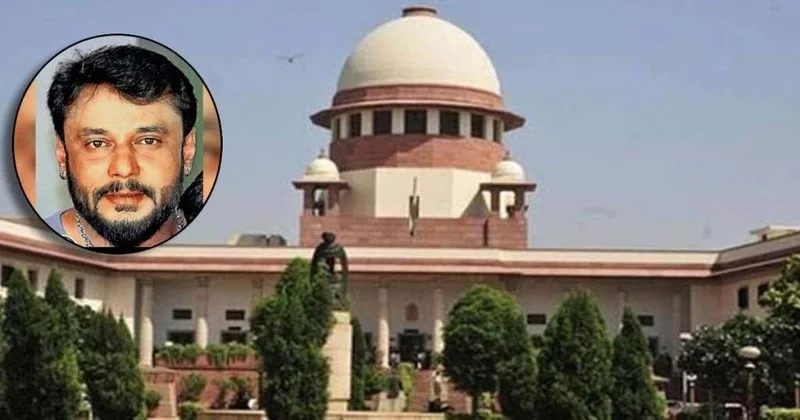
New Delhi: The Supreme Court on July 24 raised serious questions over the manner in which the Karnataka High Court granted bail to Kannada actor Darshan and other accused in the sensational Renukaswamy murder case, observing that the approach adopted by the high court was “troubling” and casting doubt on whether judicial discretion had been applied properly.
A bench comprising Justices J.B. Pardiwala and R. Mahadevan reserved its verdict on the Karnataka government’s plea seeking cancellation of the high court’s order dated December 13, 2024, which had granted bail to Darshan and his co-accused. Expressing its unease, the apex court remarked that the way the high court handled the bail application raised concerns about its broader approach to serious criminal cases.
“What is troubling us is the manner in which the high court has dealt with the issue of bail in this case. We are sorry to say this, but does the high court pass such orders in all bail applications?” the bench asked pointedly during the hearing.
The court specifically flagged the high court’s reasoning that the “grounds of arrest were not provided” in a murder investigation, wondering aloud if the judge truly grasped the basics of criminal law. “Is this his understanding in a murder case? This is a high court judge. We wish to know whether the court, while exercising its discretion, has applied its mind judicially,” the bench observed.
Earlier, on July 17, the Supreme Court had already voiced its doubts about the high court’s decision, saying it was “not at all convinced” by how the discretion to grant bail was exercised in a case of this gravity.
Darshan, along with actress Pavithra Gowda and several associates, stands accused of abducting and murdering 33-year-old Renukaswamy, reportedly a fan who had allegedly sent obscene messages to Gowda. The Karnataka government moved the Supreme Court on January 6 this year, challenging the bail granted to the actor and six others, arguing that it undermined the investigation into a crime carrying charges under Section 302 of the IPC (murder).
Senior advocate Siddharth Dave, representing Darshan, sought to defend the high court’s order by highlighting what he claimed were inconsistencies in the prosecution’s version. He pointed to a significant delay a gap of 12 days in the recording of statements by one of the key eyewitnesses.
However, the Supreme Court appeared unconvinced, describing the high court’s discretion as “perverse”. In a sharp observation, the bench told Dave, “On a lighter note, don’t you think the high court has effectively passed an order of acquittal? We are not going to repeat the same mistake of deciding guilt or innocence at this stage.”
Senior advocate Siddharth Luthra, appearing for the Karnataka government, strongly argued that the high court’s bail order amounted to a “pre-trial acquittal”, as it was passed without properly considering crucial pieces of evidence, including eyewitness accounts and forensic material.
Pavithra Gowda’s counsel, meanwhile, tried to distance her from the alleged murder, arguing that no direct injury or assault was attributed to her. But the bench firmly rejected this line of defence, observing: “All of this happened because of you. If you had not been involved, Darshan (A2) would not have got involved, nor would the others. You are the root cause.”















Comments