





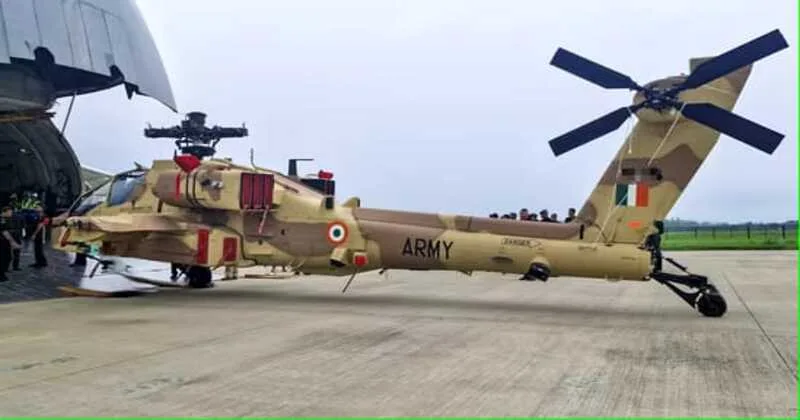
In a bold stride towards fortifying India’s borders, the first three of six long-awaited Apache AH-64E attack helicopters have finally touched down at Hindon airbase, near New Delhi. Delivered as part of a Rs 5,691 crore deal inked with the United States in February 2020, these advanced combat helicopters were airlifted aboard a massive Antonov-124 transport aircraft and arrived at 10 am on July 22. The remaining three choppers are set to arrive by November.
From Hindon, the Apaches will soon be stationed at Jodhpur, where the Indian Army established its Apache squadron in March last year to secure the volatile front with Pakistan. Their presence in Jodhpur sends an unmistakable signal: India is not just watching its western borders; it is now capable of overwhelming precision strikes that can cripple enemy assets before they even move.
Equipped with a lethal mix of Hellfire Longbow air-to-ground missiles, 70 mm Hydra rockets, 30 mm M230 chain guns, and Stinger air-to-air missiles, the Apache AH-64E represents a quantum leap in offensive firepower. These helicopters are not just tools of attack; they are platforms of shock and awe. Capable of destroying tanks, armoured vehicles, radar posts, terror camps, and logistic convoys, the Apaches offer the Indian Army a potent capability to dominate the skies and shape the battlefield.
What makes these helicopters truly formidable is their integrated Longbow radar system, AN/APG-78, mounted above the rotor. This mast-mounted, millimetre-wave radar can track up to 128 targets simultaneously and prioritise 16 of them for immediate action. Uniquely designed to remain concealed behind terrain features while scanning the battlefield, it allows the Apache to ‘see without being seen,’ popping up only to deliver devastating fire. Approximately half of the Apaches ordered for the Indian Army and Air Force are fitted with this advanced radar, giving India an asymmetric edge in any future conflict scenario.
Both Army and Indian Air Force variants of the Apache are identical, ensuring seamless integration and operational synergy. With a shared fleet of 28 Apache helicopters, 22 already inducted by the IAF under a Rs 13,952 crore deal signed in September 2015, India now possesses a fearsome, unified aerial strike capability. These cutting-edge aircraft are tailor-made for terrain like the Thar and the border regions of Rajasthan and Punjab, where rapid response and overwhelming firepower can neutralise enemy columns in minutes.
Beyond the missiles and sensors, the Apache’s battlefield effectiveness is boosted by a high degree of survivability. With armoured crew compartments, crash-resistant airframes, and hardened rotor blades, these choppers are engineered to absorb damage and complete their missions. This ruggedness ensures that the Apache can operate in high-threat environments and still return to fight another day.
But the Apache is not just about brute force. It is a smart warrior on the battlefield. The helicopter’s ability to receive live drone sensor feeds in real time opens a new chapter in network-centric warfare. This gives Army commanders a panoramic, real-time view of the battlefield, allowing coordinated strikes, faster threat identification, and dynamic targeting. The result is a platform that not only fights but commands the fight.
The timing of this induction is no coincidence. Coming just weeks after Operation Sindoor and amid heightened tensions along India’s western border, the Apache adds a fearsome dimension to India’s defence posture. Its very presence forces adversaries to rethink their moves, knowing they are now under the shadow of a silent predator that strikes with pinpoint accuracy.
For Pakistan, this deployment is nothing short of a nightmare. Whether it’s an enemy tank formation or a terror launchpad, the Apache brings with it a promise: swift justice from the skies. With its induction, India has raised the bar in air-land battle preparedness, making its western front not just secure, but untouchable.
















Comments